
The title of this piece makes a bold-sounding claim, so let this opening be plain: there is no free land, and no honest path to owning land without money eventually changing hands. What does exist — and has existed in Michigan for well over a century — is a way to start buying land with little or no money down: purchasing directly from the seller over time, through what Michigan calls a land contract, a form of seller financing.
For generations, this is genuinely how many working families — farmers, laborers, people the banks would not lend to — acquired land. It is also a path with real costs and a serious risk that must be stated as plainly as the opportunity. This article explains the mechanism generally, honors its history, and names its dangers. It is education only, not financial or legal advice.
The Argument
FACT: In a Michigan land contract, the seller finances the purchase: the buyer makes payments directly to the seller over time, and legal title generally transfers only when the contract is paid in full. No bank loan is required, which is why a down payment can sometimes be small or, by agreement, absent.
COMMENTARY: The honest argument is narrower than the title: ‘no money’ can only ever mean ‘no money down at the start.’ Taxes, insurance, maintenance, and every monthly payment are still money, and missing them can cost the buyer the land and everything already paid in. A path that built real ownership for many families deserves respect — and a buyer who walks it deserves the whole truth first.
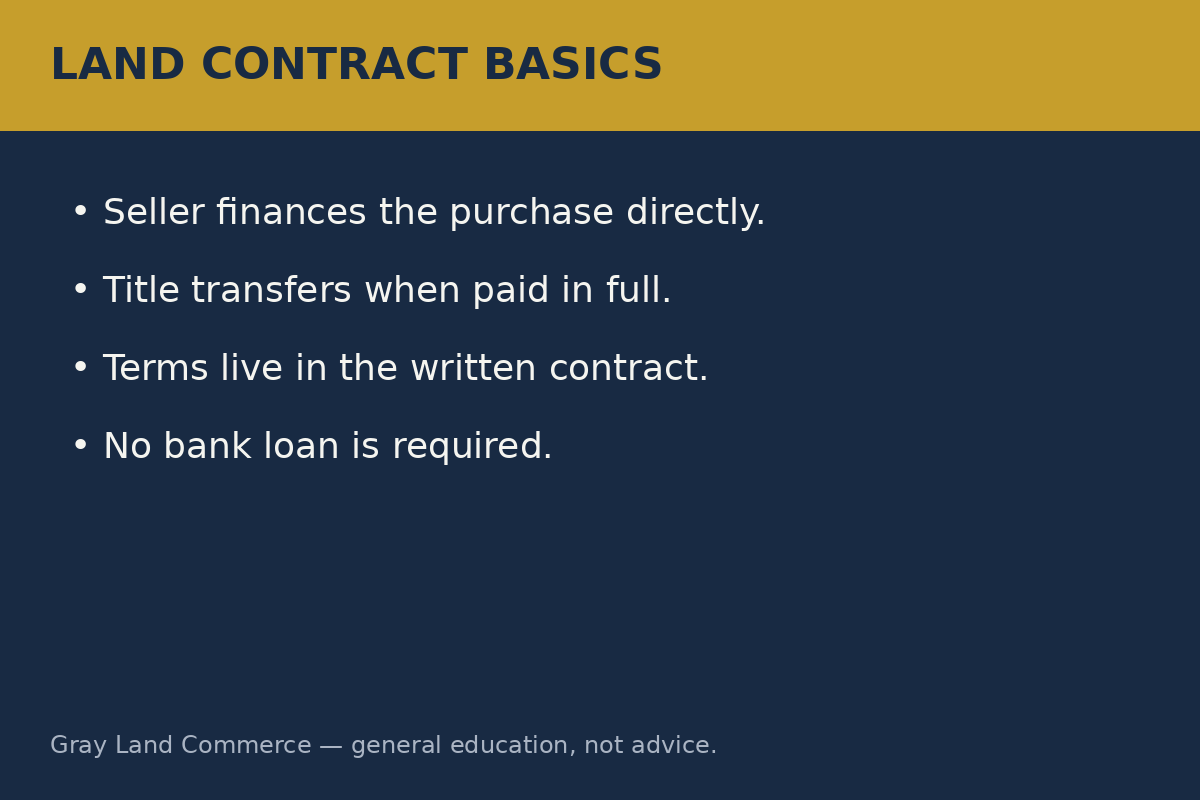
How a Land Contract Actually Works
The buyer and seller agree on a price, an interest rate, a payment schedule, and a term — often monthly payments for a set number of years, sometimes with a larger final ‘balloon’ payment due at the end. The buyer usually takes possession, uses the land, and is responsible for property taxes, insurance, and upkeep from the start, even though the deed stays in the seller’s name until the contract is completed. Because no bank sets the terms, a seller can agree to terms a bank would not — including a very small down payment, or none — in exchange for the price, rate, and security the contract gives them.
Historically, this arrangement filled the gap left by conventional lending: in the nineteenth and early twentieth centuries, seller financing and its cousins were how much of rural America changed hands, long before standardized mortgages. In Michigan the land contract remains a recognized, commonly used instrument today — legitimate, legal, and entirely dependent on the specific written terms. That last point is the one that matters: in a land contract, the paper is the deal, and two contracts can differ enormously.
The Real Costs and the Real Risk
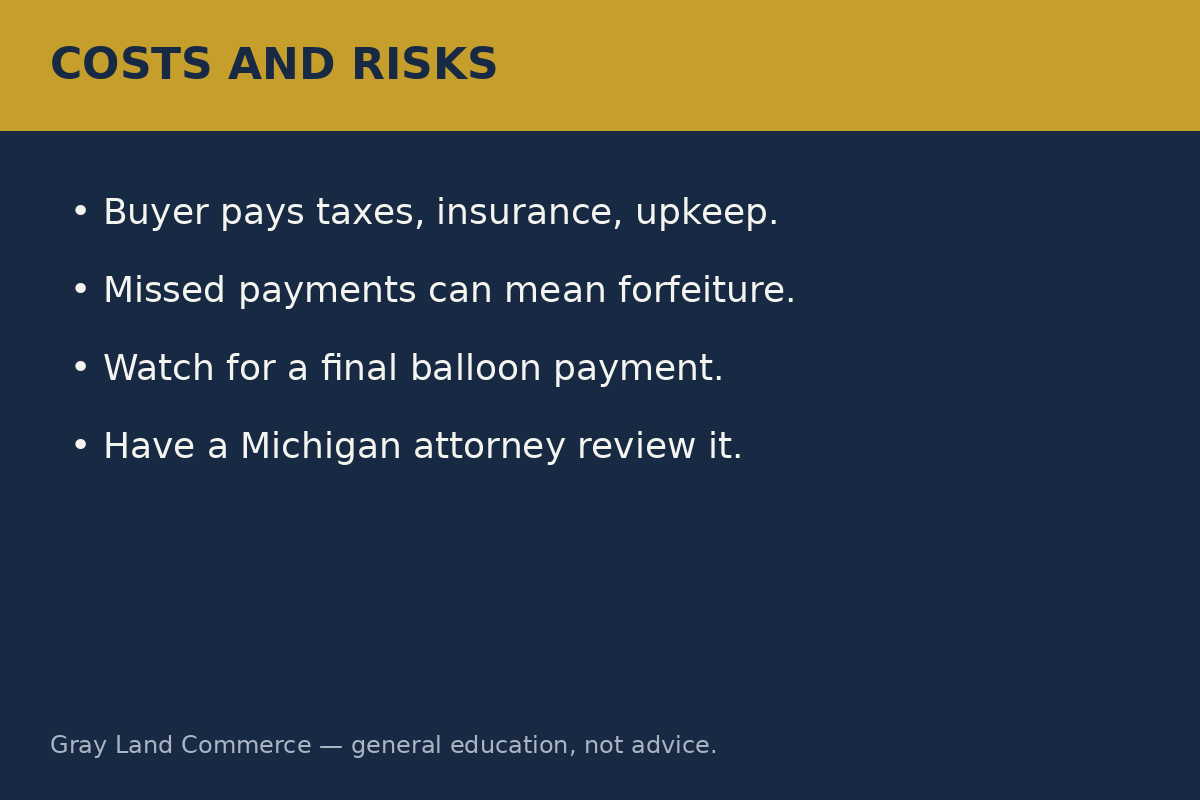
Start with costs people forget. Property taxes are owed every year whether the contract mentions them or not, and the buyer typically pays them. Insurance on any structures is the buyer’s burden in practice, because the buyer holds the risk of loss. Maintenance, utilities, and any required permits are the buyer’s. A purchase with no money down can still demand steady money every single month — which is why ‘no money’ must never be heard as ‘no cost.’
Then the risk, stated plainly: forfeiture. If a buyer falls behind, Michigan land-contract law generally allows the seller to pursue forfeiture after notice, a process that can be faster than mortgage foreclosure and can end with the buyer losing the land — and, depending on the contract, much of what was paid in. Buyers also carry the risk that a balloon payment comes due before they can refinance or save it. None of this makes land contracts a trap; it makes them a serious instrument that rewards buyers who read every line, verify taxes are current, record the contract, and have the terms reviewed by a Michigan real-estate attorney before signing — a modest cost that protects the entire purchase.
Frequently Asked Questions
Can you really buy land with no money?
Only in the narrow sense of no money down: some sellers agree to finance the full price through a land contract. The buyer still owes monthly payments plus property taxes, insurance, and maintenance from the start. There is no free land.
What is a Michigan land contract?
A form of seller financing in which the buyer pays the seller over time and receives legal title when the contract is paid in full. Terms — price, interest, schedule, and any balloon payment — are set by the written contract between buyer and seller.
What is the biggest risk of buying on a land contract?
Forfeiture: if the buyer falls behind on payments, the seller can generally pursue forfeiture after proper notice, and the buyer can lose the land and much of what was already paid. Buyers also face balloon-payment and tax obligations that must be planned for.
Is this article financial or legal advice?
No. It is general education about how land contracts and seller financing work in Michigan. Land purchases are major legal transactions; anyone considering one should have the specific contract reviewed by a licensed Michigan real-estate attorney.
Want Jackson’s top local stories in one place? Browse the businesses shaping the area in the NeighborClick Local directory — JOIN the FREE Private Insider List for local stories, business spotlights, community updates and even if you don’t have business you’ll be an Insider.


Comments