

South of downtown Jackson, past the last of the city grid, there is a gate on South Jackson Road that most of Jackson has driven by a thousand times. Behind it: nearly 300 acres of oak-hickory woods, grassland, marsh and pond, and five miles of trail. It is called Dahlem — “Jackson’s Nature Place” — and this year it turns fifty.
There will probably not be a parade. Anniversaries of nature centers rarely get one. But the fiftieth year of the John and Mary Dahlem Environmental Education Center is worth marking, because of how it started: not with a parks bond or a developer’s gift, but with a homework assignment — and because of the two women, a biology teacher and a philanthropist who lived to 103, whose work is still holding the place up.
The Argument
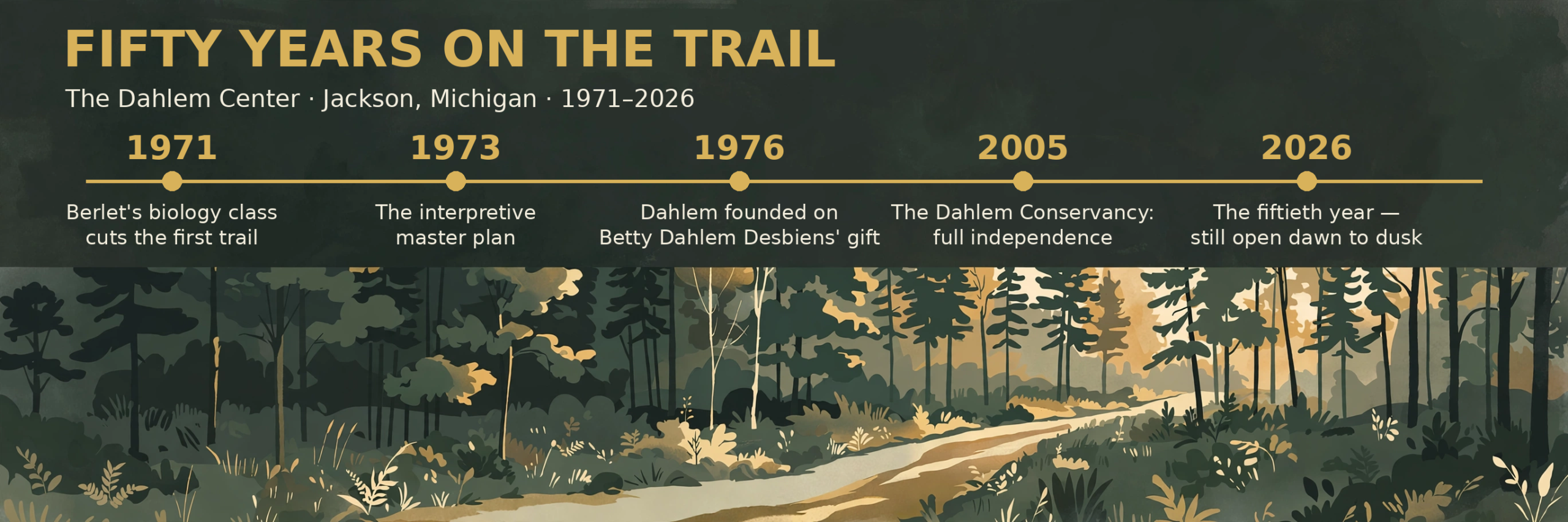
Dahlem exists because two Jackson women did unfashionable things for a very long time. In 1971, Jackson Community College biology teacher Myrna Berlet took her class onto college land south of town and cut the first trail; her 1973 interpretive master plan led directly to the nature center established in 1976. That center was funded by Betty Dahlem Desbiens, whose founding donation named it for her parents, John and Mary Dahlem — and who spent the following forty-seven years giving to Jackson until her death in 2023 at age 103. In 2005 the center became the independent Dahlem Conservancy. In 2021, Berlet’s estate left it a $5.1 million endowment. Fifty years on, the classroom project is nearly 300 acres, five miles of trails, and one of the most quietly consequential pieces of land in Jackson County.
It Began With Homework
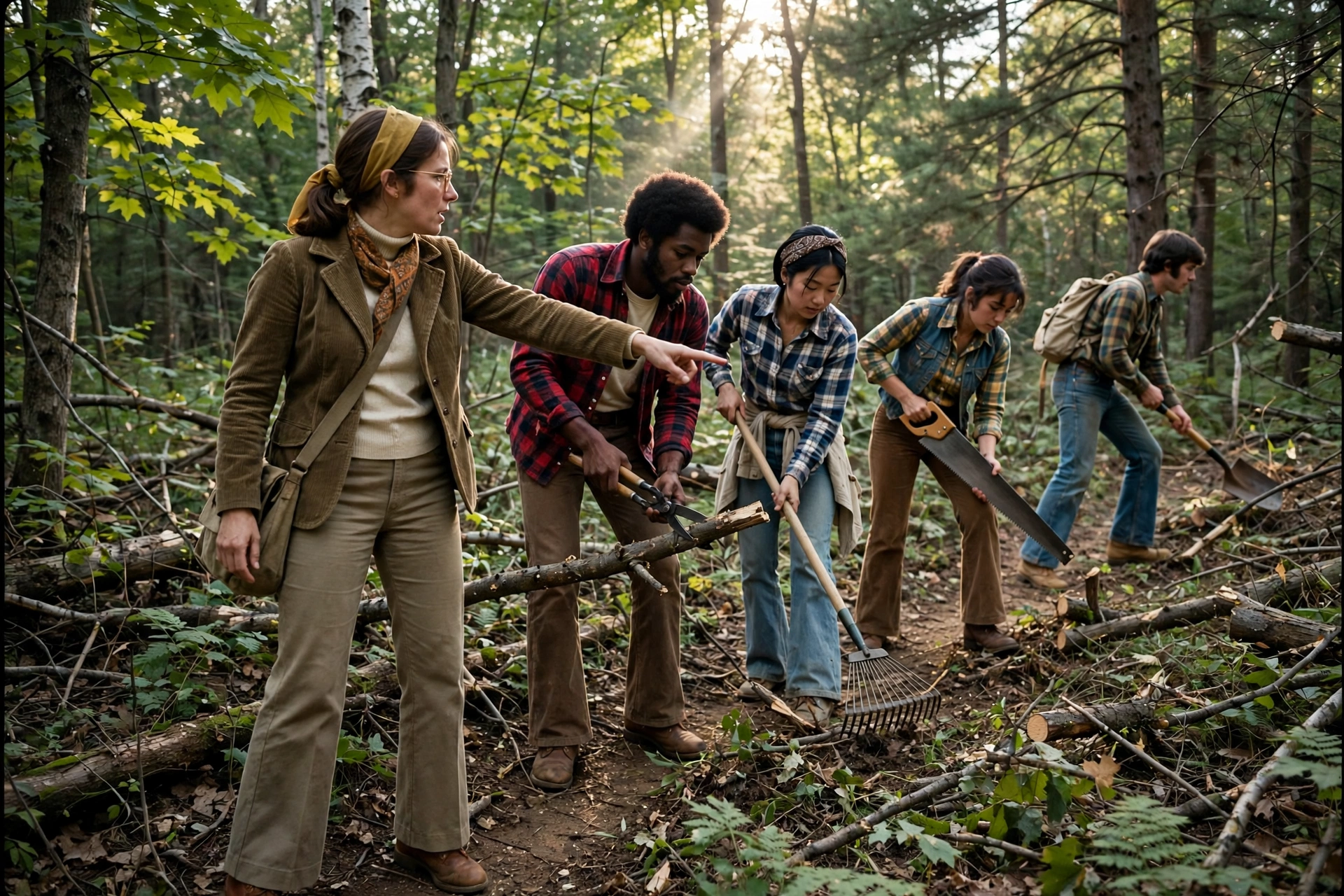
The Dahlem Conservancy’s own account of its founding, delivered by executive director Ben Dandrow in a 2022 address to the Jackson Community Foundation, is disarmingly plain about it. In 1971, Berlet’s biology class cut the first trail on the property. In 1973, while teaching an environmental problems class, she developed an interpretive master plan for the land. That plan, in the Conservancy’s words, “led to the establishment of the nature center that became known as Dahlem in 1976.”
This sequence matters. Dahlem was not a park that later acquired an education program; it was an education program that acquired land, trails, and eventually a name. The teaching came first, in 1971. Everything since — the visitor center, the gardens, the preschool, the five miles of trail — is the elaboration of a syllabus.
The Teacher
Myrna Berlet arrived at the land with credentials and with mud already on her boots. She held a B.S. in biology and an M.S. in zoology from the University of Michigan, and she taught at Jackson Community College — now Jackson College — for thirty-two years: biology, botany, zoology, nature photography, and field biology among her subjects. She retired in 1998.
Outside the classroom she was half of one of Jackson’s more remarkable couples. With her first husband, Walter Berlet, she spent twenty-eight years producing wildlife films — work the Ella Sharp Museum later honored in its “Living Wilderness” exhibition — shown in classrooms and on television stations around the world.
At Dahlem she was never merely a founder in the ceremonial sense. She was appointed to the center’s first board of directors in 1977 and stayed on the board, in the Conservancy’s telling, as member, officer, advisor, and volunteer for the next forty-four years. The board named her a member emeritus in 2015. The center’s Little Acorns preschool, the Conservancy says, is a living testimony to her vision of teaching the very young “the love and reverence for nature.” Dandrow’s summary is the one that has stuck: she was “a guiding force for over 50 years” in Dahlem’s mission.
The Name on the Gate
If Berlet supplied the plan, Betty Dahlem Desbiens supplied the place — and she was, fittingly, a teacher too.
Betty was born in Jackson in 1920, the year American women won the right to vote — a coincidence she liked to cite, the Conservancy notes, because she could not imagine her educated mother being barred from the ballot. She took her bachelor’s degree at the University of Michigan and a master’s at Columbia, taught English, history, and social studies in Hanover-Horton, Royal Oak, the Panama Canal Zone, Guam, and Hawaii, came home to Jackson in 1958, served as principal of East Jackson Memorial Elementary School, and finished her career as an assistant professor of special education at Wayne State University, where she earned her doctorate.
In 1976 — the same year Berlet’s master plan came to fruition — Betty made the founding donation that established the John and Mary Dahlem Environmental Education Center and its foot trails, named in honor of her parents, on Jackson Community College property. It was an educator’s gift: not a monument, but a teaching institution, named for the two people who had first taught her.
Independence
For its first twenty-nine years, Dahlem lived inside the college — its land, its rhythms, its budgets. In 2005 that changed. Betty assisted with the legal creation of the Dahlem Conservancy, the step that made the center, in the Conservancy’s words, “fully independent from the college in programming, staffing, funding, and management.”
It was the same pattern as 1976, repeated by the same woman: find the institution Jackson needs, supply what it lacks, and structure it to outlast the giver. The college kept its land relationship with the center; the Conservancy took responsibility for everything that happened on it.
A Century of Giving
To list what Betty Dahlem Desbiens funded across 103 years is to risk making her sound like a foundation. She was, by every account, a person — one with a remarkable geographic range. In Jackson, she volunteered for and was a major funder of the Falling Waters Trail; led the restoration of the J. Sterling Wickwire barn at Dahlem and funded the Dahlem Community Gardens; was largely responsible for restoring downtown’s historic National Humane Alliance fountain — the Ensign fountain — in Blackman Park; and supported the Cascades Humane Society, the Hanover Horton Historical Society, the Grand River Environmental Action Team, and a dog park that carries her name, among much else.
In 1988 she did it again a thousand miles south, as a founding member and later president of the Key West Botanical Garden Society, which took a neglected city-run garden and rebuilt it into the Key West Tropical Forest & Botanical Garden. The pond there bears her married name: Desbiens Pond.
The honors accumulated near the end: a Susan B. Anthony Award in 2001; a special tribute from the State of Michigan; a Lifetime Achievement Award from the Jackson County Michigan Historical Society; and in 2023 a proclamation from the City of Jackson thanking her for “over a century of positive change in and around Jackson.”
Betty Dahlem Desbiens died on September 24, 2023, at the Henry Ford Allegiance Hospice Home, at the age of 103. The Conservancy’s memorial records that she asked for three bird feeders to be placed outside her window, and that she got outdoors, at the end, to enjoy the nature she had spent a century arranging for other people to enjoy.
The Teacher’s Last Gift
Berlet had died two years earlier, in February 2021, at age eighty — but her work at Dahlem was not finished either.
In January 2022, the Jackson Community Foundation announced the largest gift in its history: $5.18 million from the Berlet estate, with $5 million invested as an endowment — the Berlet Fund for Nature — expected to return roughly $250,000 a year to the Dahlem Conservancy, every year, in perpetuity. A separate gift of nearly $1.3 million from the Myrna Berlet Trust endowed science equipment at Jackson College.
Consider the symmetry, because it is the whole story in miniature. The donor gave the center its founding gift in 1976 and its independence in 2005. The teacher gave it its first trail in 1971, its plan in 1973 — and, fifty years after that first trail, its financial permanence. The two women between them covered both halves of what an institution needs to survive: a reason to exist, and the means to keep existing.
Dahlem at Fifty
What stands at 7117 South Jackson Road today is the accumulated result. Nearly 300 acres of gardens, forest, grassland, meadow, marsh, and pond. Five miles of hiking trails, including the 3/8-mile Nature for All Trail, a paved loop built for visitors with limited mobility — for wheelchairs, walkers, and strollers — with benches and sensory signage along the way. A visitor center with live animals and a wildlife viewing window. Year-round programs, from the Little Acorns preschool Berlet envisioned to the fall Goblin Walk that most Jackson families know it by.
The trails are open to the public every day, dawn to dusk, by donation.
Fifty years is a long time for a classroom project to run. It is running still — on a teacher’s plan, a donor’s name, and an endowment built out of a biology teacher’s estate. If there is a fiftieth-anniversary celebration to be had, the most faithful one is probably the simplest: walk the first trail. It is still there. It has been there since 1971, when a class of Jackson students cut it through the woods because their teacher told them the land itself was the lesson.
Sources: Dahlem Conservancy, “Berlet Fund for Nature” and “Remembering Betty Dahlem Desbiens,” and “About Dahlem,” dahlemcenter.org; MLive / Jackson Citizen Patriot reporting on the Berlet Fund for Nature (January 2022); Rural Innovation Exchange, “Conservationist leaves $5 million to Jackson nature center”; KONK Life, Key West Tropical Forest & Botanical Garden history series; Ella Sharp Museum, “Living Wilderness” exhibition record; Pure Michigan, The Dahlem Center.
A note on images: the illustrations accompanying this piece are AI-generated artwork created for this story. They are impressions of Dahlem’s woodland and of the 1971 trail-cutting — not photographs of the Dahlem Center, of Myrna Berlet, or of Betty Dahlem Desbiens.
Want Jackson’s top local stories in one place? Browse the businesses shaping the area in the NeighborClick Local directory — JOIN the FREE Private Insider List for local stories, business spotlights, community updates and even if you don’t have business you’ll be an Insider.


Comments