
What happened
Every community keeps its oldest memories the best way it can. Sometimes that is a courthouse record. Sometimes it is a name carved in stone. And sometimes, in Jackson County, it is a sermon dated by the night the sky fell down.
This Friday, November 13, it will be 193 years to the day since the night of November 13, 1833, when the greatest meteor storm in recorded American history tore across the sky over a young United States. Millions of people saw it. Preachers, farmers, enslaved families, ship captains, and scientists all watched the same heavens come apart, and a great many of them believed, at least for a few hours, that the world was ending.
Jackson County watched it too. We know that because of one quiet sentence, printed 48 years later in the county’s own history book. In the Napoleon Township chapter of the History of Jackson County, Michigan, published in 1881, the writers recorded the township’s first Methodist sermon this way:
“The first sermon preached in Napoleon township by a Methodist Episcopal minister was in the evening of Nov. 13, 1833, the night of the great ‘star-fall,’ or meteoric shower. The preacher was probably Rev. Colelazer, whom night had overtaken while traveling through this section.”
Read that sentence again. The township had no calendar landmark grand enough for its first sermon, no courthouse date, no famous visitor. So it dated the sermon by the sky. The night the stars fell was the timestamp.
The details: A preacher the night overtook
The passage is honest in a way modern writing rarely is. It says “probably.” The preacher was probably Rev. Colelazer. The writers of 1881 were working from the memories of settlers who had been there, nearly five decades after the fact, and they left their uncertainty in print instead of sanding it off.
What the wider record shows is that the man they remembered was real, and he was exactly where they said he was. Church histories of the period name the Rev. Henry Colelazer, spelled Colclazer in some records, as one of the first Methodist itinerants on this circuit. The 1881 county history’s own chapter on Jackson’s churches records that he preached in Jackson in 1831, two weeks after the Rev. E. H. Pilcher, and organized the county’s first Methodist congregation that summer. Calhoun County’s history and the Albion College yearbook tradition place the same Henry Colelazer, in that same year of 1833, among the three men who resolved to found the academy that grew into Albion College.
So picture what the details give us. A circuit rider, one of a handful of preachers covering hundreds of miles of Michigan wilderness on horseback, caught by darkness on a November road in a township that was barely a year settled. A cabin or a clearing. A small company of pioneers gathered for the first sermon their township would ever hear. And overhead, whether they yet knew it or not, the most astonishing sky of the century was assembling itself.

The details: The night the stars fell
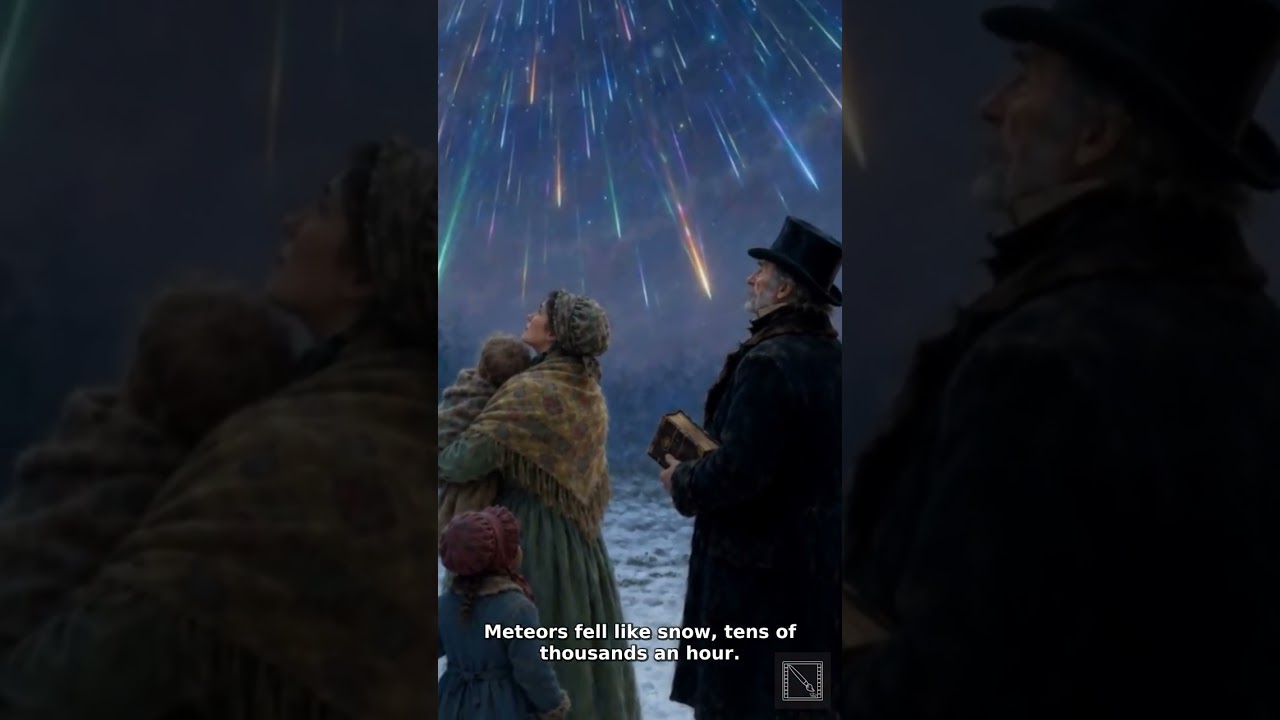
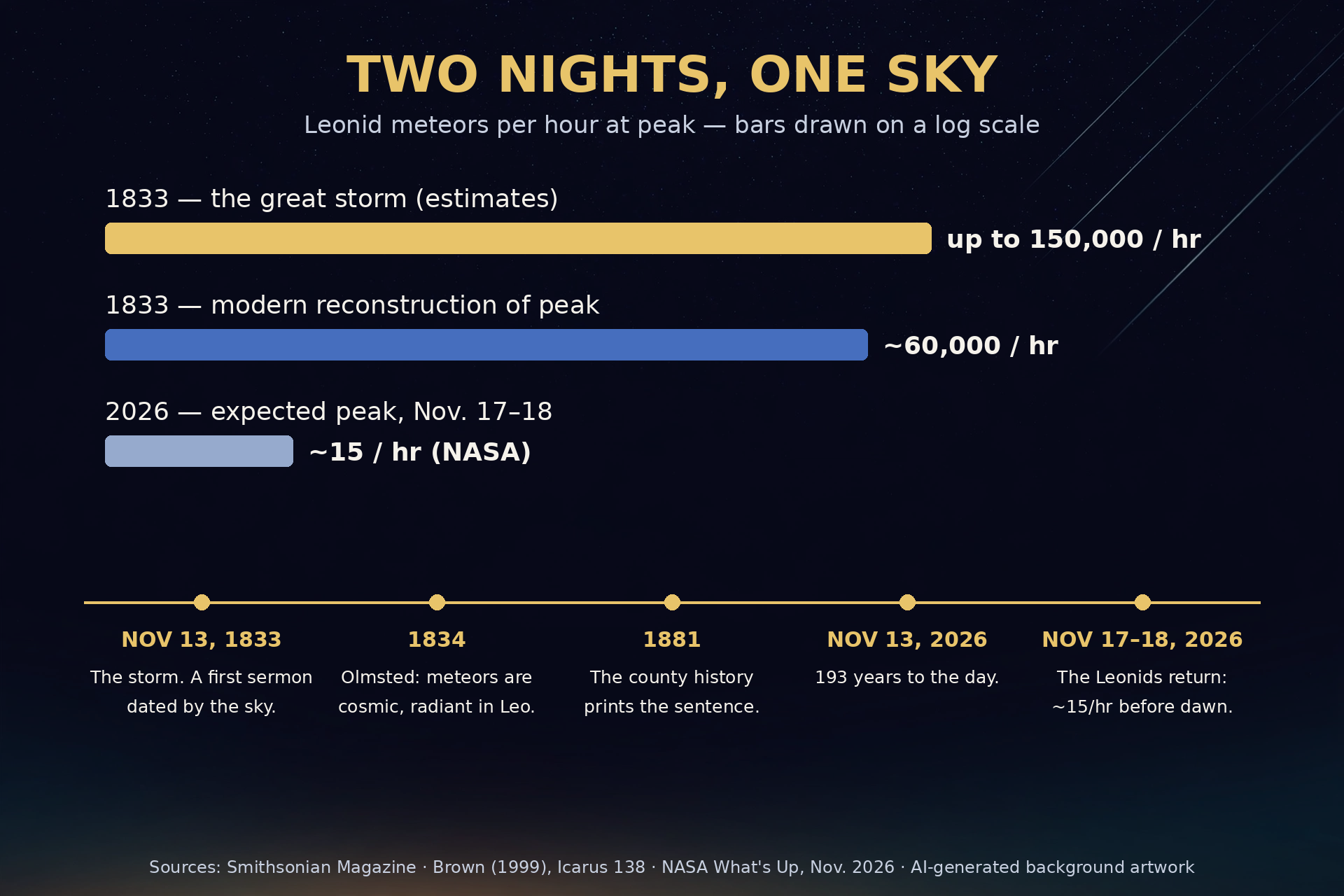
What happened over North America on the night of November 12 into 13, 1833, has never been matched since. The Leonid meteor shower, in most years a modest display, returned that night as a storm. Smithsonian Magazine, summarizing the historical estimates, puts the peak at between 50,000 and 150,000 meteors visible per hour. Careful modern reconstructions of the best eyewitness counts, the work of meteor researcher Peter Brown, put the peak nearer 60,000 an hour. By any count, witnesses described meteors falling like snowflakes in a blizzard, too many to number, streaking from a single point in the constellation Leo until the sky itself seemed to be raining light.
The honest details matter here, so here is one. Astronomers who have studied the 1833 storm place its peak in the small hours of November 13, beginning the evening of the 12th and cresting around 4 a.m. The county history dates the Napoleon sermon to the evening of November 13 and calls that evening the night of the star-fall. The shower stayed active across the surrounding nights, so the sky that week was not an ordinary sky. But the book was written 48 years later, from memory, and memory compresses a week of wonders into the one night that mattered. What the record proves is not the hour of the sermon. It proves that when Napoleon Township reached for a date to hang its first sermon on, it reached for the falling stars, and every reader in 1881 knew exactly which night that meant.
The night did more than give a township a timestamp. It changed science. Before 1833, meteors were widely treated as a kind of weather, something the atmosphere did. After that night, a Yale professor named Denison Olmsted did something modern: he crowdsourced. He appealed through newspapers for eyewitness accounts from ordinary people across the country, collected the letters, and published his conclusions in the American Journal of Science and Arts in 1834. The meteors, he argued, were not weather at all. They were a cosmic event, arriving from beyond the Earth, all of them radiating from one fixed point in Leo. He was right. Peter Brown’s standard history of the shower opens with the sentence the field still stands on: “Meteor Science in its modern form was born on the morning of November 13, 1833.”
One night. A sermon in the Michigan woods, a science born in New Haven, and a sky nobody who saw it ever forgot.
The Argument
Here is the conversation this story asks Jackson County to have, and it is a conversation about how a place remembers.
The argument is this: the most important sentence in the Napoleon Township chapter is not really about a sermon. It is about a community so new it had almost nothing, no church building, no settled ministry, meetings in private houses for five more years, that nonetheless understood its own moment as part of a cosmic one. The settlers of Napoleon did not date their first sermon by the land office, the township act, or the county seat. They dated it by the night heaven itself seemed to move. That choice, preserved in print, tells us what those people thought their lives were: small, frontier, fragile, and somehow inside a story as large as the sky.
There is a second half to the argument, and it concerns us, not them. The 1833 storm founded a science because one professor believed the eyewitnesses of ordinary people were data worth gathering. The county history that preserved Napoleon’s sentence worked the same way, collecting the memories of aging pioneers before they were gone. Both records exist because somebody wrote down what regular people saw. Every generation gets the archive it bothers to keep. Jackson County’s archive, on this one page, kept a sermon and a meteor storm in a single sentence, and 193 years later that sentence is still doing its work, if we bother to read it.
That is the choice the falling stars put in front of this county every November. We can let the Leonids come and go as a weather-app footnote. Or we can do what Napoleon Township did, and actually look up, together, on the record.
The details: The same sky, next week
The Leonids are coming back next week, on schedule, in their modern and quieter form. NASA’s November 2026 skywatching guide advises that the shower is best in the early morning hours of Tuesday, November 17 and Wednesday, November 18, after the Moon sets, with up to around 15 meteors per hour under ideal conditions, though most viewers will see fewer. The International Meteor Organization’s prediction agrees, and no storm is forecast. Nobody is predicting 1833. Nobody credible expects the sky to fall.
But fifteen meteors an hour, from a dark Jackson County field, in the cold before dawn, is not nothing. It is the same river of comet dust, shed by Comet 55P/Tempel-Tuttle, that lit the sky over Rev. Colelazer’s road. The radiant is the same point in Leo that Olmsted’s letter writers described. Find a dark place away from the lights, give your eyes half an hour, and you will be watching the identical appointment Napoleon Township kept in 1833, in its ordinary year instead of its miraculous one.
And this Friday, November 13, the date itself completes 193 years. The county history used that night as a timestamp for a sermon. The least a county can do, 193 years on, is remember why the timestamp worked: because once, over these exact fields and forests, the stars fell, and the people who lived here thought it was worth writing down.
A note on the images: the pictures with this story are AI-generated artwork created for it. They are impressions of a Michigan frontier night in November 1833 and of the Leonid sky, not photographs of Napoleon Township, of Rev. Colelazer, or of the 1833 storm, for which no photographs exist.
Want Jackson’s top local stories in one place? Browse the businesses shaping the area in the NeighborClick Local directory — JOIN the FREE Private Insider List for local stories, business spotlights, community updates and even if you don’t have business you’ll be an Insider.


Comments