

The Argument
- What: One week before Jackson voters choose their next mayor, a third man is asking for the job — but his name will not appear on the ballot. Trent Woodard, a Jackson renter and father, is running a self-declared write-in campaign built around a transitional housing plan he designed himself, The Founders Community. (FACT: his campaign posts on Nextdoor, July 31–Oct. 26, 2026.)
- Who is on the ballot: Former Mayor Derek J. Dobies and John Wilson advanced from the August 4 nonpartisan primary; incumbent Mayor Daniel Mahoney did not seek reelection, and the winner serves a two-year term. Woodard is not on that printed ballot, and this article does not pretend otherwise. (FACT: The Mitten Daily, Oct. 17, 2026; City of Jackson Election Division.)
- The plan: Five steel-frame, all-electric micro-housing units of 160 square feet each, proposed to City Council as a one-time pilot costing $122,500 — against roughly $144,000 a year the city now spends, by his figures, putting five families in hotel rooms. He presented it at the Oct. 20 council meeting, and he says City Manager Jonathan Greene confirmed the city has it and will set up a meeting. (FACT: his posts, Oct. 18 and Oct. 21, 2026.)
📕 DOWNLOAD THE OPEN BLUEPRINT — FREE (PDF)

Who Trent Woodard is
Woodard is not a politician and holds no office — he says so himself, often. He announced the write-in campaign in a Nextdoor post on July 31, 2026, and has posted steadily since, laying out his platform in his own words.
By his own account, he is a Jackson renter who receives SSI and is raising two kids; in September he was on Nextdoor looking for a private landlord who could work with a household on SSI, and in October he was asking neighbors for moving boxes. He says he has spent the past year fighting predatory landlords in court and authored an “At-Will Act” petition aimed at what he calls corporate insurance greed. His two saved favorites on Nextdoor are telling: the Jackson Interfaith Shelter and LifeWays Community Mental Health.
His line, from the July 31 launch thread: “I’m not at the right or the left I’m the people.” His slogan is “Blueprints Over Slogans” — and the blueprint is literal: in mid-October he published a labeled floor plan of the unit he designed, down to the width of the center aisle.
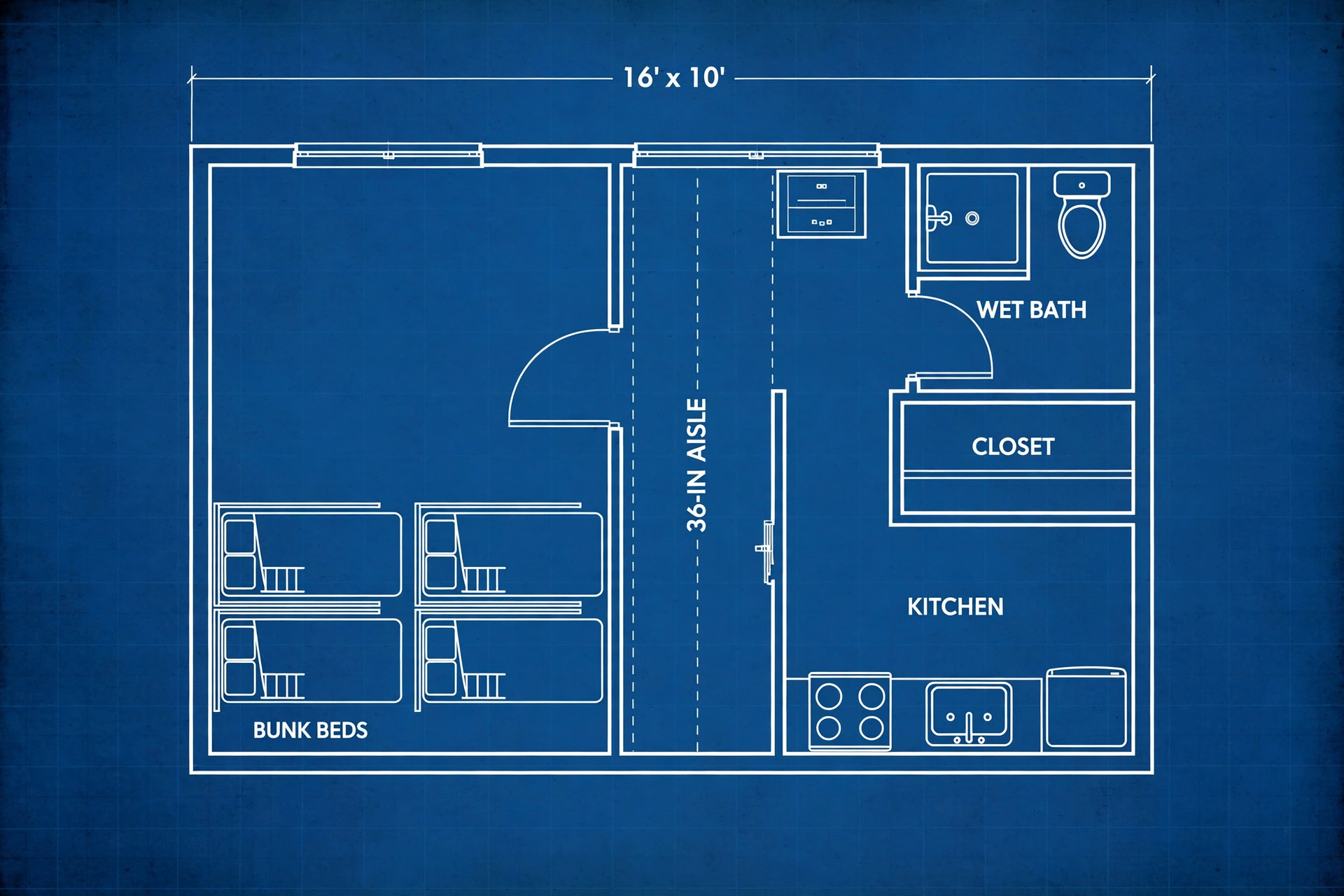
The Founders Community: the unit
The unit is 16 feet by 10 feet — 160 square feet — drawn with steel-frame and SIP (structural insulated panel) construction, no wood framing, all-electric. The floor plan he published Oct. 17 shows two heavy-duty steel bunk beds with under-bed storage drawers, a 36-inch clear center aisle, a private wet bath with an enclosed shower stall and toilet, a walk-in closet he labels “Fits Family of Four,” a kitchen with a four-burner stove, sink, upper cabinets and under-counter mini fridge, a wall-mounted mini-split, frosted egress windows, and rubber-matting floors. In an Oct. 18 post he writes that he engineered the design himself, in five variants with full 3D renderings and floor plans.
The village around the units, from his Sept. 27 “Founders Community Vision” post: cooking setups designed to eliminate open-fire hazards, privacy fencing of tall natural shrubbery, residents hired from the community for maintenance and groundskeeping at fair pay, posted standards covering pet cleanup and quiet hours, help for seniors and disabled residents navigating SSI and disability programs, and “No Wrong Door” access to prevention and master leasing programs.
He is not a licensed contractor, and he does not claim to be one. He is a citizen who drew a housing unit, priced a pilot, and carried it to City Hall himself.
The math, and what happened at City Hall

The financial spine of the campaign is a comparison Woodard makes in his Oct. 18 post: “this city spends roughly $144,000 a year putting five families in hotel rooms, and when the vouchers run out, those families are back on the street with nothing to show for it.” Rent paid, nothing owned, the same bill again next year. Against that, his Oct. 21 post reports that on Oct. 20 he stood in front of Jackson City Council and placed The Founders Community on the public record: five transitional micro-units at $122,500 one time — and that during recess, City Manager Jonathan Greene spoke with him directly, confirmed his office has the proposal, and said the city will reach out to set up a meeting.
On funding, his Oct. 18 post says the structure is “Model C fiscal sponsorship running on redirected existing grant dollars. Zero new taxpayer money.” The project, he writes in an Oct. 26 post, “is designed to be a nonprofit, not city taxes, not city taxpayers. I’m trying to build assets for Jackson’s future.” There is no donation appeal anywhere in his posts. On permission, he says he has “mapped the zoning path through the city’s own code, including the Planned Unit Development process and exactly what the pre-application conference requires,” and on Oct. 26 he posted that he had come from a meeting at the state capitol with a state representative candidate, local leaders, and representatives from two area churches about The Founders Community.
For scale, his Oct. 26 housing post cites the city’s 100 Homes at $178,000 (up from $175,000 three years ago, with about $35,300 in public money per home, by the figures he cites) and ALICE data putting 40% of Michigan households below the threshold for affording the basics, 45% in Jackson County. His argument: a city where nearly half of households cannot cover the basics should be building assets it owns instead of renting motel rooms by the year.
The landlord plan
Housing is not the only detailed plank. In a Sept. 22 post he calls “just a thought,” Woodard lays out a framework aimed at Jackson’s local landlords: guaranteed five-day “Fast-Track” inspections for owners who keep properties up to code, with reduced fees and three-to-four-year certification cycles; a “Tenant Trigger” line under which a verified safety hazard instantly strips a landlord of Fast-Track status; voluntary, tiered repair grants for health, safety and weatherization work — roofs, furnaces, lead abatement, not cosmetics — forgiven to zero over one to five years in exchange for a retention agreement; heavy enforcement reserved for out-of-state slumlords; and an ask that landlords drop rigid “3x rent” screening multipliers, paired with master leasing and rent-guarantee partnerships through the Community Action Agency. He closes by asking landlords and renters for feedback before taking it to City Council — a full policy draft, published for his neighbors to argue with, which they did.
Cameras, tents, and the setting that can change back
His Oct. 26 post on license-plate cameras is the most tightly argued thing he has written. Per his account of the Sept. 8 public hearing: about eleven residents spoke, not one asked the council to keep the cameras, and the council voted 5 to 2 to fund them anyway — twice. He writes that the police chief said Jackson’s plate data sat in a nationwide database until about ten days before the vote, when it was changed to county-only: “Not by law. By a setting. A setting that can be changed back just as quietly.” His price tag: about $28,000 a year for a subscription the city will never own, to a company in Atlanta. His counter-proposal: a Jackson law — Jackson decides who can search Jackson data, every search on a public log, no automatic renewals, proof the system works or the contract ends. His frame: “It is the motel voucher deal again, this time with our movements. Money out every year, nothing owned, nothing built, no control.”
He takes the same side of the street on Ordinance 2026-03, the new tent and camping ban: in his Oct. 17 post he writes that it passed 4 to 3 despite nearly two dozen residents speaking against it, with no enforcement or shelter-capacity plan attached, and that it “does nothing except penalize human beings for having nowhere else to go.” His alternative: rapid-deployment emergency triage shelters and community-backed housing.
His July 31 launch post rounds out the platform: emergency rent and utility support to keep families housed before crisis, mobile crisis teams pairing clinicians with shelters, paid summer jobs for local teens, and priority repairs for high-risk intersections. In his Aug. 12 post he notes he attended the United Way and Jackson Community Foundation homelessness forum as “a resident and Mayoral candidate,” with positions drawn from “time on the streets listening directly to our unhoused neighbors.”
How a write-in vote works — read this part carefully
Woodard’s name will not be printed on the Nov. 3 ballot. To vote for him, go to the Mayor section in the nonpartisan part of the ballot, fill in the oval on the write-in line, and write the name in: TRENT WOODARD. Keep the ballot clean, with no extra marks, so the scanner reads it properly. (His first campaign post, in July, mistakenly gave a different form of his name; every post since uses Trent Woodard. Write TRENT WOODARD.)
One piece of honest voter guidance applies to every Michigan write-in candidate, Woodard included: under state law, write-in votes are counted only for a candidate who filed a Declaration of Intent with the proper clerk by the deadline — this year, Friday, Oct. 23. His posts do not mention the filing, and it could not be confirmed from public records before publication. That is guidance for any voter considering any write-in, not a charge against him; the City Clerk’s office can confirm a filing directly.
(COMMENTARY: Here is what the two printed campaigns are not offering: a plan you can hold in your hands. One side wants to manage the city better; the other wants to watch it harder. Both are arguments about process. The renter from the Monroe section of town showed up with drawings, a zoning path, a funding structure asking for zero new taxpayer money, and a price — $122,500, once — against $144,000 a year renting motel rooms that leave the city owning nothing. Agree with every plank or not, that is the oldest kind of candidacy there is: a citizen who did the arithmetic and brought the receipts. City Hall’s manager has the proposal and, by Woodard’s account, a meeting is coming. Jackson has until Nov. 3 to decide whether the man with the blueprint deserves more than a meeting. This page’s view: he does.)
Get to know him — and envision working with him
Everything in this article comes from Woodard’s own public posts, and he is not hard to find or hard to reach. On Nextdoor — his Nextdoor profile — he has been talking with Jackson neighbors in the open since January 2025: the platform, the floor plans, the arguments with his critics, all of it in his own words, in the feed where his closest neighbors actually live. On Facebook — his Facebook page — he posts the longer statements, including his account of addressing City Council on Oct. 20.
Read him there the way you would size up any man you might do business with. Then envision how you would work with him: a neighbor deciding whether his village belongs on your street; a landlord weighing his Fast-Track offer; a church asking what two churches at the capitol are already asking; a tradesperson wondering who lays the first skid. He is building in public, and the door he is building through is open.
📕 DOWNLOAD THE OPEN BLUEPRINT — FREE (PDF)
FAQs
Is Trent Woodard on the ballot?
No. The printed mayoral ballot is Derek J. Dobies vs. John Wilson. Woodard is running a write-in campaign, which he has declared publicly and repeatedly since July 31, 2026. (FACT: City of Jackson Election Division; his posts.)
How do I vote for a write-in candidate for Jackson mayor?
In the Mayor section of the nonpartisan ballot, fill in the oval on the write-in line and write TRENT WOODARD. Keep the ballot clean. Under Michigan law, write-in votes count only for candidates who filed a Declaration of Intent by Oct. 23, 2026; the City Clerk can confirm any write-in candidate’s filing.
What is The Founders Community?
Woodard’s proposed transitional housing village: 160-square-foot, steel-frame, all-electric micro-units he designed (five variants, published floor plans), starting with a five-unit pilot proposed to City Council at $122,500 one time, funded — per his plan — by Model C fiscal sponsorship on redirected existing grant dollars, with no new taxpayer money. (FACT: his posts, Oct. 17–26, 2026.)
Is he a builder or contractor?
No trade license is claimed anywhere in his posts. He is a Jackson renter and father who designed the unit, mapped the zoning path, and presented the pilot to City Council on Oct. 20, 2026, himself. (FACT: his posts.)
When is the election?
Tuesday, Nov. 3, 2026. Polls open 7 a.m. to 8 p.m.; early in-person voting runs through Nov. 1. In Jackson’s council-manager government, the mayor leads the council while a city manager runs daily operations. (FACT: The Mitten Daily, Oct. 17, 2026.)
Want Jackson’s top local stories in one place? Browse the businesses shaping the area in the NeighborClick Local directory — JOIN the FREE Private Insider List for local stories, business spotlights, community updates and even if you don’t have business you’ll be an Insider.
Source links
- Trent Woodard on Nextdoor (campaign posts, floor plans, platform, July 31–Oct. 26, 2026): https://nextdoor.com/profile/01RBK-GgNhmHL5STJ
- Trent Woodard on Facebook (including his Oct. 21, 2026 post on addressing City Council): https://www.facebook.com/profile.php?id=100002162708611
- City of Jackson Election Division (official candidate and election information): https://cityofjackson.org/267/Election-Division


Comments