

Gray Land News | October 10, 2026
FACT: Michigan is building a quantum workforce and research capacity through Michigan State University’s NSF-supported Quantum Motor City program and the University of Michigan’s $9 million quantum sensor-network project. Neither initiative is based in Jackson, and this review did not establish a comparable Jackson-based program. Free access to real quantum hardware is available through IBM, while D-Wave offers trial opportunities. But the uploaded survey needs a significant correction: Microsoft says its advertised Azure Quantum credits stopped being usable after June 1, 2025. Jackson’s immediate opportunity is readiness—education, careful experiments, university partnerships, and cybersecurity planning—not buying a miracle computer.
The Argument
Michigan is building real quantum capacity — students training on actual hardware at MSU, a $9 million sensing project at U-M — while Jackson has no seat at the table. That is not a crisis. It is an opening. Free access to real machines exists today, the skills transfer even if quantum stalls, and the most immediate business issue, post-quantum cybersecurity, needs attention now rather than in 2030. Jackson does not need its own quantum computer. It needs a learning group, a phone call to the universities, and one small honest experiment. Become useful, not merely excited.
Michigan’s Quantum Story Is Real—but It Is Not One Single Race
COMMENTARY: “quantum computing” conjures a machine solving every business problem; the actual story is more interesting and more useful.
FACT: quantum computing uses superposition, entanglement, interference; properly designed algorithms could outperform conventional computing on certain problems, but not most tasks.
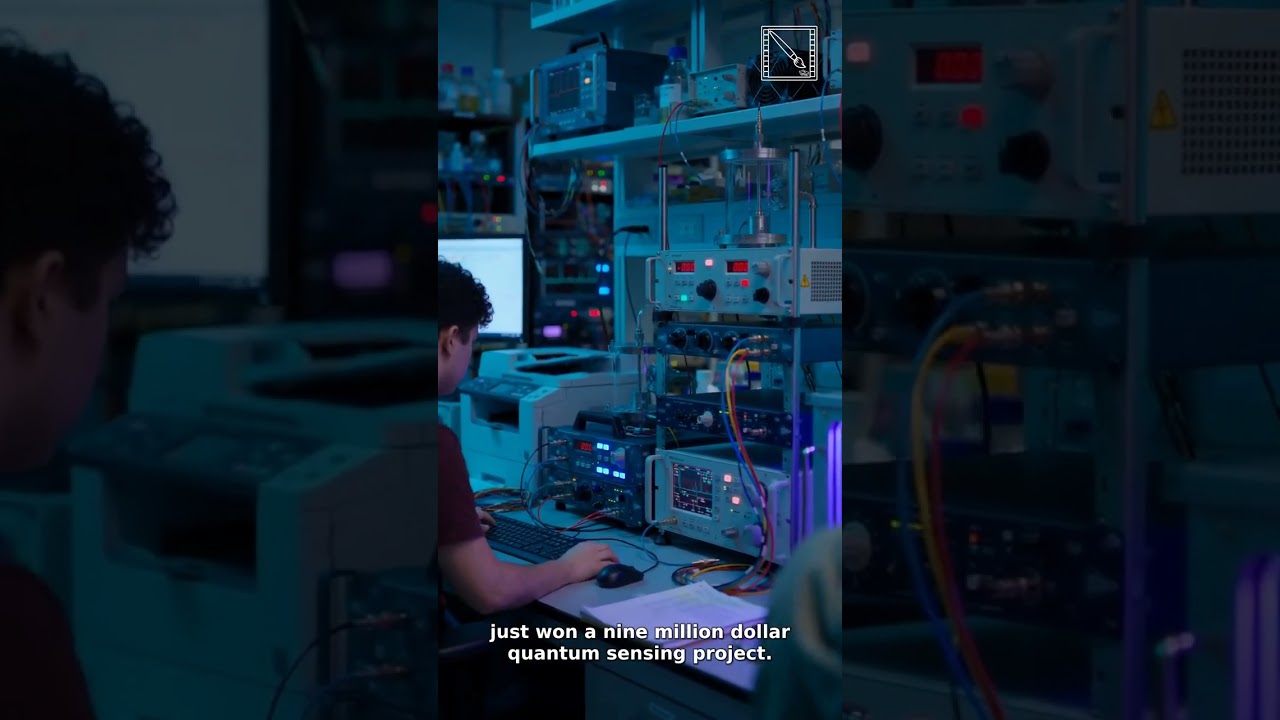
FACT: U-M’s sensor-network project is quantum SENSING (entanglement-linked sensors improving measurement) — not a general-purpose quantum computer.
COMMENTARY: distinctions matter; Michigan is developing pieces of an ecosystem; Jackson’s question is where it could contribute and what evidence justifies investment.
MSU’s Quantum Motor City: A Workforce Pipeline, Not a Factory Announcement
FACT: began 2024 as a pilot for Detroit high school students; led by MSU assistant professor Ryan LaRose; inaugural campers programmed IBM quantum computers and toured MSU’s Laboratory for Hybrid Quantum Systems.
FACT: July 29–31, 2026 camp was free residential (housing + meals); nearly 100 applications from 10 states, 78 admitted (vs ~24 in 2024, ~32 in 2025) — university-reported participation, not employment outcomes.
FACT: 2026 open to any high school student incl. outside Michigan; no prior quantum experience needed; prerequisites basic algebra/trig; NSF-supported through Sept 2028; advisory board incl. MiSTEM, Detroit Public Schools, IBM, EeroQ.
COMMENTARY: credible educational doorway, not a jobs promise; the 2026 camp already happened — monitor future announcements; a local contribution is helping students prepare and reach these opportunities.
U-M’s $9 Million Project: Better Measurement, Not Instant Business Software
FACT: Prof. Zheshen Zhang leads a five-year, $9M Office of Naval Research project on distributed entangled quantum sensing (announced Dec 2025; coverage Feb 2026).
FACT: research examines fundamental limits of sensor networks — whether entanglement, stabilization, error correction improve sensitivity/bandwidth; testbeds at U-M and Princeton; potential uses incl. GPS-free navigation and inertial sensing — research objectives, not a finished product.
COMMENTARY: computing asks how to solve; sensing asks how accurately to observe. Worth attention for measurement-minded manufacturers, but a federal award is not a purchase order.

Is Jackson Really “Not in It Yet”?
FACT: the survey identifies MSU/U-M activity but no Jackson-based initiative; this research likewise found no publicly documented Jackson quantum research center, workforce initiative, or involvement — a finding about evidence reviewed, not proof no Jackson resident participated privately.
COMMENTARY: the defensible statement is narrower — Jackson is not an identified host and has no visible local participation strategy; a community can enter via education, suppliers, software skills, cybersecurity, partnerships before hosting hardware; the first missing piece may be coordination, not a machine.
Free Quantum Computing: What You Can Actually Access
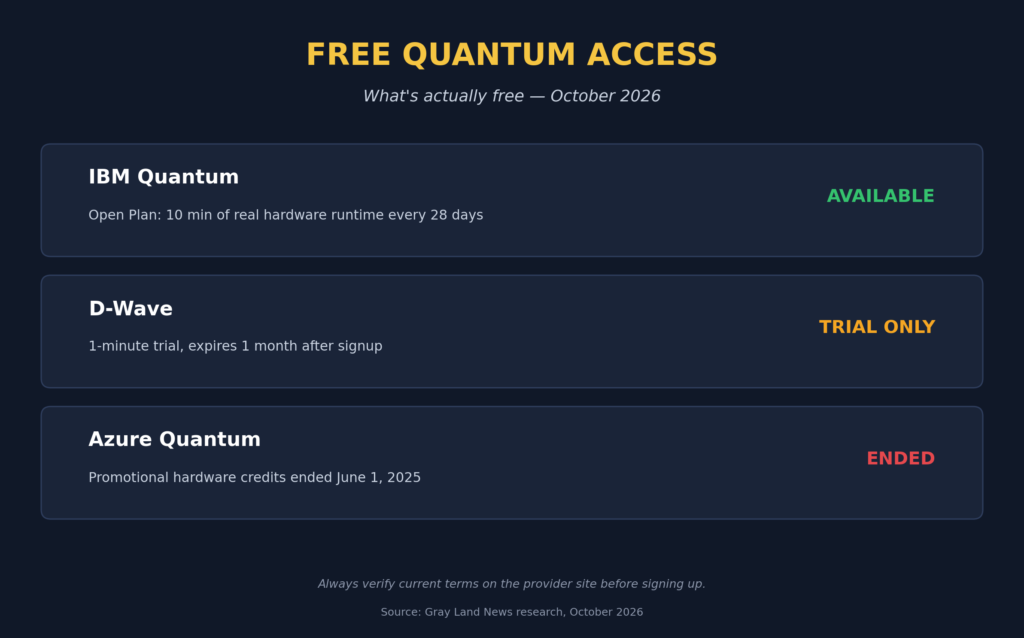
FACT: “free” can mean real processor time, a trial, simulation software, or educational resources — never blend them. IBM Quantum Open Plan: up to 10 minutes of quantum runtime every 28 days (runtime, not study time); free learning resources included. D-Wave Leap: initial trial of one minute QPU/hybrid-solver access, expiring one month after signup — prepare before activating; confirm solvers/allowances. Azure Quantum: still a cloud service, BUT Microsoft’s credits FAQ says Azure Quantum credits could no longer be used after June 1, 2025 — do NOT present automatic Azure credits as a current offer.
COMMENTARY: simulation is valuable preparation, not proof of business advantage; judge “quantum-inspired” software by results, not branding.
What Is Real—and What Is Still Hype?
FACT: quantum hardware exists, public experiments are possible, error correction is active engineering — but qubits are noise-sensitive; more physical qubits alone doesn’t solve reliability.
COMMENTARY: qubit count is not a universal performance score; before buying quantum optimization services ask: conventional baseline? data/integration costs included? does the quantum component improve the result? repeatable? what happens when trial ends? “Business value by 2028–2032” is a forecast, not a purchasing guarantee.
The Most Immediate Business Issue May Be Cybersecurity
FACT: NIST finalized its first three post-quantum cryptography standards in 2024 — designed to resist attacks from conventional and future quantum computers; PQC runs on conventional computers, no quantum computer needed.
FACT: NIST recommends starting with identifying systems using affected encryption and engaging vendors; CISA/NSA/NIST recommend quantum-readiness roadmaps, cryptographic inventories, supply-chain review.
COMMENTARY: a sensible first IT conversation covers which systems depend on quantum-vulnerable public-key crypto, what must stay confidential for years, vendor migration plans, upgrade-vs-replace; preparation, not panic — don’t abandon backups, MFA, patching, training.
What Would It Take for Jackson to Participate?
COMMENTARY: a proposed local on-ramp — (1) a learning group (students, educators, programmers, technicians, employers) starting with programming, probability, linear algebra, basic quantum concepts; (2) contact MSU’s quantum program and innovation center about educational collaboration before proposing any facility (no organization has agreed to anything — proposed outreach, not commitments); (3) test one small non-sensitive problem — fictional scheduling dataset, conventional baseline first, then quantum/hybrid, recording quality, runtime, effort, cost; (4) publish what was learned — method, limitations, reproducible findings.
Questions Jackson Businesses and Workers Are Asking
Can I use a real quantum computer for free? Yes — IBM’s Open Plan gives limited recurring hardware runtime; D-Wave describes trial opportunities (confirm access/eligibility).
Will quantum improve my business immediately? Don’t assume it — identify a specific problem, set a conventional baseline, require measurable improvement before paying.
Can a Jackson high school student join Quantum Motor City? 2026 accepted students beyond Michigan, but that camp concluded — confirm future dates/terms.
Do I need a physics doctorate? No — 2026 prerequisites were basic algebra and trig.
Is U-M’s sensor project a rentable quantum computer? No — it’s sensing research, not a public computing offer.
Does Jackson need its own machine? Not to start — people, partnerships, documented work first.
Jackson’s Opportunity Is to Become Useful, Not Merely Excited
COMMENTARY: Michigan’s quantum progress deserves attention because there’s substance beneath the terminology — a growing educational pipeline, federally supported sensing research, access to actual machines. Jackson needn’t pretend it has a quantum economy, nor wait until every commercial question is settled before educating its people. Build transferable skills, test modest ideas, prepare security systems, cultivate relationships with Michigan expertise. Keep the ambition. Demand the evidence.
Want Jackson’s top local stories in one place? Browse the businesses shaping the area in the NeighborClick Local directory — JOIN the FREE Private Insider List for local stories, business spotlights, community updates and even if you don’t have business you’ll be an Insider.


Comments