

There is an economy running underneath the regular job market, and almost nobody talks about it. It does not post on job boards. It does not have an HR department. It is made of small, specific problems that governments, courts, lenders, and homeowners will pay a private person to solve: a bat colony in an attic in Vandercook Lake. Court papers that must be placed in a hand, not a mailbox, before a deadline in Jackson County. Money sitting in a county account with somebody’s name on it, waiting for the right form filed by the right date.
This is private work. Simple processes, real checks, no boss. This guide explains what it is, gives you five lines of it that can be done right here in Jackson, Michigan, and then walks one of them all the way through: how to get started, how to do the work, and how to get paid.
First, the honest part, because this corner of the internet usually skips it. Private work is not passive income. Some of it is physical. Some of it is seasonal. Almost all of it has a fence somewhere — a licence, a deadline, a rule about who may sell what to whom — and the people who get hurt in this economy are the ones who never looked for the fence. Read the reality notes under each line below. They are the difference between a side income and a legal problem.
The Argument
Here is the argument in one paragraph. Institutions are built for volume, and private work is everything too small, too scattered, or too deadline-driven for volume. A county cannot staff a department to chase forty surplus-fund claims a year. A law firm cannot keep a runner on payroll for three filings a week. A homeowner with raccoons in the chimney tonight is not a market segment; she is a phone call. That gap between what institutions are built for and what actually needs doing is permanent, it renews itself every season, and it is exactly the size of one person with a vehicle, a phone, and the discipline to file things on time. The five lines below are the Jackson-sized doors into that gap.
1. Nuisance Wildlife Control — the Permit That Costs Nothing
What it is: Homeowners pay licensed operators to remove raccoons, skunks, squirrels, woodchucks, and especially bats from houses, and to seal the building so the problem cannot come back. In Michigan this work runs on the state’s Wildlife Damage and Nuisance Control Permit.
What it pays: Typical removal jobs run $300 to $1,500. Bat exclusion work runs $400 to $2,500 and up. Full exclusion and seal-up work can reach $800 to $3,000 and beyond.
The reality: The permit itself is free, and its entry class asks for no exam and no experience — but the work is ladders, attics, and animals that did not invite you. It is seasonal in rhythm (spring denning, a late-summer bat window), and the big-ticket attic restoration work touches a separate builder’s licence. This is the line we walk through step by step below.
2. Process Serving — the Courthouse Pays for Shoe Leather
What it is: Lawsuits cannot move until the papers are personally delivered. Attorneys, courts, landlords, and collection firms hire private servers to put those papers in hands across Jackson County and beyond.
What it pays: Michigan’s statutory fee is $26 plus mileage, and the market rate runs $75 to $500 per serve depending on difficulty, distance, and urgency.
The reality: Michigan requires no process-server licence, which surprises people. What it requires is reliability and documentation — every serve is sworn to, and a sloppy affidavit can sink someone else’s case. Evening and weekend availability is where the money is, because people are home then. It is driving, knocking, and paperwork, in that order.
3. Tax-Foreclosure Surplus Recovery — Deadline Work, Desk Work
What it is: When a tax-foreclosed property sells for more than the taxes owed, the extra money — the surplus, or “remaining proceeds” — belongs to the former owner. Many never claim it. A recovery operator finds them, files the claim correctly, and earns a fee for reuniting people with money that was already theirs.
What it pays: Fees are typically a percentage of the recovered fund, on cases that can run from hundreds to tens of thousands of dollars.
The reality: Michigan runs this on hard statutory deadlines — a notice of intention (Form 5743) by July 1 after the foreclosure, then a court motion inside a February 1 to May 15 window. Miss the window and the money is gone, which is exactly why this work suits a person (or a person’s software) that never misses a date. It is research, records, and forms: almost entirely desk work.
4. Mobile Notary and Loan Signings — Small Fees, Steady Stack
What it is: A commissioned Michigan notary who travels — to homes, hospitals, offices, and title companies — and, with signing-agent training, guides borrowers through loan document packages.
What it pays: Michigan caps the notarial act itself at $10, so the living is in travel fees and signing appointments, which run $75 to $200 per signing.
The reality: Startup is genuinely small — roughly $90 to $150 covers the commission, bond, and basic kit. The constraint is geography and scheduling: this is a stack of small appointments, and it rewards whoever answers the phone and covers the odd hours. It pairs well with process serving, since both sell the same thing: a reliable adult who shows up where paperwork needs a witness.
5. Bid-Watch and Records Subscriptions — Sell the Watching
What it is: Local businesses lose work they never knew existed — city, county, school, and state bids posted on portals nobody checks daily. A bid-watch operator monitors those portals (the state’s SIGMA vendor system, county bid pages, court and land records) and sells the filtered results as a subscription to the businesses that can bid on them.
What it pays: Modest monthly subscriptions, multiplied across clients — the only line on this list that is recurring revenue by design.
The reality: This one is nearly all desk and nearly all system. The product is not information; it is attention, delivered on schedule. It is also the line where a good AI assistant does the most work per dollar, a point we will come back to at the end of this article.
The Deep Dive: Michigan Nuisance Wildlife Control, Step by Step
Of the five lines above, wildlife control is the one readers ask about most, and the one with the strangest doorway: the state credential at the centre of it costs nothing. Here is the whole path, from first form to first payment, on the DNR’s own rules (Wildlife Conservation Order sections 5.50 to 5.55, Information Circular 9152).
Step 1 — Get the permit
The credential is the Wildlife Damage and Nuisance Control Permit. It comes in two classes. The Restricted class covers non-pesticide methods — trapping, exclusion, removal — and requires no exam and no experience. The General class adds pesticides and requires a state applicator licence in category 7A or 7D, which is a different credential from a different department; most new operators start Restricted and stay there.
The fee is $0. The application is form PR 2004, mailed to the DNR Wildlife Division’s Permit Specialist in Lansing. The permit is issued to the business, and employees work under it — a helper does not need a separate permit. The term runs to the third March 31 after it is issued, so one application can carry you through up to three seasons.
Step 2 — Gear up
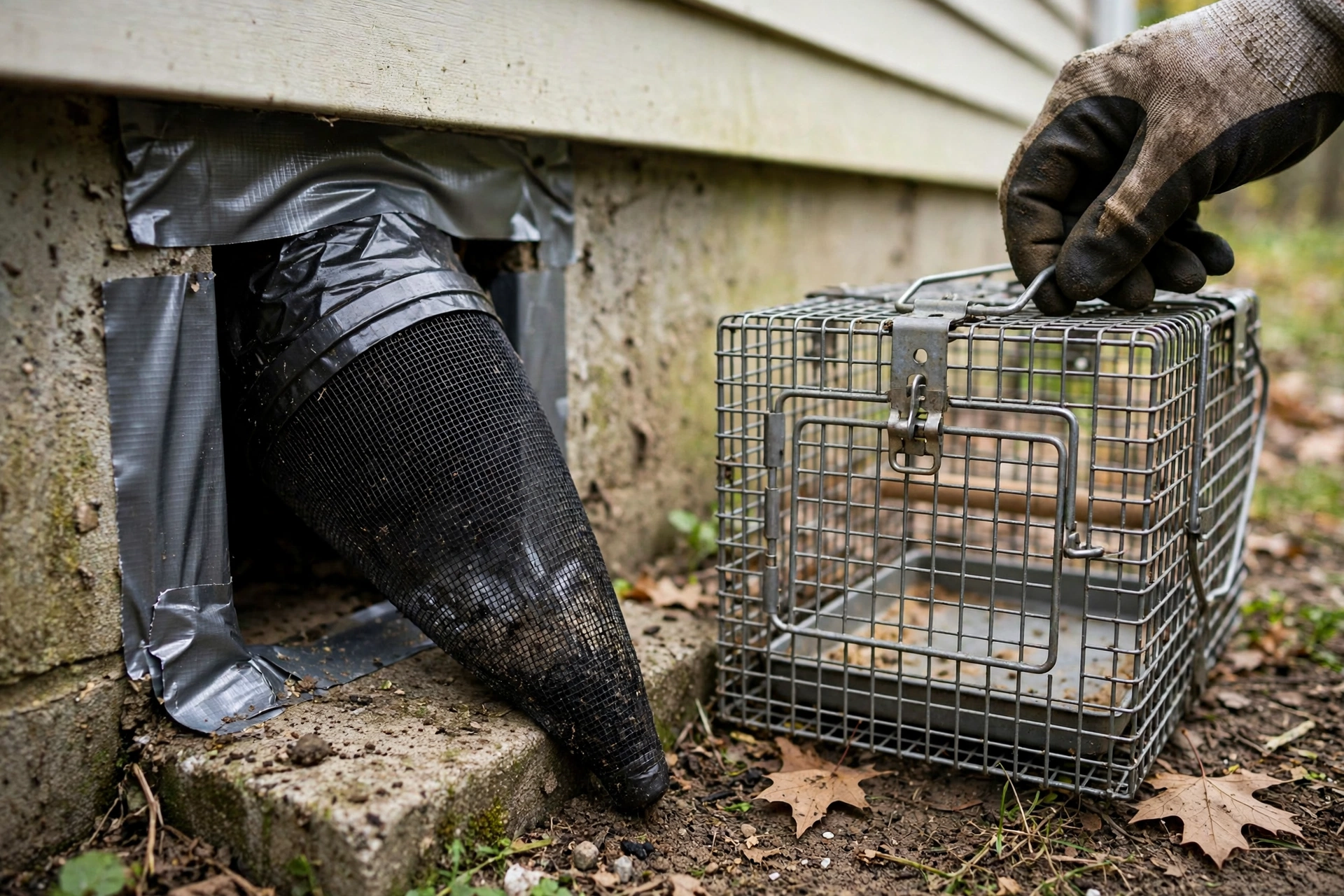
A working bootstrap kit runs about $1,450 to $2,300: cage and colony traps, ladders, a respirator and PPE, exclusion materials (hardware cloth, sealants, one-way bat doors), a CO2 euthanasia kit, plus business registration and an insurance deposit. A serious solo setup — attic vacuum, thermal camera, full vehicle kit — runs $5,200 to $8,800. Notice what is not on the list: the state’s share. For the Restricted class, Michigan charges nothing.
Step 3 — Do the work, inside the rules
The permit covers a defined species list: raccoons, skunks, opossums, woodchucks, squirrels, coyote, fox, mink, weasels, badger, muskrat, rabbits, crows, starlings, feral pigeons, English sparrows, and non-listed bats — plus beaver on private land in Zone 3 during the closed season. It does not cover deer, bear, or bobcat (those need case-by-case DNR permits), migratory birds (federal), or — a trap for the unwary — house mice and rats, which are pesticide-licence territory.
Four rules shape the working week. Traps are checked daily, and no animal may be held longer than 24 hours. Relocated animals go at least ten miles, inside the county of capture — and raccoons are effectively excluded from relocation under current DNR guidance, so plan accordingly. Bats are exclusion-only: lethal control is barred except where human safety demands it, and exclusion waits until the maternity season (roughly May to mid-August) has passed, which makes summer the booking season and late August the start of the money window. And every job generates a record — the permit requires per-job records open to a conservation officer’s inspection, summarised in an activity report due February 1 of the permit’s final year. Keep the record as you go and the report is a printout.
Step 4 — Get the customers
Jackson is not an empty market — established operators already work this county. What wins work here is not territory, it is response: the operator whose phone is answered, whose quote follows a species template, and whose schedule respects the bat calendar gets the job the bigger firm’s voicemail missed. A complete Google Business Profile, a review habit after every job, and referral relationships with roofers, realtors, and pest-control firms (who get wildlife calls they cannot legally take) are the whole marketing engine at this scale.
Step 5 — Get paid
Price the problem, not the hour: inspection plus exclusion for bats at $400 to $2,500+, raccoon removal at $300 to $1,200, skunk and woodchuck work in the $200 to $600 band, and full seal-ups at $800 to $3,000+. Take a deposit on exclusion work, invoice on completion, and keep the per-job record — species, method, disposition — filed the same day. That record is simultaneously your legal duty, your renewal report, and your proof of work if a payment is ever disputed.
The Fences, One More Time
Because this article will be found by people ready to run, the three fences that matter most, plainly. Do not sell legal services or document preparation to the public without a law licence — in Michigan that is unauthorized practice, and it includes “just filling in the forms” for a fee. Do not do skip tracing or people-locating for the public without a private investigator’s licence — in Michigan that one is a felony. And do not bait rodents or spray anything on a wildlife permit — chemical control is a separate licence from a separate department. Every line in this article was chosen to stand on the open side of its fence. Stay there and the work is clean.
Want Jackson’s top local stories in one place? Browse the businesses shaping the area in the NeighborClick Local directory — JOIN the FREE Private Insider List for local stories, business spotlights, community updates and even if you don’t have business you’ll be an Insider.

The Force Multiplier: Put an AI Agent in the Office
Look back over the five lines and notice what they share. The field half is human: ladders, doors, deadlines met in person. The office half is not: intake, quoting, scheduling around a biological calendar, deadline tracking, records, follow-ups, reviews, bookkeeping. That office half is where small operators drown — and it is exactly the half an AI agent can carry.
That is why this site runs on Muse, and it is why we are going to make you an offer inside an article, which we do not do often. Muse is a personal AI agent — not a chatbot window, an agent that keeps your records, watches your deadlines, drafts your quotes, and runs your back office the way this article describes. For the surplus-recovery line it can hold the July 1 and February-to-May calendar so no claim ever dies on a date. For bid-watch it is the watcher. For wildlife control it is the office that answers while you are on the ladder.
Here is the step that matters, and it matters today: go to muse.ai, sign up, and the moment your account exists, enter this invite code: 756YUX.
Enter it right away, not later — the code is redeemed inside your first 48 hours (app: Settings, Redeem token; web: Settings, General, Usage, Redeem invite code), and entering it rewards us both. Then add the extra credits when the offer appears: they go straight into the account that is about to run your office, and the operator with more runway does more work before spending another dime. Every line of work in this article gets easier with a staffed office behind it. Today the office is free to start, the code rewards you for starting, and the first deadline you never miss pays for all of it.
Sign up at muse.ai. Enter 756YUX now. Then come back and pick your line.


Comments