
The Argument
The data center fight that has consumed other Michigan townships has arrived in Jackson County — and Summit Township, Jackson’s southern neighbor, is trying to write its rules before a proposal forces the question. The township has published proposed zoning amendments that sort data centers into four sizes and attach conditions to each: how they cool, how they prove the power exists, and how far they must sit from homes. Whether a hyperscale center ever seeks a Summit Township address is unknown. The argument here is simpler: a township that writes calm rules in advance governs; a township that waits governs in a panic.
The Facts
FACT: Summit Township’s published proposed amendments state that its current ordinance defines a data center in one sentence and allows data centers as permitted uses by right in all commercial districts and as conditional uses in office and industrial districts — provisions the township says “do not address the reality of today’s data centers.”
FACT: The draft is organized around three concerns: (1) impact on water resources, (2) demand for electricity, and (3) noise from cooling systems, transformers, HVAC equipment, and backup generators. Cooling would generally have to use a closed-loop system or municipal water, with a groundwater exception only under state environmental (EGLE) oversight.
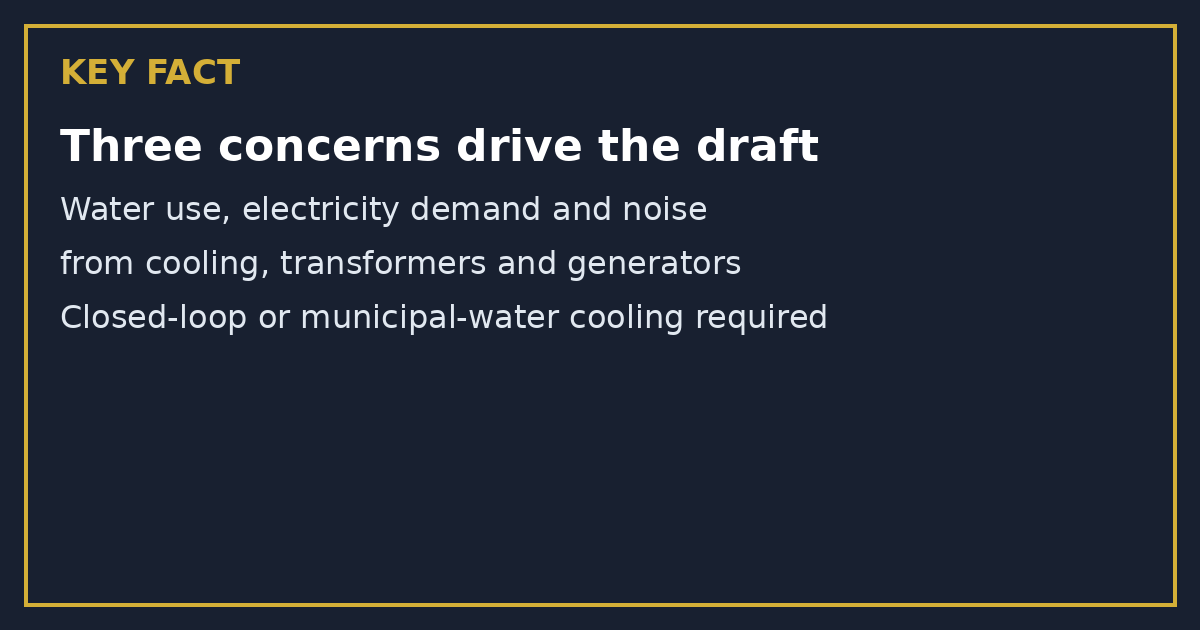
FACT: On electricity, the township would defer to the Michigan Public Service Commission and require a developer to provide assurances from the energy supplier that the project’s electric needs can be fulfilled. On noise, data centers would have to meet a 55 dB(A) average hourly level — the same standard Michigan’s PA 233 sets for solar, wind, and battery storage projects — with pre-construction noise studies for larger projects.
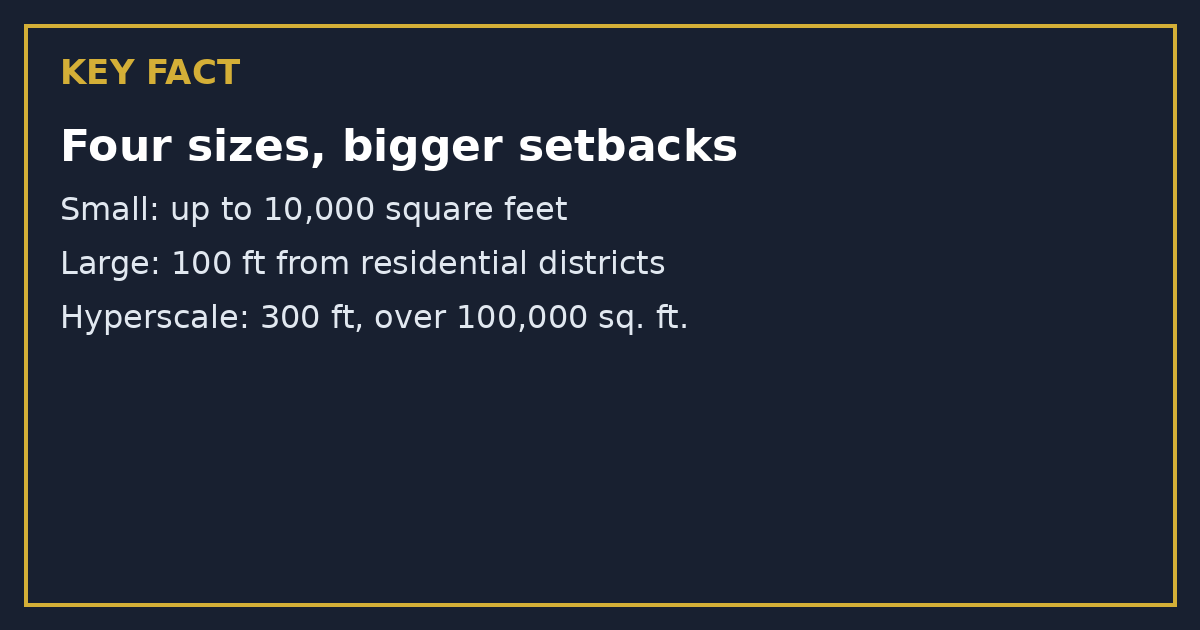
FACT: The draft sets four size classes: small (up to 10,000 sq. ft.), medium (10,000–50,000), large (50,000–100,000), and hyperscale (over 100,000 sq. ft.), using local buildings as yardsticks — a Meijer at about 225,000 sq. ft. and Westwood Mall at about 600,000. Large centers would need a 100-foot setback from residential districts; hyperscale centers, 300 feet. All sizes would become conditional uses, ending by-right approval.
FACT — STATUS, STATED PLAINLY: The document the township published is labeled a proposed draft amendment. This post does not claim a final adoption vote, hearing date, or effective date, because none is stated in the township document opened for this post — readers should confirm the current status with Summit Township before relying on any single provision.
What It Means
COMMENTARY: The draft’s own preface names the flashpoint: the proposed Oracle hyperscale center in Washtenaw County’s Saline Township. Summit Township is close enough to that fight to learn from it without living it. Its approach — regulate water, power, and noise; defer utility pricing to the state; and acknowledge that Michigan’s Zoning Enabling Act bars simply banning a lawful use — reads as an attempt to be strict and lawsuit-proof at the same time.
COMMENTARY: For Jackson County residents, the practical point is that these rules would shape any future proposal’s first conversation: a developer would arrive knowing the cooling, setback, and noise terms in advance. That is what zoning is for — and it is far cheaper to argue about decibels now than about a specific building later.
Frequently Asked Questions
What is Summit Township proposing for data centers?
Proposed zoning amendments that sort data centers into four size classes, make them conditional uses, and set rules for cooling water, electricity assurances, noise (55 dB(A)), and setbacks of 100 feet (large) and 300 feet (hyperscale) from residential districts.
Is a data center being built in Summit Township?
No specific project is named in the township document opened for this post. The amendments are framed as advance regulation, prompted in part by hyperscale proposals elsewhere in Michigan, including Saline Township.
Why can’t the township just ban data centers?
The draft preface states that excluding legitimate uses of property is contrary to Michigan’s Zoning Enabling Act: a township may regulate where a lawful use goes, but cannot prohibit it where a demonstrated need exists.
Has the township adopted the amendments?
The published document is a proposed draft; no adoption vote or effective date is stated in it. Confirm the current status directly with Summit Township.
Want Jackson’s top local stories in one place? Browse the businesses shaping the area in the NeighborClick Local directory — JOIN the FREE Private Insider List for local stories, business spotlights, community updates and even if you don’t have business you’ll be an Insider.


Comments