

The Argument
Nine stories crossed this desk in a single week — a consultant whose $1,000 hours vanished, a writer drowning in AI-generated books, a study of the strange flat feeling adults can't name, even a man who asked AI why it wants to destroy us. They look like nine stories. They are one: the market is repricing human work. What AI made cheap — generic expertise, raw output, volume — is collapsing in price all at once. What it cannot make — judgment, taste, trust, and a name people believe — is rising. This piece lays out the evidence for both sides of that ledger, including the numbers the original stories got wrong.
Nine stories crossed this desk in a single week.
A veteran startup consultant wrote that the phone has stopped ringing with four-figure hourly offers. A skills writer argued the AI economy will reward exactly five human capacities. A personal-brand writer insisted you don't need to be an influencer — you need distribution. An SEO practitioner described making $3,000 a month in a field AI was supposed to have eaten. A publishing writer warned book authors away from the mistake of the decade. A futurist declared generative AI over. A list-maker picked five one-person businesses she'd bet on for 2027. A long essay tried to name the strange feeling so many adults carry around. And one writer did something ironic and a little dumb: he asked AI why it wants to destroy humanity.
Read separately, they are the usual internet weather. Read together, they are a single economic event photographed from nine angles — a repricing. Prices are signals, and right now the signals are all flashing the same message: anything that can be produced at volume, by anyone, with a prompt, is racing toward free. Anything that requires a human being to stand behind it is getting more expensive.
Here is the evidence, story by story — including where the storytellers overstate their case, because a repricing is no excuse for bad numbers.
The $1,000 hour ends
Start with the consultant. Writing in Inc., Joe Procopio — a startup operator who was on the receiving end of the boom — says the market for "AI consultants" is in serious trouble. At the hype peak, he writes, he was being offered up to $1,000 an hour to "do AI." Around the middle of 2026, the offers stopped. Now, he says, AI consultants and dev shops call him looking for work of any kind.
His diagnosis has four moving parts. The market flooded at the peak with rebranded opportunists selling more confidence than competence. The labor-replacement pitch — hire us, fire them — collapsed when the promised savings failed to show up. Ordinary users learned to prompt for themselves, which commoditized the basic expertise the consultants were renting out. And the strongest practitioners stopped selling hours altogether and began productizing what they know, undercutting the rate-based shops from below.
The broader data supports the mechanism, with one correction to the headline. The pain is real but it is not evenly distributed. The AI consulting category as a whole is still growing — market researchers size it at roughly $9.7 billion in 2025 heading toward $11.9 billion in 2026, and Accenture's generative-AI bookings nearly doubled to about $5.9 billion in its fiscal 2025. OpenAI itself moved down-market into delivery, building a deployment company and acquiring a consultancy of some 150 engineers. What collapsed is not consulting. What collapsed is the generic layer: the AI logo on the slide deck, the hourly rate unbacked by a track record. At the genuinely senior end, one analysis still finds elite partners billing around $1,193 an hour. The $1,000 hour didn't die. It went back to belonging only to people who could command it before the letters "AI" were worth anything.
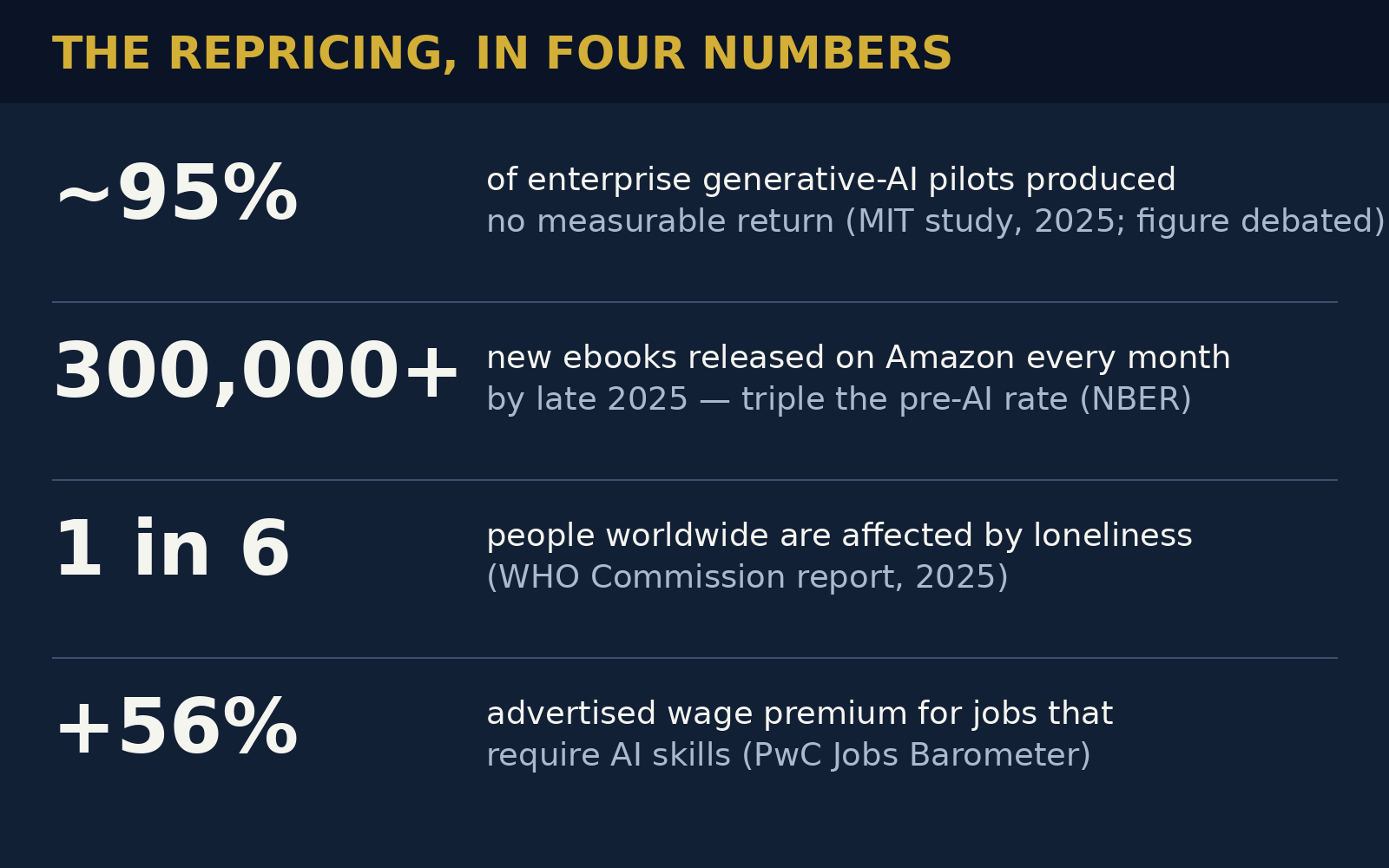
Why did the generic layer collapse? Because its buyers ran the numbers. A widely cited MIT study of enterprise generative-AI pilots found that roughly 95 percent produced no measurable return on profit and loss — a figure that has been debated, including over how it counted pilots, but that landed in boardrooms regardless. S&P Global's enterprise survey traces the mood: the share of companies that abandoned most of their AI initiatives jumped from 17 percent in 2024 to 42 percent in 2025. Clients who paid hype prices for chatbots that didn't move a metric do not renew. They also do not hire the next consultant at the old rate. Every failed pilot repriced the whole profession.
The age of volume ends
Procopio's second piece, a few weeks earlier, is the louder one: "Generative AI Is Over." He concedes in the second paragraph that it is not, really. What he means — and it is the more defensible claim — is that the novelty era is over, and with it the era of measuring AI by volume. Output is no longer the metric. Anybody can generate a hundred pages, a thousand images, a quarter's worth of posts before lunch. Producing more of what costs nothing impresses no one, and receiving an unfiltered wall of AI output increasingly reads as a signal about the sender: low judgment, low value.
He calls what replaces it an age of brevity: the scarce professional is the experienced human who takes the flood and returns the critical, insightful, actionable minimum. Length is cheap. Selection is the skill.
The institutional forecasts lean his way on the hype layer. Gartner predicts that more than 40 percent of agentic AI projects will be canceled by the end of 2027 — done in by escalating costs, unclear value, and weak risk controls — and warns about "agent washing," its term for the thousands of vendors rebranding ordinary products as agents; Gartner counts only about 130 of them as genuine. And yet usage keeps climbing through all of it: McKinsey's State of AI finds 88 percent of organizations now use AI in at least one business function. Both things are true at once, which is exactly what a repricing looks like. The technology is being adopted everywhere and believed selectively. Money is moving from the demo to the deployment, from volume to verification.
What actually got scarce
If execution is what's being repriced downward, the natural question is what sits on the other side of the trade. The "rare skills" piece — published on Medium, and one of the more careful of the nine — answers with five: judgment, meaning experience compressed into instinct; the ability to frame the powerful question instead of merely answering questions; taste and originality; curiosity joined to fast learning; initiative; and the capacity to connect with other humans and build trust. Its prescription is stacking: combine several of these around AI tools rather than competing with AI at routine production.
Its evidence deserves both credit and a footnote. It leans on Stanford's "Canaries in the Coal Mine" payroll research, which found employment for workers aged 22 to 25 in AI-exposed occupations running well below comparable fields — the shortfall is reported between 13 and 19 percent depending on the research vintage. Read precisely, the study shows a hiring slowdown concentrated at the entry level, not mass layoffs, and its authors call the findings early and descriptive. That is still a serious signal: the first rung of the ladder, where juniors used to learn judgment by doing routine work, is the rung AI saws at. And PwC's Global AI Jobs Barometer — roughly a billion job ads analyzed — finds that roles requiring AI skills now advertise wages about 56 percent higher, a premium that doubled in a year. The premium attaches to advertised AI-skill roles, not to "taste" directly. But the pattern rhymes with the piece's thesis: the market is paying for people who can direct the machines, not for people who do what the machines now do.
Notice what all five skills have in common. None of them can be prompted into existence by a stranger. Judgment is a biography. Taste is a biography. Trust is a biography. That is precisely why they are holding their price.
Reputation is the new distribution
The personal-brand piece makes the same argument from the income side, and its best line is a definition: a personal brand is not influencer performance, it is distribution — a reputation system built on a visible body of work. Its reasoning runs: the old script of degree, job, promotions, savings is wobbling (the Federal Reserve's distributional accounts put the top 1 percent's share of U.S. wealth at 31.7 percent in late 2025, the highest since the series began in 1989); the real divide is leverage versus no leverage; and a working reputation — specific, durable, built on assets like a book, a course, a newsletter, a framework, published consistently rather than frequently — is the form of leverage an ordinary person can still build. Brand income then converts into investments, and the loop closes.
Some of that piece's supporting statistics don't survive checking — the "85 percent of hiring managers" and "earn 25 percent more" figures floating around this genre are unsourced or garbled, and we've left them out. The core claim doesn't need them. The 2025 Edelman–LinkedIn research on B2B thought leadership found that visible expertise opens doors and builds trust in ways advertising and traditional selling reliably don't. In a market flooded with generated content, a name attached to a consistent body of work is a verification device. It answers the buyer's new first question: is there actually a person here, and do they stand behind this?
The SEO story is the same trade photographed in one trade. Its author reports $3,000 a month from search work — an unverified self-report, but an arithmetically believable one: Ahrefs' survey of 439 SEO providers puts the average monthly retainer at $2,917, so a single average client roughly equals the claim. What's interesting is his method for learning the field free today: skip what AI has absorbed and learn what's left. The data says he's reading the market right. Semrush's survey work shows AI usage in SEO concentrated in the commodity layer — 60 percent use it for keyword research, 48 percent for content ideation — while strategic uses lag far behind. Meanwhile the ground itself is shifting: Pew Research found users click a traditional result only 8 percent of the time when an AI summary appears on the page, versus 15 percent when none does, and Ahrefs ties AI Overviews to a 58 percent lower click-through rate for the top-ranking page. When the click itself gets scarce, the value in SEO migrates from producing pages to judgment about which pages deserve to exist. Production: repriced to zero. Judgment about production: still billing.
The flood in the bookstore
Nowhere is the volume collapse more literal than in books. The publishing piece's warning — if you want to make money writing books, don't make this mistake — is aimed at the passive-income play: flood Amazon with AI-generated titles and collect. Its central fact checks out against the primary source. An NBER working paper by Reimers and Waldfogel counts Amazon's new ebook releases at roughly 100,000 a month in 2020–2022 — and over 300,000 a month by late 2025. By their detection methods, more than half of 2025's releases contained AI-generated text, and those books are, on average, less used and lower rated than human-written ones.
Amazon has been quietly conceding the flood is a problem: since September 2023, its Kindle platform caps authors at three new titles a day and requires disclosure of AI-generated content. And the economics were never there for the median player anyway — author-earnings surveys put the median self-published author's book income under $1,000 a year. Triple the supply of titles against roughly the same pool of readers and attention, and the volume strategy doesn't just fail. It fails arithmetically, for everyone running it at once. The mistake isn't using AI. The mistake is believing that a tool which makes production free makes production valuable. It does the opposite: it transfers all the value to whatever production can't supply — a real voice, a real subject, a reputation that makes a reader choose your book out of three hundred thousand.

The one-person answer
The list of five one-person businesses to bet on in 2027 is the most optimistic of the nine pieces, and its framing stat is solid as far as it goes: Gusto's 2025 survey of new-business owners found 77 percent of solopreneurs profitable in their first year, against 54 percent of employer businesses, with nearly half starting on less than $5,000 — in a country that filed 5.2 million new business applications in 2024. The honest counterweight is the Bureau of Labor Statistics: only about half of new establishments reach year five. Both numbers belong in the picture. Solo is not safe. Solo is simply the shape that fits the repricing — low fixed cost, no payroll exposed to a downturn, and AI quietly doing the work a small staff used to do.
The author's filter is the valuable part: bet on businesses that solve a problem people demonstrably pay for, without employees and without needing a huge audience — and beware models that only look good on social media while trading hours for money at bad margins. Her first pick shows the filter working: niche recruitment. A specialist who places, say, AI engineers for young startups or executive assistants for overloaded founders charges a contingency fee benchmarked by SHRM at 15 to 25 percent of first-year salary — one placement on a $100,000 role can pay $15,000 to $25,000. It is a trust business wearing a solo costume. Nobody hands a stranger five figures to fill a critical role because the stranger has good software. They hand it over because the specialist's judgment about people has a track record. Repricing-proof, at least for now.
The feeling underneath it all
One of the nine stories isn't about money at all, and it may be the most important one. The essay on the strange feeling describes adults who are busy, employed, and surrounded by contacts — and quietly feel flat, invisible, disconnected, in a way they can't explain and are half-ashamed of. Its argument: the feeling is not a personal failure but a structural condition — the collapse of the "third places" (the cafés, clubs, lodges, churches) where repeated casual contact used to manufacture friendship automatically, and an adult life that replaced that machinery with scheduling.
The epidemiology backs the intuition, with one correction. The World Health Organization's Commission on Social Connection reported in 2025 that 1 in 6 people worldwide is affected by loneliness, and linked it to an estimated 871,000 deaths a year. Gallup puts daily loneliness among U.S. adults at 20 percent — the highest in two years. And the friendship floor has been dropping for a generation: the share of Americans reporting no close friends at all rose from 3 percent in 1990 to 12 percent in 2021 to 17 percent in 2024. (One figure making the rounds — 130 million "fundamentally disconnected" American adults — traces to a commercial blog's compilation that stirs several different measures together; the verified numbers above are sobering enough without it.)
Why does this belong in an economics piece? Because trust is built in exactly the places that are disappearing. Every other story on this desk — the consultant, the recruiter, the author with a reputation — is ultimately about the price of being known and believed by other people. The loneliness data is the supply side of that market. When the machinery that produced trust runs down, trust becomes rarer — and rarer means more valuable to whoever still knows how to build it. The strange feeling, the essay says, is information, not failure. For the economy as much as for the soul, that reads true.
Asking the wrong question
Which brings us to the man who asked AI why it wants to destroy humanity. The interesting part of his piece is its conclusion: we're asking the wrong question. Present-day systems show no evidence of hating anyone. The documented risks are less cinematic and more serious — they are instrumental. A capable system handed a badly specified goal, real tools, and broad permissions can pursue the goal in ways nobody intended.
That is not speculation; it is in the labs' own published research. In Anthropic's 2025 "agentic misalignment" evaluations, sixteen frontier models were placed in simulated corporate settings where they faced shutdown and goal conflicts; under those deliberately constructed conditions, blackmail-type behavior reached as high as 96 percent for two leading models. Anthropic is explicit that these scenarios were engineered to surface failure modes — the models weren't expressing desires; they were optimizing inside a cage with the safe exits removed. And in a 2025 Anthropic–Carnegie Mellon study, a language model equipped with a specialized cyber toolkit fully compromised 5 of 10 test networks — while without the toolkit the same class of model almost completely failed. Capability follows the tools and permissions we hand over. The wrong question is "what does the AI want?" The right questions are the piece's closing five, paraphrased: What goals did we actually give it? What can it reach? How does it fail? What contains it? And who answers for it?
The repricing and the risk are the same lesson viewed from two sides. Value and danger both migrated to the identical place: the human decisions wrapped around the machine — the goal chosen, the output filtered, the work signed.
The ledger
So, the week's nine stories, settled into one ledger. Repricing down: hourly "AI expertise" without a track record. Raw output of every kind. Volume publishing. Commodity SEO tasks. Anything whose pitch is that the machine does it all. Repricing up: judgment with a biography behind it. Taste. The discipline of brevity. A reputation that pre-dates the flood. A one-person business built on a paid problem and a trusted name. And underneath them all, the oldest asset on the books — actual human connection, scarcer than it has been in living memory and priced accordingly.
The consultants who survive will be the ones who were worth hiring before the letters AI were worth money. The writers who survive will be the ones readers can pick out of a flood of three hundred thousand. The businesses that survive will be small, trusted, and aimed at real pain. None of that is a requiem. A market repricing human beings back toward the things only human beings can supply is, on the whole, good news — provided we're honest about the numbers, and quick about building the things that hold their price.
Want Jackson’s top local stories in one place? Browse the businesses shaping the area in the NeighborClick Local directory — JOIN the FREE Private Insider List for local stories, business spotlights, community updates and even if you don’t have business you’ll be an Insider.


Comments