

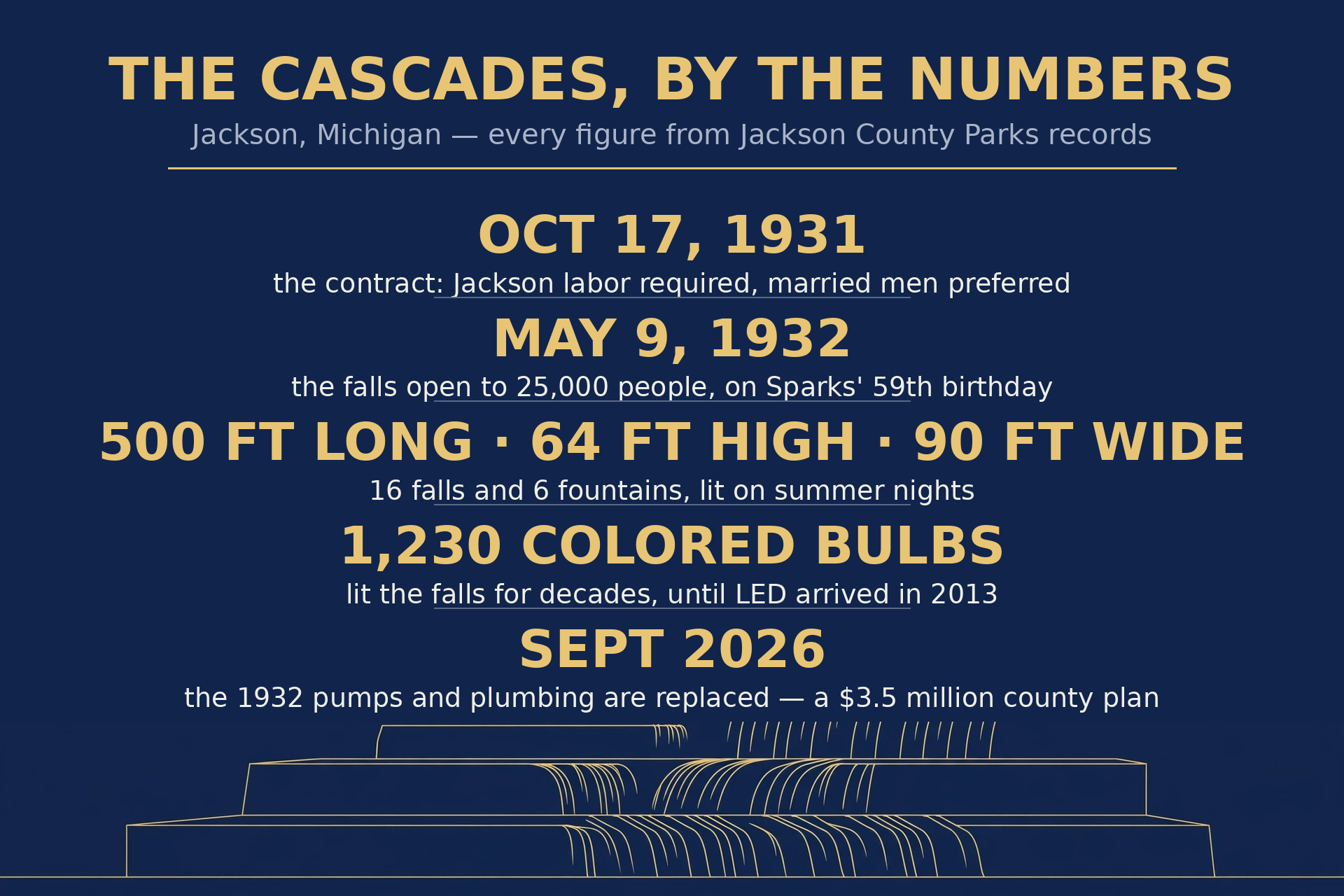
FACT: Ninety-five years ago this past Saturday — October 17, 1931, with the Great Depression at its deepest — Jackson County’s Sparks Foundation awarded a construction contract with two clauses that read less like engineering than like a relief program. The builder would use Jackson labor. And married men would be shown preference.
FACT: This fall, for the first time, the machinery underneath that contract is being torn out. Jackson County Parks reports that construction officially started in September 2026 on replacing the pumps and plumbing of the Cascade Falls — and that much of what is being replaced is original from 1932. The landmark is being re-plumbed in the same season its Depression-era contract turns ninety-five.
FACT: The Cascades is the illuminated waterfall at the heart of Sparks Foundation County Park: 500 feet long, 64 feet high, 90 feet wide, with six fountains, sixteen falls — eleven of them illuminated — and 126 steps climbing each side. A 2,000-gallon-per-minute pump filters, chlorinates, and recirculates its water in a closed loop. On summer nights it runs choreographed light-and-water shows, and it has been Jackson’s front porch since before most of the city’s living residents were born.
FACT: The man behind it arrived in Jackson in 1882, a nine-year-old immigrant from England named William Sparks. He clerked in a grocery store at fourteen, putting in fourteen-hour days, and in 1900 he joined the Withington brothers to form the Sparks-Withington Company. It started with a dozen employees making buggy parts. By 1929 it employed more than 7,000 people, riding the automobile age and selling products like the Spartan Radio and Horn. Sparks served three terms as Jackson’s mayor. His nickname — “Captain” — came from commanding the Jackson Zouaves, a drill team famous for marching 300 steps a minute with Enfield rifles.
FACT: It was on a trip to Barcelona with the Zouaves, the county’s history records, that Sparks saw a fountain and formed the idea for the Cascades — the fountain county histories identify as the Magic Fountain of Montjuïc. Back home, directly west of the Sparks house at West and Kibby, lay acres of swampy bog land. His first plan for it was modest: a skating pond. The plan grew — a championship golf course, lagoons, a canal, toboggan slides, landscaped picnic grounds, a clubhouse, and at the center of it, the falls. In the fall of 1929, weeks from the crash that opened the Depression, William and Matilda Sparks set up their foundation to build it.
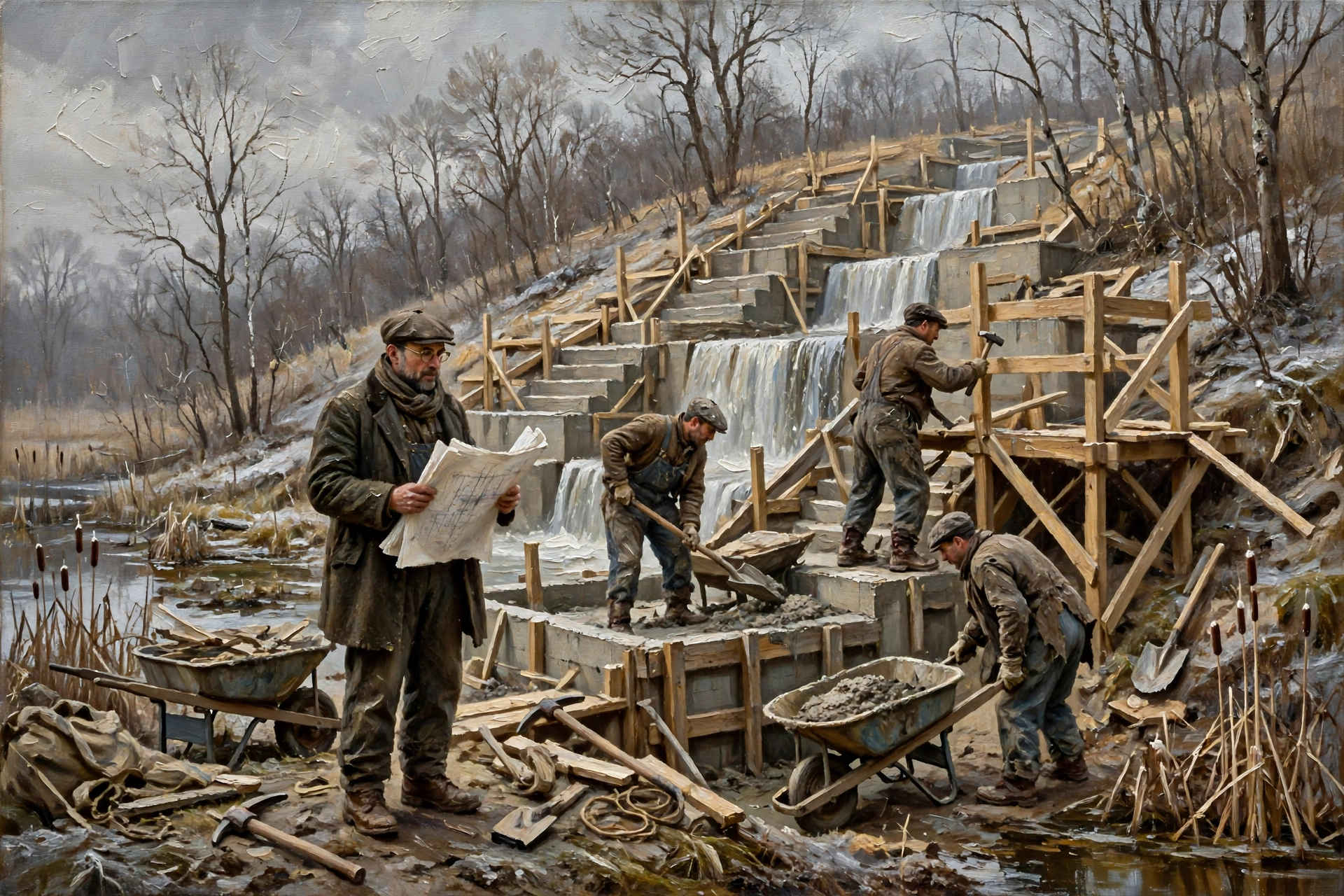
FACT: Engineers tested the idea first with a ten-foot scale model. Then, on October 17, 1931, the contract went to the North-Moller Construction Company — nearly all the work except the electrical — with a hard deadline of April 26, 1932, the Jackson-labor clause, and the married-men preference written in. Jackson Magazine’s history of the falls puts the crew at about eighty men: all Jackson men, with preference given to those with families. Through the winter of 1931–32, in the worst economy the country had ever known, those men poured and plumbed a 500-foot concrete waterfall on a swamp — and finished on schedule.
FACT: The falls opened on May 9, 1932, to a crowd of 25,000 people. It was Captain Sparks’ fifty-ninth birthday. Jackson County’s history preserves a description of that first night, from Guy C. Core: as dusk thickened and water splashed down the concrete falls into the reflecting pools, “powerful lights flashed on and the colorful, fast changing spectacle drew gasps of admiration from the assembled throng.” Word of the spectacle spread around the country and the world. Jackson, a factory town flat on its back, suddenly had a wonder in it — one its own unemployed men had built.
FACT: Sparks died in 1943, at seventy, and shortly after his death the entire 465-acre foundation park, Cascades included, was given to Jackson County. The county has run it ever since — through a “Save the Cascades” rescue in 1969–70 after vandalism and decay nearly closed it, a “Cascades Rebirth” in 1982–83, concrete work in the nineties, and a splash pad in 2017. Millions of visits have stacked up across ninety-four years: first dates, family Wednesdays, fireworks on the summer holidays, grandparents who were brought as children bringing children of their own. The rhythm still runs every summer — Family Fun Night on Wednesdays, live music on Saturdays at the Rotary Bandshell in the same park, the falls lit from eight to eleven, Memorial Day to Labor Day.
FACT: One honest correction to the legend, because this story deserves it straight. The falls were not untouched for ninety-four years. The county replaced the fountain pumps and controls in 1998–99, swapped the falls’ 1,230 colored incandescent bulbs for LED in 2013, and renewed the fountain pumps and motors again in 2019. What never got replaced — the part of the machine that is genuinely a 1932 survivor — is the underground works: the plumbing network and the pump room poured and piped when the falls were built. That is what the county says is original, and that is what this fall’s project finally retires.
The Argument
COMMENTARY: Read the two clauses again, because they are the whole story in miniature. In October 1931, nobody in Jackson needed a waterfall. Men needed wages, and married men with families needed them first — so a private citizen with a foundation wrote the need into a construction contract and paid for the wonder anyway. The Cascades was not a WPA project or a New Deal program; Washington’s famous jobs programs did not exist yet. It was a hometown jobs program a year and a half early, disguised as a fountain, funded by the profits of the same factory economy that was collapsing around it.
COMMENTARY: And notice what the contract bought. Not a monument to Sparks — a machine for gathering. Ninety-four years of Jackson’s common life have run through that park: the county fair crowds, the Wednesday family nights, the couples who met on those steps. The falls outlasted the company that paid for them, the Depression that provoked them, and very nearly the county’s ability to keep them. When Fox 47 cameras showed cracking concrete and worn pumps in September 2024, and an anonymous donor answered with a million dollars that spring, Jackson was not really arguing about plumbing. It was deciding whether the gathering place gets a second century.
COMMENTARY: There is a quieter lesson in the timing. The 1931 contract and the 2026 construction start are the same gesture, ninety-five years apart: in a hard season, do the work, hire it done properly, and build the thing that holds people together. The first generation built it with married Jackson men on winter wages. This generation’s job is smaller and less romantic — pipes, pumps, a pump room — and it is exactly as important, because machinery is where landmarks actually live or die.
FACT: The road to this fall’s work was long. An engineering inspection in 2012 produced a capital improvement plan for the falls; the lighting went LED the next year; the county passed a parks millage in 2018 that raised money for falls improvements; and the crumbling concrete drew television cameras in 2024 before the anonymous million arrived. The present-day work is the largest commitment the falls have asked of Jackson in decades. The county’s revitalization campaign puts the need at $3.5 million to preserve the Cascades for another hundred years; $1.9 million has been committed by local champions, aimed at the concrete and the pump room, alongside the million-dollar anonymous gift of 2024. A design and engineering process ran through 2025, and in September 2026 the construction itself officially started: replacement of the pumps and plumbing, funded by grants, donations, and park millage money. The county’s stated hope for the upgrades is plain — that they “help ensure that the Cascades is around for another 100 years.”
FACT: So this fall, crews are under Jackson’s landmark doing 1932’s unfinished business: retiring the last big pieces of the original machine, the ones that carried sixteen falls and six fountains through ninety-four summers. Above them, the concrete steps that North-Moller’s Jackson men poured through a Depression winter still climb both sides of the water. The contract that built them turned ninety-five on Saturday. The waterfall the Depression built is getting new works — so that the next crowd of 25,000, whenever it gathers at dusk, still gasps on cue.
Want Jackson’s top local stories in one place? Browse the businesses shaping the area in the NeighborClick Local directory — JOIN the FREE Private Insider List for local stories, business spotlights, community updates and even if you don’t have business you’ll be an Insider.


Comments