


Every month, small business owners open their analytics dashboards and stare at the same headline number: how many people visited the website. When the number climbs, it feels like winning. When it stalls, panic sets in. But after watching businesses chase that number for years, one uncomfortable truth keeps proving itself: the traffic number on your dashboard is not the scoreboard. Revenue is.
This guide breaks down what organic traffic really is, how it compares with every other channel sending visitors your way, and why the quality of your visitors matters far more than the quantity. You will also get honest 2026 timelines for SEO, a clear-eyed look at how AI Overviews are reshaping search, and a practical starting plan built for small and local businesses.
The Argument
Here is the thesis of this entire article: better visitors beat bigger numbers. Ten thousand casual browsers who bounce in eight seconds will never outperform five hundred motivated buyers who arrived with a problem your business solves. A visitor who finds you through a specific search, reads your content, and starts to trust your expertise is worth more than a hundred accidental clicks. Everything that follows — channels, conversion rates, SEO timelines, content strategy — is the practical machinery for attracting better visitors instead of merely more of them.
What Is Organic Traffic—and How Does It Compare With Other Channels?
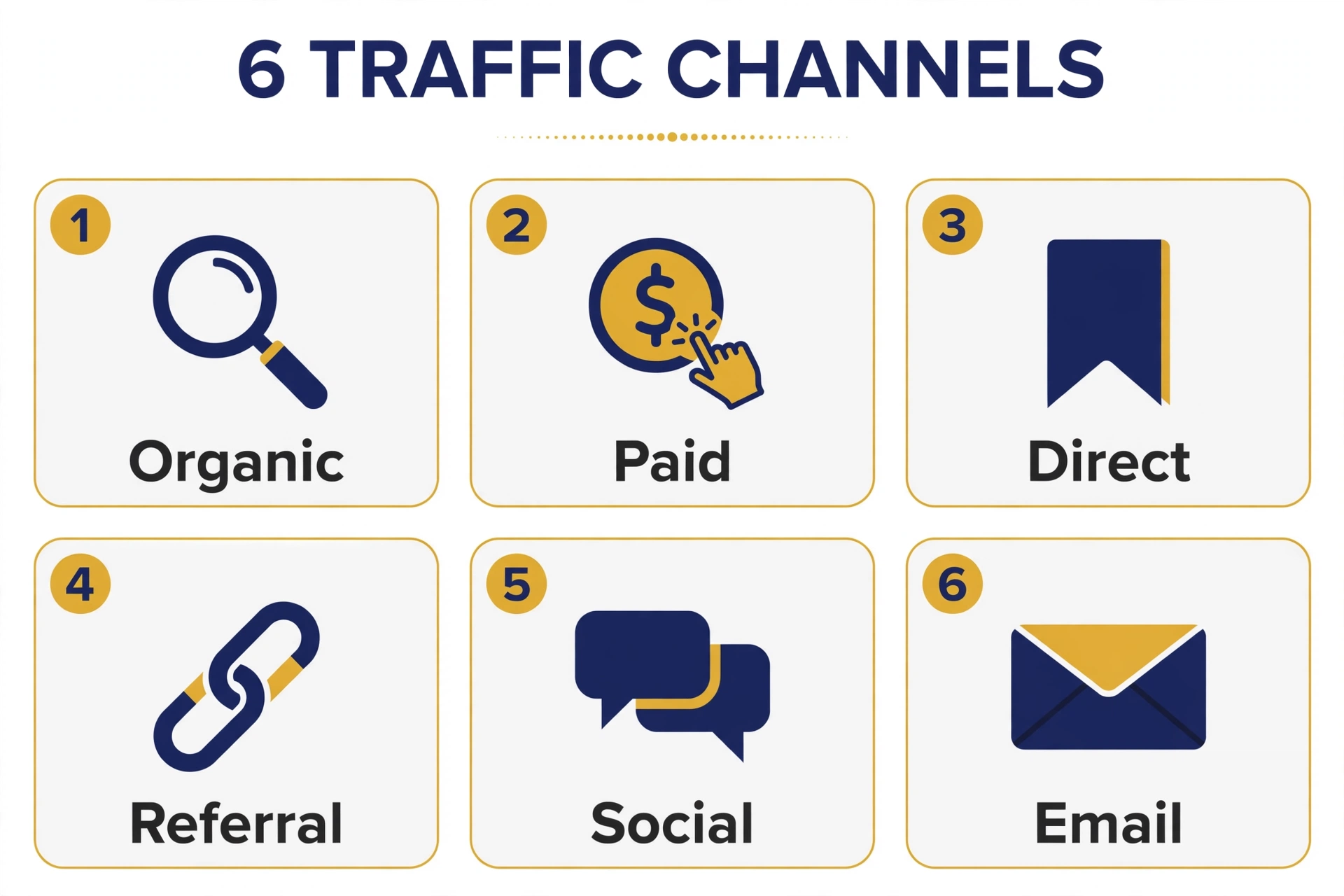
“Website traffic” is the umbrella term for every visit your site receives. “Organic traffic” is one slice of that pie: visitors who arrive from unpaid search results because a search engine decided your page was the best answer to their query. To understand why organic traffic is so prized — and where it falls short — compare it with the four other channels.
Organic search
Organic search visitors arrive with intent. They typed a question or a need into a search engine, and your page earned the click without you paying for it. This traffic compounds: a strong article can keep delivering visitors for years, and the effective cost per visit drops toward zero over time. The tradeoff is speed and control. You cannot buy your way to the top of organic results, and algorithm updates can move your rankings overnight.
Paid traffic
Paid traffic — search ads, social ads, display — is the faucet you control. Turn on spend and visitors arrive within hours, precisely targeted by keyword, interest, or geography. It is perfect for testing offers and filling short-term gaps. But the moment you stop paying, the traffic stops, and costs climb as competition for attention increases. Paid traffic rents attention. Organic traffic builds an asset.
Direct traffic
Direct traffic is people who type your address, use a bookmark, or click a link your analytics cannot identify. It is the footprint of brand awareness — customers who already know you exist. You cannot buy direct traffic outright; you earn it through reputation, repeat business, and offline visibility. For local businesses, a healthy share of direct traffic is a sign your name is getting around town.
Referral and social traffic
Referral traffic arrives from links on other websites; social traffic comes from platforms like Facebook, Instagram, TikTok, and LinkedIn. Both are discovery channels — people were not necessarily looking for you, but something interesting interrupted their scroll. Social can spike dramatically, since one viral post can dwarf a month of search traffic, but it is volatile and visitor intent is usually low. Referrals from respected sites, on the other hand, deliver both visitors and credibility.
Email traffic
Email traffic comes from your own list — subscribers who opted in and clicked through. It is the most controllable channel you own: no algorithm stands between you and the inbox. A subscriber list is an asset that appreciates over time. Every piece of content you publish gives you another reason to show up in inboxes and bring people back to your site.
Why Does Traffic Quality Matter More Than Volume?
Traffic volume is a vanity metric when it is divorced from intent. A thousand visitors who found you while researching exactly what you sell will always outperform ten thousand who arrived by accident and left in seconds. High-intent visitors convert at dramatically higher rates, cost less to acquire over time, and send positive engagement signals — longer visits, more pages viewed, fewer bounces — that search engines notice.
Think of it as arithmetic. Ten thousand visits converting at 0.1 percent produce ten customers. Five hundred visits converting at 5 percent produce twenty-five. The smaller audience wins by a wide margin, and it does so while costing less in hosting, ad spend, and support time. Chasing raw volume without filtering for intent is how businesses end up with impressive graphs and empty cash registers.
What Is a Good Website Conversion Rate?
Conversion rate — the percentage of visitors who take a desired action — is the number that turns traffic into business. Across industries, average website conversion rates typically sit between 2 and 4 percent. Ecommerce sites often land around 1 to 3 percent, while lead-generation and local service sites frequently see 5 percent or more, especially on phone calls and quote requests where intent runs hot.
Benchmarks are only a starting point, though. What moves your number is far more controllable than most owners realize: a clear offer stated in plain language, pages that load fast and work flawlessly on phones, visible trust signals like reviews and real photos, and one obvious next step instead of five competing buttons. Small improvements compound — lifting conversion from 2 to 3 percent is a 50 percent increase in customers from the same traffic.
What SEO Fundamentals Still Matter in 2026?
Tactics change, but the foundations of search visibility have been remarkably stable. In 2026, these five fundamentals still decide who wins organic traffic.
Match search intent with genuinely helpful content
Every query carries an intent: learn, compare, or buy. Pages that satisfy the intent behind the keyword outrank pages that merely repeat it. Original insight, real examples, and clear answers beat thin rewrites of what already ranks.
Technical health: speed, mobile, and Core Web Vitals
Most local searches happen on phones, and slow pages bleed visitors before they ever read a word. Fast loading, mobile-friendly layouts, and solid Core Web Vitals scores remain table stakes — they will not win you rankings alone, but their absence will quietly lose them.
E-E-A-T and topical authority
Search engines increasingly reward demonstrated experience, expertise, authoritativeness, and trust. For small businesses, this is an advantage: real credentials, genuine customer stories, and deep coverage of your niche are things large generic sites cannot fake.
Local SEO: your Google Business Profile, reviews, and consistency
For businesses serving a geographic area, local SEO punches far above its weight. A complete and active Google Business Profile, a steady stream of genuine reviews, and consistent name-address-phone details across the web decide who appears in the local map pack — often the most valuable real estate in local search.
Structured data and schema markup
Schema markup helps search engines understand your content — your business hours, services, FAQs, and articles — which can earn rich results like star ratings and FAQ dropdowns. It is one of the highest-leverage technical tasks a small site can complete in an afternoon.

How Are AI Overviews Changing Organic Traffic?
AI Overviews — the generated answers appearing at the top of search results — are reshaping what organic traffic looks like. Simple informational queries increasingly get answered on the results page itself, which means fewer clicks for basic “what is” content. This is the rise of zero-click search, and it is real.
But reports of SEO’s death are greatly exaggerated. What still earns clicks in the AI-Overview era: original data and research that models quote, first-hand experience no model can replicate, local relevance for “near me” queries, commercial and comparison content where buyers want depth, and brand searches from people who already know you. The winning move is to become a cited source — structure content with clear headings, direct answers, and quotable facts — while building direct channels like email that no algorithm can take away.
How Should a Pillar-and-Cluster Content Strategy Work?
A pillar-and-cluster strategy organizes your content the way search engines think: by topic, not by keyword. You create one comprehensive pillar page covering a core topic your best customers care about — say, “roof replacement” for a roofer — then publish a cluster of detailed articles answering specific long-tail questions, each linking back to the pillar and to each other.
This structure builds topical authority: instead of ten disconnected posts, you own a visible library on one subject. Internal linking spreads ranking power across the cluster, and visitors naturally journey from a specific question to your comprehensive guide to your contact page. For a small business, three to five well-built clusters can cover nearly everything customers ever ask.
How Should Social Media and Paid Advertising Support Content?
Think of content as the asset and social and paid as the distribution system. Every article you publish gives you a week of social posts — quotes, tips, short videos — that drive discovery traffic back to the site. Paid advertising then accelerates what already works: put spend behind your best-performing content, retarget visitors who read but did not convert, and use ads to test headlines and offers before committing months of SEO effort.
The golden rule: never build your house on rented land. Social followings and ad accounts are borrowed audiences. Use them to feed the assets you own — your website and your email list — and every dollar of distribution keeps paying dividends long after the campaign ends.
Why Does Email Have a Compounding Role?
Email is the only channel where your reach compounds without paying a platform for the privilege. Every visitor who subscribes becomes someone you can reach on demand — with new content, seasonal offers, and reminders — at essentially zero marginal cost. A list of a thousand engaged subscribers will reliably outperform ten thousand social followers you cannot reliably reach.
The compounding math is simple: content attracts visitors, a share of visitors subscribe, and each email you send brings subscribers back while new content keeps adding more. Start with one clear signup offer — a useful checklist, a local guide, a first-visit discount — placed on every page, and treat every subscriber as the most valuable visitor you have, because they are.
How Long Should Small and Local Businesses Expect SEO to Take?
Here is the honest answer nobody selling SEO wants to give: it depends, but plan in quarters, not weeks. Google Business Profile improvements and review velocity can move local map rankings in one to three months. Low-competition keywords on an established site often respond in three to six months. Competitive terms on a newer site typically need six to twelve months of consistent effort before the flywheel spins on its own.
What accelerates results: an older domain with existing authority, fast technical fixes, a steady publishing cadence, and genuine reviews arriving regularly. What slows them down: brand-new domains, thin or duplicated content, inconsistent business listings, and the classic mistake — publishing for three months, seeing little, and quitting right before momentum arrives. SEO rewards the patient and punishes the sporadic.
Frequently Asked Questions
What is the difference between organic traffic and website traffic?
Website traffic is the total of all visits to your site from every source. Organic traffic is the unpaid-search slice of that total — visitors who clicked your listing in search results without you paying for the click. All organic traffic is website traffic, but not all website traffic is organic.
How long does SEO take to work for a small business?
Expect early local signals in one to three months, meaningful keyword movement in three to six months, and compounding returns after six to twelve months of consistent publishing, reviews, and technical upkeep. Businesses that quit at month three almost always quit too early.
Is paid traffic worth it for a small business?
Yes — as an accelerator, not a foundation. Paid ads are ideal for testing offers quickly, promoting time-sensitive events, and retargeting warm visitors. The smartest small-business play is using paid traffic to build the email list and content audience that eventually reduces your dependence on ads.
Do AI Overviews mean SEO is dead?
No. AI Overviews reduce clicks for simple informational queries, but they increase the value of original research, first-hand experience, local relevance, and commercial-intent content. SEO is shifting from “rank for everything” to “be the source worth citing” — and the businesses adapting to that shift are still growing organic traffic.
What Should You Do First?
Overwhelmed? Start here. These seven steps, in order, give a small or local business the highest return for the least effort:
- Claim, complete, and actively maintain your Google Business Profile.
- Make sure your site loads fast and works flawlessly on phones.
- Pick one pillar topic your best customers care about and outline its cluster.
- Publish one genuinely helpful article on a schedule you can sustain.
- Put a clear call to action and an email signup on every page.
- Ask every happy customer for a review — and respond to each one.
- Track conversions, not just traffic, and review the numbers monthly.
Want Jackson’s top local stories in one place? Browse the businesses shaping the area in the NeighborClick Local directory (https://local.graylandcommerce.click/) — JOIN the FREE Private Insider List (https://local.graylandcommerce.click/join/) for local stories, business spotlights, community updates and even if you don’t have business you’ll be an Insider.


Comments