

The Argument
On Friday, November 20, 2026, WIBM enters its 100th year of broadcasting from Jackson, Michigan. Its first Jackson broadcast was November 20, 1927. That makes this the beginning of its hundredth local year, not its hundredth birthday. The centennial comes November 20, 2027. Before Jackson, WIBM was a portable station licensed in Chicago, built to move from town to town. When federal regulators moved to end portable broadcasting, its owner arranged a permanent home here.
Jackson saved a station that could no longer keep traveling. Something temporary became something lasting. Along the way, a stuttering teenager found work at its microphone, formats and call letters changed, and a printed typo muddled its age. The real story needs no borrowed years. It has plenty of its own.
A Station on Wheels (1925–1927)
WIBM was first licensed on June 3, 1925, to Billy Maine in Chicago, Illinois. Its call letters were randomly assigned from a sequential list. They stand for nothing.
It began as a portable broadcasting station. These stations traveled on movable platforms and were hired out for a few weeks at a time to theaters in small towns that had no station of their own. A January 1926 advertisement promoted WIBM theater broadcasts at Carbondale, Illinois.
Before WIBM had a lasting Jackson address, moving was the business. A theater could hire the station for a short run, and the station would move on when the run ended. That is almost the reverse of what we celebrate now. An anniversary honors the staying.
Toward the end of 1926, ownership passed to C. L. Carrell of Chicago. Carrell operated seven portable stations. WIBM was one of seven traveling operations under one owner. Nothing about that beginning suggested a station that would stay in one place for a hundred years.
Facing Deletion
In May 1927, the newly formed Federal Radio Commission warned that it would soon stop licensing portable facilities. The warning followed General Order No. 6, dated April 26, 1927. Facing deletion, Carrell arranged to move WIBM permanently to Jackson.
Traveling had been the station’s reason for being. Now its portable status threatened its ability to remain on the air. Saying Jackson saved WIBM is shorthand for that specific turn. Carrell found it a permanent home here when the traveling operation faced an end. What had been hired out for weeks would begin accumulating years in one city.
November 20, 1927
WIBM began broadcasting from Jackson on November 20, 1927, on 1370 kHz. Its studios were on the ninth floor of the building now called the Blake Building, at 180 W Michigan Avenue. At the time, it was known as the Reynolds Building.
That gives this history a place you can point to. Not simply “somewhere downtown,” but the ninth floor of a building with its own long Jackson story.
In 1930, ownership transferred from Carrell to WIBM, Incorporated. In 1941, under the North American Regional Broadcasting Agreement, the station moved from 1370 kHz to its current frequency, 1450 kHz. After several studio moves, WIBM began operating from 2511 Kibby Road in September 1948.
The address changed. The number on the dial changed. But the city did not. Moving studios no longer meant leaving town.
The Boy Who Only Stuttered When He Talked
Jack Paar, later the host of The Tonight Show from 1957 to 1962, worked as a part-time WIBM announcer in the mid-1930s. In his 1983 memoir, P.S. Jack Paar, he described quitting school at sixteen and becoming a radio announcer at WIBM.
By his own account, Paar had stuttered badly as a child and had tuberculosis at fourteen. He wrote that he never stuttered when reading, only when speaking spontaneously. At first, the station let him announce only its identification. His exact memory of that line was: “This is WIBM, in Radio Block, Jackson, Michigan. Eight o’clock, Bulova Watch Time.”
It is a small assignment to remember so precisely. Yet in Paar’s telling, those prepared words offered something ordinary conversation did not: a way to speak without the stutter.
By his own account in the memoir, Paar was given the night announcer job, from 9 P.M. until midnight. His other early duties included sweeping the floor and emptying the waste baskets. Those chores keep the story human. Before the famous television host, there was a young announcer with a late shift and waste baskets to empty.
His account does not establish that one job cured him. It tells us something more specific: reading and spontaneous speech were different experiences for him, and WIBM gave him words to read.
The Top 40 Years
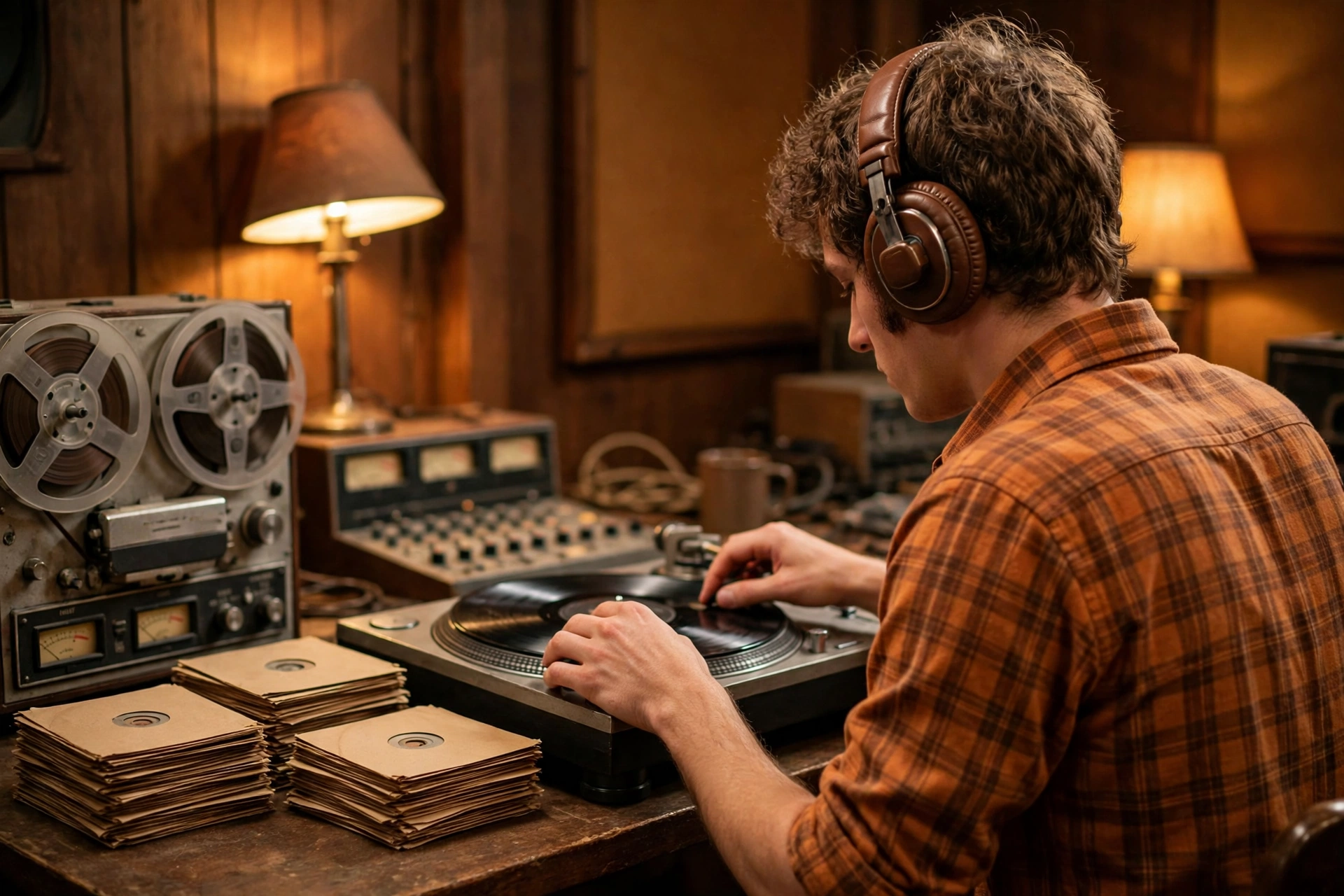
In the 1960s and 1970s, WIBM was the Jackson area’s Top 40 station. Casey Kasem’s American Top 40 was heard on WIBM throughout the 1970s. Bill Hennes, the broadcast consultant, was an afternoon-drive personality at WIBM in the early 1960s.
Here the story changes sound. Paar’s remembered station identification gives way to hit records, an afternoon-drive personality, and a countdown heard across a decade. The station’s history becomes easier to approach through the question: Which WIBM do you remember?
For someone whose connection began in these years, Top 40 may be its defining identity. That does not make the earlier chapters less important. It shows how one station can belong to different listeners in different ways. A long station history is not one unchanging program stretched across a century. It is a succession of reasons to tune in. The Top 40 years were one substantial chapter, not the beginning of WIBM, and not its final form.
The Wandering Call Letters
In 1980, the Top 40 format moved to WIBM’s FM sister at 94.1. The AM station became WXCM and adopted country music. In 1987, the WIBM call letters returned with an oldies simulcast of 94.1 WIBM-FM.
Cascades Broadcasting bought the station in 1994 and changed its calls to WCXI, with a country format. The WIBM calls returned again in 1995. In 1997, the station adopted soft adult contemporary programming as “Easy Relaxed 1450 AM.” It switched to an ESPN Radio sports format in March 1999. Longtime sports host Greg O’Connor has broadcast on WIBM since 2000.
This stretch asks readers to keep two things separate: the station’s continuing history and the name or format it used at a particular moment. The letters disappeared and returned. The programming changed. Those changes belong in the story rather than outside it. It would be tidier to describe a century under one name, playing one kind of music. It would also be wrong. The changes are part of the station’s story, not a detour from it. The letters had no hidden meaning when assigned. Their local associations came afterward, through years of use in Jackson.
The Power Cow
In 2014, WIBM was also heard on 101.9 FM. On June 30, 2016, it changed from sports to country, branded “95.9 The Power Cow.” It is heard on translator W240DG at 95.9 FM.
Effective December 12, 2019, Jackson Radio Works sold WIBM, two sister stations, and three translators to McKibbin Media Group, Inc. for $3.8 million. That price covered the group of stations and translators, not WIBM alone. Jamie McKibbin, who lived from 1977 to 2020, founded the group with his wife, Katina. Katina McKibbin is now its president and owner. WIBM’s sister stations include WKHM, the 970 AM news/talk station, and WKHM-FM, “K105.3.”
Today, WIBM is a country station heard on 1450 AM and 95.9 FM. Its weekday schedule includes The Bobby Bones Show from 6–10 a.m., Connor Dockery from 10 a.m.–2 p.m., and “The Captain” Steve Boyle from 2–7 p.m. Its studios are at 1700 Glenshire Drive in Jackson. The AM signal is 810 watts. The anniversary belongs to that working station, too. The history reaches a current address, a current lineup, and a current sound.
The Typo That Stole Three Years
Some references incorrectly give WIBM’s Jackson debut as November 20, 1924. The WIBM entry in the 1958 edition of Broadcasting Yearbook is one example. The year is a typographical error. The correct date is November 20, 1927.
The typo moves the Jackson beginning three years too early. It takes the station’s actual chronology and substitutes an older one. A wrong date can look settled simply because it appears in a reference book. Repetition can harden the mistake, making a correction seem less familiar than the error.
WIBM’s original license dates to June 3, 1925. Its Jackson broadcasting dates to November 20, 1927. The erroneous date describes neither beginning. Accuracy does not diminish the anniversary. The real history already offers more than enough to remember.
The 100th Year
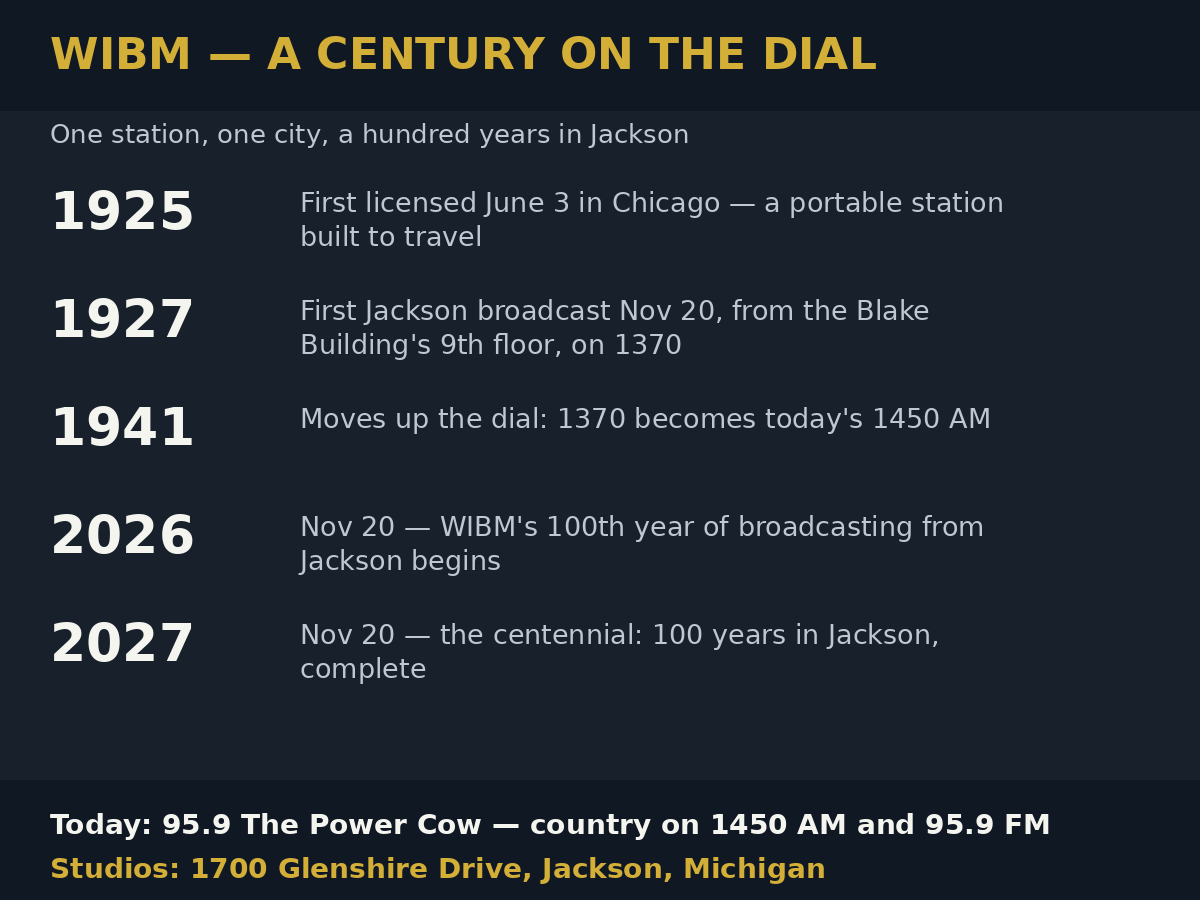
WIBM’s hundredth year of broadcasting from Jackson runs from November 20, 2026, through November 19, 2027. On November 20, 2026, it completes 99 years here and begins year 100. Its hundredth Jackson birthday falls on November 20, 2027.
The Blake Building celebrated its own hundredth anniversary in September 2026. WIBM first broadcast from its ninth floor when the building was about a year old. Their anniversaries sit close together, but they mark different beginnings. The building reaches a hundred before the station completes a hundred years of broadcasting from Jackson.
Giving WIBM its full hundredth year allows room for the whole account. Not just the famous announcer. Not just the Top 40 years. Not just the name currently heard on the air. The portable beginning matters because it explains how unlikely permanence once was. The changes matter, too. Staying in Jackson did not mean standing still. Frequencies, studios, formats, and call letters all changed. The city remained the constant.
This November begins the hundredth year. Next November completes it. Between those dates sits a chance to remember how a station built to leave became a station that stayed.
FAQ
When did WIBM start broadcasting in Jackson?
November 20, 1927, from the ninth floor of the Reynolds Building, now the Blake Building.
How old is WIBM, exactly?
Its license dates to June 3, 1925. On November 20, 2026, it completes 99 years of broadcasting from Jackson and begins its hundredth local year. Its Jackson centennial is November 20, 2027.
What frequency was WIBM on originally?
Its first Jackson frequency was 1370 kHz. It moved to 1450 kHz in 1941.
Did Jack Paar really work at WIBM?
Yes. He was a part-time announcer in the mid-1930s; by his memoir account his work included station identification, night announcing, sweeping, and emptying waste baskets.
What do the call letters WIBM stand for?
Nothing. They were randomly assigned from a sequential list.
Why do some sources say WIBM began in 1924?
That year is a typographical error found in references including the station’s 1958 Broadcasting Yearbook entry. The correct Jackson debut was November 20, 1927.
What is WIBM today, and where can I hear it?
WIBM is a country station branded “95.9 The Power Cow,” heard on 1450 AM and on 95.9 FM through translator W240DG. Its studios are at 1700 Glenshire Drive in Jackson.
Where were WIBM’s first Jackson studios?
On the ninth floor at 180 W Michigan Avenue, in the building then called the Reynolds Building and now called the Blake Building.
Want Jackson’s top local stories in one place? Browse the businesses shaping the area in the NeighborClick Local directory — JOIN the FREE Private Insider List for local stories, business spotlights, community updates and even if you don’t have business you’ll be an Insider.


Comments