

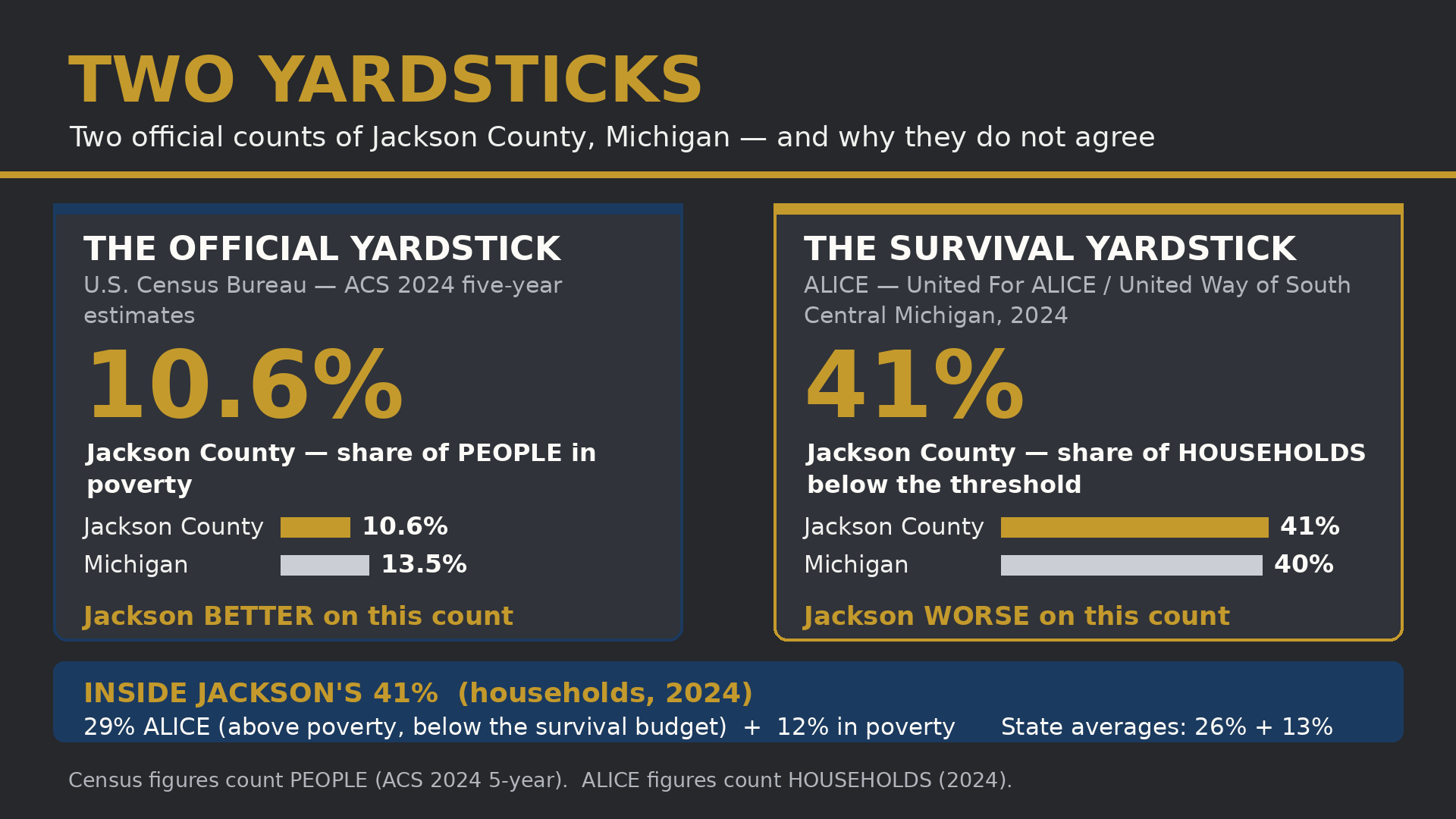
FACT: Two official-looking numbers describe Jackson County, and they do not agree. By the Census Bureau’s count, 10.6% of Jackson County’s people lived in poverty in the ACS 2024 five-year estimates — 15,949 people — against 13.5% of people statewide. By the survival-budget count, 41% of Jackson County’s households could not afford the basics in 2024, against 40% of households across Michigan. On the first yardstick, this county beats the state. On the second, it trails it. Both numbers are real, both come from serious counting, and the distance between them is where a large share of Jackson County actually lives.
FACT: The two numbers are not measuring the same thing, and that is the point. The Census rate compares household income against the Federal Poverty Level, a single federal line. The ALICE measure — tracked nationally by United For ALICE and locally by the United Way of South Central Michigan — compares income against a Household Survival Budget priced for the county where a household actually lives. One yardstick asks who has fallen below a national floor. The other asks what it costs to stand up in Jackson County.
FACT: The survival budget is not a comfortable life. It prices housing, child care, food, transportation, health care, and technology, plus taxes — and the report that builds it calls it “a minimal budget, with no room for emergency expenses, debt payments, or saving for the future.” The United Way of South Central Michigan’s own summary of the 2024 figures is plainer: households below the threshold “couldn’t afford the basics.”
FACT: Look at how Jackson County’s 41% is built, because the split is the story. In 2024, 29% of the county’s households were ALICE — above the poverty line, below the survival budget — against a state average of 26%. Another 12% of households were in poverty, below the state average of 13%. Add them and roughly 26,013 of the county’s 63,446 households fell below the threshold. Jackson does not have more deep poverty than Michigan. It has more of the in-between: households past the official line that still cannot cover a bare-minimum budget priced in their own county.
FACT: The state ALICE report illustrates what that in-between looks like with two full-time jobs. A family of four with two full-time workers, a cook and a teller earning $62,946 a year combined, falls about $15,000 short of the $78,216 family-of-four Household Survival Budget. Two paychecks, full time, and the arithmetic still does not close. Coverage of the same 2026 report put a wider frame around it: MLive reported that 36% of Michigan’s full-time workers did not earn enough to cover the survival budget for one adult and one child.
FACT: Honesty about who is being counted matters here. The ALICE figures count households below the threshold regardless of work status — the group includes people working full time, and it also includes retirees, people between jobs, and people who cannot work. In the six-county region’s 2023 figures, 49% of households headed by someone 65 or older were below the threshold. Nobody honest gets to call this only a story about workers. But nobody honest gets to call it a story about people who do not work, either.
FACT: The strain concentrates where you would expect. In the six-county region the United Way of South Central Michigan serves — Calhoun, Clinton, Eaton, Ingham, Jackson, and Kalamazoo counties — the 2023 figures put 41% of households below the threshold, 171,521 households in all. Within that region, 74% of households led by a single mother with children were below the threshold, and so were 72% of households headed by someone 25 or younger.
FACT: The wider county picture makes the Jackson result harder to wave away. The county’s median household income is $66,155, against $72,389 statewide, on the same ACS 2024 five-year estimates. Jackson households earn less than the Michigan norm and still post a lower official poverty rate. A reader who checks other trackers may see Jackson’s poverty rate listed at 11.6% instead — those are different Census vintages measuring different windows. Every Census figure in this piece comes from the ACS 2024 five-year estimates, the same source, the same years, both sides of every comparison.
The Argument
COMMENTARY: The official poverty rate answers a narrower question than the one Jackson County households actually face. It counts who has fallen below a single federal line. It does not ask what rent, child care, and a tank of gas cost in this county, and it was never built to. A county can win that ranking outright — Jackson does, by nearly three points — while two in five of its households cannot cover a budget with no savings, no debt payments, and no cushion in it. That is not a contradiction in the data. It is a gap in what the headline number is for.
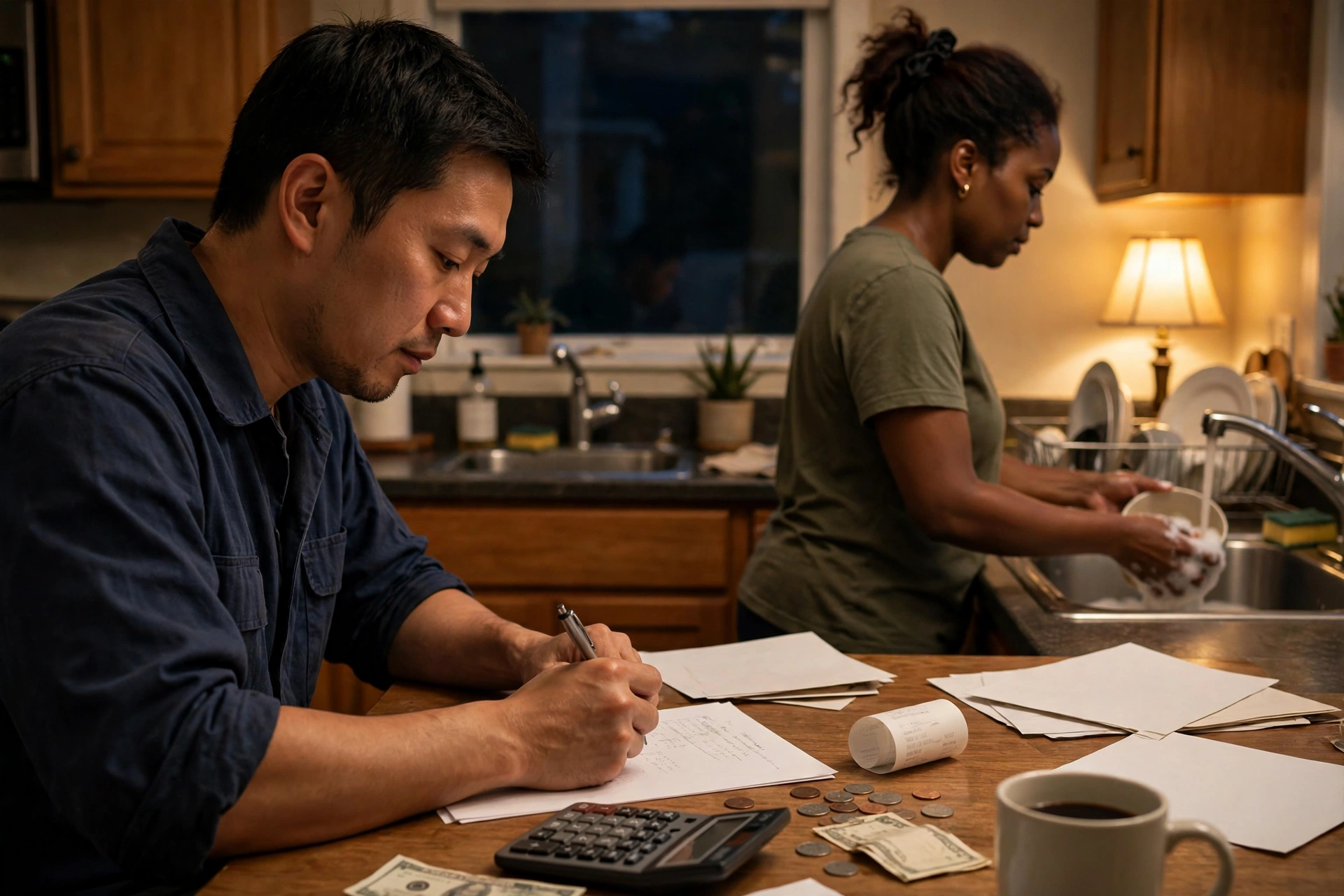
COMMENTARY: And notice where Jackson’s gap sits. The county’s problem is not concentrated at the very bottom; its poverty share runs below the state average. It is spread across the band above the line — the 29% of households who are, by the official count, fine. Those households do not show up in the poverty rate, do not qualify as poor, and do not appear in the rankings that say Jackson is beating Michigan. They appear at the kitchen table, doing arithmetic that does not close, one car repair away from a crisis the statistics will record as somebody else’s category. The people living in the gap between the two numbers are not an edge case in this county. At two households in five, they are close to the median experience.
COMMENTARY: The trend gives no rescue and no catastrophe, and the piece should say so plainly. Jackson’s below-threshold share was 42% in 2021 and 41% in 2024. The six-county region improved from 41% in 2023 to 39% in 2024. The numbers are moving, slightly, in the right direction — and the gap is still there, roughly two households in five, year after year. This is not a spiral. It is a stuck condition, and stuck conditions are the ones communities stop seeing precisely because they never make a dramatic headline.
FACT: So the two numbers stand, both verified, measuring different things. In the ACS 2024 five-year estimates, 10.6% of Jackson County’s people lived in poverty, better than Michigan’s 13.5%. In 2024, 41% of Jackson County’s households — about 26,000 of them — lived below a bare-minimum survival budget, worse than Michigan’s 40%. The first number says the county is winning. The second says two in five of its households cannot afford the basics where they live. The story of Jackson County’s economy is not in either number alone. It is in the people standing between them, counted as fine by one yardstick and underwater by the other, waiting for somebody to ask which number the county plans to believe.
Want Jackson’s top local stories in one place? Browse the businesses shaping the area in the NeighborClick Local directory — JOIN the FREE Private Insider List for local stories, business spotlights, community updates and even if you don’t have business you’ll be an Insider.


Comments