
COMMENTARY: There is a particular kind of stress that only business owners know: the books say the month was good, customers are happy, work is booked — and the bank account still feels thin. That gap is rarely a sign that the business is failing. More often, it is a timing problem. Money earned and money in hand are two different events, and the distance between them is called cash flow. Understanding that distance is the difference between panic and planning.
This piece looks at cash-flow timing through a simple scientific lens: inflows and outflows move on different clocks, seasons push those clocks around, and a business can be genuinely profitable on paper while briefly short of cash in real life. Being early — paid late relative to your bills — is not the same as being broke.
The Argument
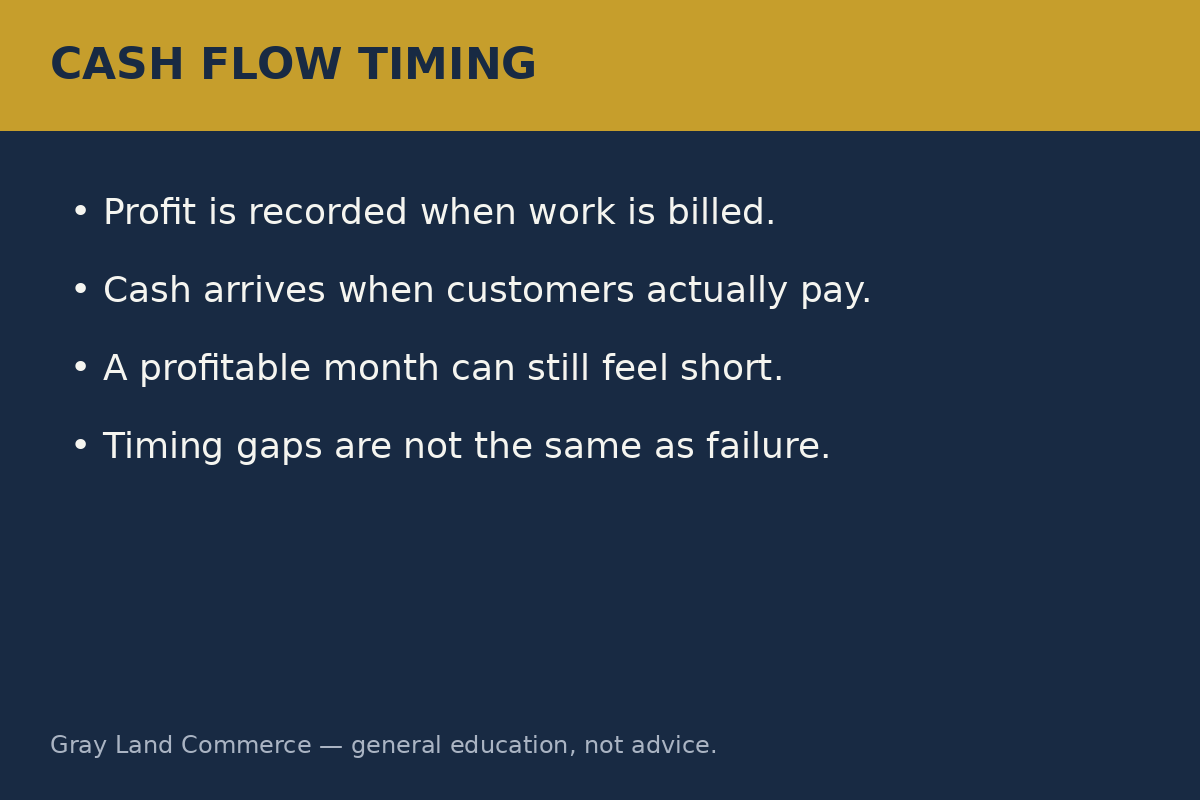
FACT: Profit is calculated when revenue is earned and expenses are recorded; cash flow tracks when money actually arrives and leaves. A business can show a profit for a month and still face a cash shortage in that same month if customers pay after suppliers, rent, and payroll come due.
COMMENTARY: That is the whole argument: most ‘broke’ feelings in a healthy business are really ‘early’ feelings. The sale happened. The value was delivered. The cash simply has not landed yet. Naming the problem correctly matters, because a timing problem has timing solutions — while a true profitability problem needs a different fix entirely.
Why Timing Gaps Happen: The Science of Inflows and Outflows
Cash moves through a business the way water moves through a watershed: it pools in some places and runs thin in others. Invoices sent today may be paid in two weeks or sixty days. Meanwhile rent, payroll, inventory, and taxes leave on fixed dates that do not wait for anyone’s payment terms. When several outflows land before the inflows they were meant to match, the account dips — even in a growing business. Growth can widen the gap, because a bigger month often means buying more inventory and doing more work before the larger payments arrive.
Seasonality adds a second rhythm. In Jackson, Michigan, winter slows some trades and empties some sidewalks, while spring and summer surge. A landscaper, a retailer, and a tax preparer all live on different calendars. None of those calendars is broken; they are simply out of phase with a monthly bill cycle that never changes. Reading your own business’s seasons — which months reliably run heavy, which run light — turns surprises into expectations.
Habits That Smooth the Gaps
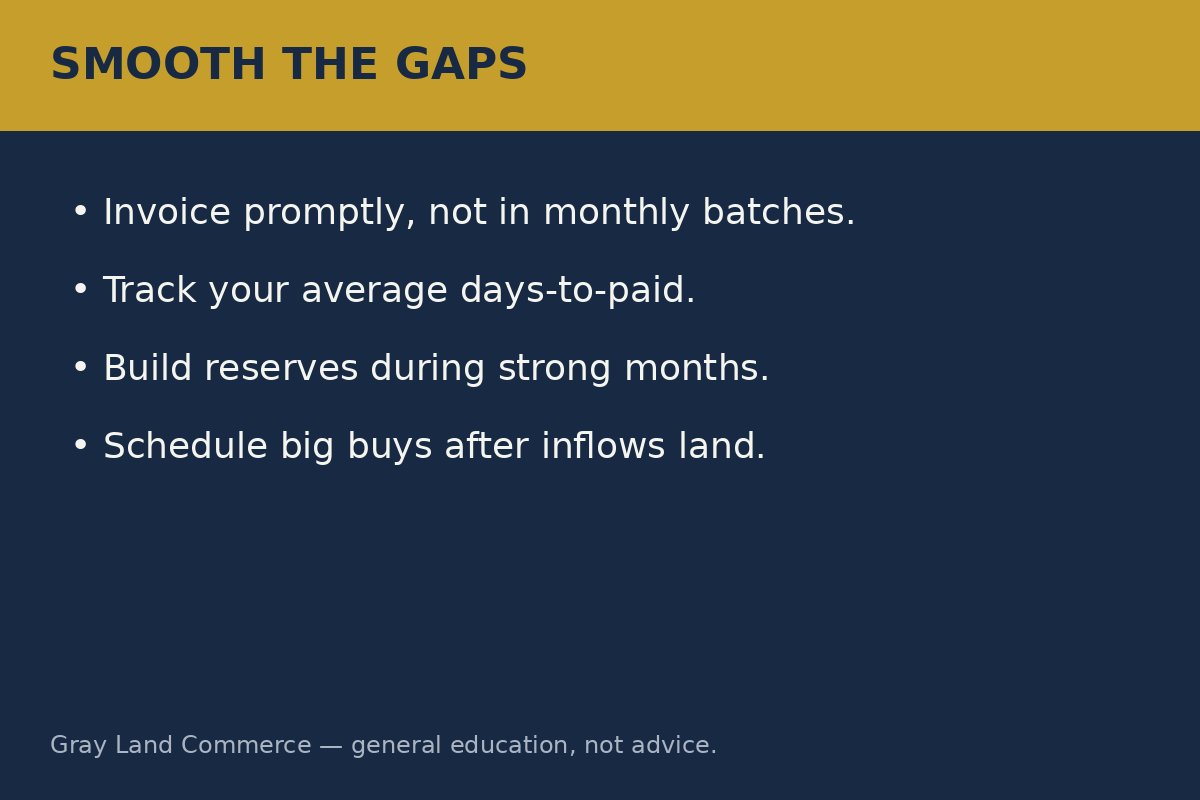
Owners who handle timing well tend to share unglamorous habits. They invoice promptly instead of in batches at month’s end. They know their average days-to-paid the way a farmer knows first frost. They keep a modest cash reserve built during fat months specifically to carry the lean ones, and they schedule big purchases for just after predictable inflows rather than just before. None of this requires new revenue. It requires seeing the calendar as clearly as the ledger.
It also helps to separate the two questions owners often blur together: ‘Are we earning enough?’ and ‘Is the money arriving in time?’ The first is answered by margins over a season. The second is answered by a simple weekly look at what is due in, what is due out, and when. A business that watches both numbers stops mistaking an early month for a failing one — and stops borrowing in a panic to solve a problem a calendar could have prevented.
Frequently Asked Questions
What is the difference between being broke and being early?
Being broke generally means the business does not earn enough to cover its costs over time. Being early means the earnings exist but the cash has not arrived yet — customers owe money that is scheduled to come in after bills are due. The first is a profitability problem; the second is a timing problem.
Why can a profitable business run out of cash?
Because profit is recorded when work is billed, while cash arrives when customers pay. If payment terms run 30 to 60 days and expenses are due immediately, growth itself can strain cash even as profits rise.
How does seasonality affect cash flow in Michigan?
Many Michigan businesses earn unevenly across the year — strong summers, slow winters, or the reverse. Fixed costs stay level while revenue swings, so owners commonly build reserves in strong months to cover predictable light ones.
What is the simplest first step to fix a timing gap?
Map the next four to eight weeks: list expected inflows with realistic payment dates and outflows with due dates. Seeing the gap on paper, early, usually reveals a practical fix — faster invoicing, rescheduled purchases, or a planned reserve — before it becomes a crisis.
Want Jackson’s top local stories in one place? Browse the businesses shaping the area in the NeighborClick Local directory — JOIN the FREE Private Insider List for local stories, business spotlights, community updates and even if you don’t have business you’ll be an Insider.


Comments