

The Argument
A smaller creator can produce a bigger response per follower—and a collaboration built around lasting content can keep working after the original post disappears. Influencers and industry experts drive organic website traffic by introducing relevant audiences, prompting branded searches, creating searchable resources, and earning editorial attention and links. The opportunity is not a secret ranking shortcut. It is a distribution strategy that can become a durable publishing asset. Across the research brief’s benchmarks, smaller creators generally outperform larger accounts on engagement rate, although exact figures vary. The business question is what that attention leaves behind: another fleeting impression, or something customers can keep finding.[ppl-ai-file-upload.s3.amazonaws]
The Size of the Bet
Influencer marketing is no longer a side experiment. Influencer Marketing Hub’s benchmark data puts the global market at $32.55 billion in 2025. The brief’s accepted 2026 forecasts span $34.1 billion to $40.51 billion: Review42’s compilation of IMH/Statista figures supplies the lower forecast range, while Mordor Intelligence, cited through Ringly, supplies the upper estimate. These are forecasts from different sources—not a settled account of actual spending.[ppl-ai-file-upload.s3.amazonaws]
Market definitions also matter. IAB’s creator advertising figures, EMARKETER’s creator revenue estimates, and influencer marketing spending estimates measure different things. Combining them into one enormous number would make a stronger headline and a weaker article.[ppl-ai-file-upload.s3.amazonaws]
The widely repeated return figure deserves similar discipline. Influencer Marketing Hub reports $5.78 returned per dollar invested in its 2026 benchmark survey. That is vendor survey data, not a promise that a local business will receive $5.78—or that the return comes specifically from organic search.[ppl-ai-file-upload.s3.amazonaws]
For this strategy, “not paid” describes distribution, not necessarily compensation. A business may pay an expert, provide a product, or offer a commission without purchasing advertising reach. The resulting visits may arrive through unpaid social distribution, referrals, branded searches, or search-discovered content. Those channels should remain separate in measurement. A creator referral is not automatically an organic-search visit.[ppl-ai-file-upload.s3.amazonaws]
The Engagement Tier Gap
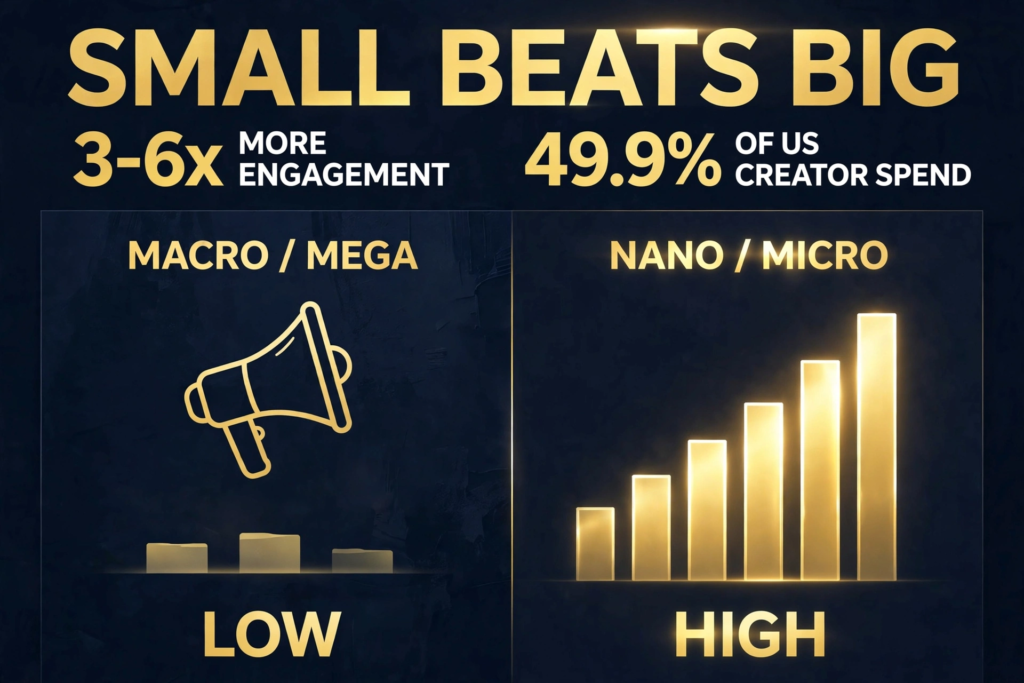
The research points consistently toward greater engagement density among smaller creators. It does not establish one universal engagement rate.
The Keepface comparison, drawing on HypeAuditor, Favikon, and Sociallyin-derived benchmarks, reports Instagram engagement of 4–6% for nano creators and 3.86% for micro creators, against 1.21% for mega accounts. But HypeAuditor’s 2025 figures, quoted by SocialPilot, put nano engagement at 1.73% and micro engagement at 0.68%. Different samples and measurement methods produce substantially different levels. The brief’s defensible synthesis is roughly three to six times the engagement rate of mega-tier accounts—not one supposedly definitive benchmark.[ppl-ai-file-upload.s3.amazonaws]
The practical tiers are:
- Nano creators: approximately 1,000–10,000 followers.
- Micro creators: approximately 10,000–100,000 followers.
- Macro creators: approximately 500,000–1 million followers.
- Mega creators: more than 1 million followers.
Higher engagement per follower does not mean greater total reach. Nor does it guarantee website visits. A smaller creator becomes valuable when the audience, subject, and next action fit the business.
Price estimates also vary. The brief places nano posts around $10–$100 and micro posts around $100–$500, with some micro estimates extending to $1,000. Bundled deliverables can cost substantially more. These are rough US market ballparks for 2025–2026, not quotes or fixed tariffs.[ppl-ai-file-upload.s3.amazonaws]
For a Jackson business, the sensible comparison is not “small versus famous.” It is “relevant versus irrelevant.” The creator who regularly answers local customers’ questions may offer a better starting point than someone whose impressive audience lives nowhere near the business.
Ten Ways Collaborations Generate Organic Website Traffic
1. Blog-Based Creators Introduce Readers and Earn Links
A creator with a substantive website can publish an interview, review, or joint resource that directs readers to the business. Other publishers may discover and reference that material, extending its reach. The brief’s Influno and SideShift references emphasize linking to a useful product or landing page rather than sending every reader to the homepage.[ppl-ai-file-upload.s3.amazonaws]
The distinction is important: seek useful coverage and appropriate links, not a purchased ranking promise.
2. Expert Roundups Create Publishable Resources
A focused roundup assembles informed answers to one meaningful question. Contributors may share the finished resource, and other sites may cite it. The resulting asset combines expertise, distribution, and opportunities for earned backlinks.[ppl-ai-file-upload.s3.amazonaws]
The editorial test is usefulness. Twenty names attached to generic advice do not automatically make an authoritative resource.
3. Collaborations Prompt Branded Searches
Someone may hear a business mentioned, ignore the immediate link, and search for its name later. SideShift identifies changes in branded search volume as an important observable signal of creator activity. Compare branded queries before and after campaign waves, while recognizing that other marketing and seasonal demand can affect the same numbers.[ppl-ai-file-upload.s3.amazonaws]
A missing referral click does not necessarily mean the introduction failed.
4. Social Sharing Generates Referrals—not Automatic Domain Authority
Social links can bring visitors. They do not directly raise domain authority simply because they exist. The brief’s NoGood reference explicitly rejects that shortcut.[ppl-ai-file-upload.s3.amazonaws]
The plausible route is indirect: exposure encourages discovery, searches, repeat visits, and potentially later editorial coverage. Those outcomes can support a broader organic strategy. But correlation between visibility and rankings does not prove that social engagement itself caused a ranking increase.[ppl-ai-file-upload.s3.amazonaws]
5. Recognized Experts Strengthen Credibility
A qualified expert can make an article more trustworthy by explaining technical details, identifying limitations, and challenging unsupported claims. The brief connects this with Google’s experience, expertise, authoritativeness, and trustworthiness framework—E-E-A-T. It does not establish an expert endorsement as a direct ranking factor.[ppl-ai-file-upload.s3.amazonaws]
Use expertise to improve the information, not merely decorate the page with a recognizable name.
6. Repeated Partnerships Cross-Pollinate Audiences
An ongoing collaboration gives an audience repeated opportunities to discover a business. SideShift describes a consistent creator program as capable of building compounding SEO value. That is a strategic proposition, not a guaranteed growth curve.[ppl-ai-file-upload.s3.amazonaws]
The strongest version leaves behind multiple useful resources, rather than repeating the same promotional message.
7. Local Creators Connect Businesses With Local Questions
Local collaborators bring knowledge of neighborhoods, customer concerns, and area-specific language. The brief identifies that knowledge as useful for content addressing location-based searches and “near me” needs.[ppl-ai-file-upload.s3.amazonaws]
For a Jackson restaurant, salon, or shop, a locally relevant guide can connect the creator’s introduction with a practical destination on the business’s website.
8. Creator Content May Expand AI-Search Visibility
The brief reports NoGood’s findings from a Goodie AI eight-month study: social citations appeared 2.6 times as frequently as owned citations, with the difference widening to 4.1 times by August 2026. This is one agency’s reported study, not a settled industry-wide rule.[ppl-ai-file-upload.s3.amazonaws]
Treat it as an emerging opportunity. Useful third-party explanations may create another route to discovery, but this evidence does not guarantee that a particular collaboration will earn an AI citation.
9. Repurposing Produces Lasting Owned Assets
An interview can become an article. A webinar can become a transcript and a question-and-answer resource. Creator-made material can become website content when usage rights permit. SideShift recommends at least one blog- or YouTube-based deliverable per creator wave because searchable assets offer more lasting value than a Stories-only campaign.[ppl-ai-file-upload.s3.amazonaws]
The point is persistence: give the introduction somewhere useful to live.
10. Audience Language Improves Content Relevance
Creators hear how their audiences actually describe problems. The brief identifies that language as keyword-research material. Questions, objections, and recurring phrases can inform more relevant website content.[ppl-ai-file-upload.s3.amazonaws]
A collaboration can therefore deliver more than distribution. It can reveal which explanations the business has neglected.
Tactic Playbooks: Build Something Worth Finding
The Expert Resource
Choose one question that matters before purchase. Invite 10–20 relevant experts, following the brief’s roundup playbook. Edit for substance, distinguish areas of agreement from disagreement, and publish a resource each contributor can reasonably share.[ppl-ai-file-upload.s3.amazonaws]
A hypothetical question for a service business might be: “What should a customer verify before accepting an estimate?” The value lies in specific answers—not compulsory praise.
Guest contributions and expert interviews offer a smaller version of the same approach. Content swaps should serve readers; reciprocal links should not become the entire purpose. The brief presents these formats as ways to combine expertise and audience distribution.[ppl-ai-file-upload.s3.amazonaws]
The Interview-to-Resource Pipeline
Record a focused podcast conversation or webinar. Turn it into an edited article, transcript, and short excerpts that lead to the complete resource. Joint webinars give both participants something useful to promote.[ppl-ai-file-upload.s3.amazonaws]
Agree on permissions before publication. The brief recommends negotiating usage rights upfront, including whether material may appear on the business’s website or in other approved uses.[ppl-ai-file-upload.s3.amazonaws]
The Local Experience Pilot
The brief recommends a small-business pilot involving three to five creators over seven to fourteen days. Use that window to test audience response, messages, links, and codes—not to declare a completed long-term SEO result.[ppl-ai-file-upload.s3.amazonaws]
For a hypothetical Jackson shop, the deliverable might combine an honest experience post with a durable resource answering questions about visiting or choosing products. Gifting, small fees, or hybrid compensation can make a pilot workable, but gifts still create disclosure obligations.[ppl-ai-file-upload.s3.amazonaws]

The Affiliate or Ambassador Program
Commission-based partnerships connect compensation to tracked results rather than a guaranteed post fee. Long-term ambassadorships create repeated opportunities for discovery. The brief cites Klear’s 2026 figure, through SearchLab, that 58% of brands run collaborations lasting at least three months; that remains an attributed industry statistic, not proof that duration alone produces results.[ppl-ai-file-upload.s3.amazonaws]
Neither arrangement is disclosure-free. A commission is a commercial connection, even when no advertising placement is purchased.
Measurement: Separate Attention From Business Results
Start with a baseline and a written definition of success. Track the immediate introduction separately from the later search effects.
The brief recommends:
- Creator-link traffic: use UTM-tagged links and examine sessions, engagement, and conversions in GA4.
- Branded searches: compare business-name queries before and after collaboration waves.
- Earned links: monitor new referring domains and relevant backlinks.
- Assisted conversions: examine whether creator exposure precedes a later search or direct visit.
- Engagement depth: review saves, shares, substantive comments, and branded mentions.
- Local results: connect codes and website activity with inquiries, sales, and foot traffic.
Use consistent campaign naming so the reporting preserves channel distinctions. Record whether a result is a creator-attributed referral, an organic-search visit, or a later conversion with an earlier creator touchpoint. The brief’s measurement framework supports tracing these relationships; it does not justify counting them interchangeably.[ppl-ai-file-upload.s3.amazonaws]
A before-and-after comparison is useful but incomplete. The brief recommends holdout logic: compare periods or markets with and without creator activity where feasible. That helps distinguish collaboration effects from seasonality and other promotions.[ppl-ai-file-upload.s3.amazonaws]
Ask two separate questions: Did the introduction produce a response? Did the resulting content continue attracting qualified visitors? The first informs the next collaboration; the second tests the compounding thesis.
Risks and Compliance: Trust Needs Supervision
The legal dates must remain distinct. The FTC revised its Endorsement Guides in June 2023. Separately, the Rule on the Use of Consumer Reviews and Testimonials, 16 CFR Part 465, took effect in October 2024. Calling them one “2024 influencer rule” confuses different instruments.[ppl-ai-file-upload.s3.amazonaws]
The brief’s compliance notes emphasize disclosure of material connections that audiences would not reasonably expect. Those connections can include cash, free products, discounts, early access, family ties, and chances to win prizes. Brands must supervise what their collaborators publish.[ppl-ai-file-upload.s3.amazonaws]
Disclosures must be clear and conspicuous: difficult to miss and understandable to ordinary consumers. The brief recommends placing “#ad” at the beginning rather than burying it among hashtags. Video disclosure must match the endorsement’s format: visual for visual claims, audio for audio claims, and both when both are used. A platform’s built-in partnership label may not suffice by itself.[ppl-ai-file-upload.s3.amazonaws]
For synthetic endorsers, the brief calls for disclosure of both the commercial relationship and the synthetic nature. Its cited FTC staff statement notes that Part 465.2 does not prohibit virtual influencers; that does not make fabricated experience or misleading presentation acceptable. These are practical compliance notes, not individualized legal advice.[ppl-ai-file-upload.s3.amazonaws]
Put the essentials in writing:
- Deliverables and publication dates.
- Compensation, gifts, and commissions.
- Exact tracking links and codes.
- Usage rights.
- Disclosure requirements.
- Monitoring and prompt correction procedures.
Fraud deserves scrutiny without inflated certainty. The frequently repeated “37% fake followers” and “$4.8 billion fraud waste” claims are weak-sourced in the brief and should not be treated as established facts. More useful checks include unexplained follower jumps, repetitive engagement-pod comments, audience geography, and inconsistent story views.[ppl-ai-file-upload.s3.amazonaws]
Questions Small Businesses Ask
Can influencers generate organic traffic if they are paid?
Yes. Creator compensation and paid distribution are different. A paid collaboration can generate unpaid referrals and later search visits, but those outcomes should be measured separately and the commercial connection disclosed.[ppl-ai-file-upload.s3.amazonaws]
Do social links directly improve domain authority?
No. The brief rejects that claim. Social distribution can support discovery and opportunities for earned coverage, but a social link is not an automatic authority increase.[ppl-ai-file-upload.s3.amazonaws]
Are micro creators always better than larger influencers?
No. Smaller creators generally show higher engagement rates in the brief’s benchmarks. That does not establish superior total reach, qualified traffic, or results for every business. Audience fit remains essential.[ppl-ai-file-upload.s3.amazonaws]
Can a short pilot prove long-term SEO value?
No. The recommended seven-to-fourteen-day pilot tests immediate response. The brief notes that domain-level authority effects lag; continuing measurement is necessary to evaluate lasting organic impact.[ppl-ai-file-upload.s3.amazonaws]
The Small-Business Close: Buy Relevance, Build an Asset
A Jackson business does not need celebrity scale to test this strategy. It needs a relevant collaborator, an honest experience, a useful website destination, and a way to measure what happens.
Start with the brief’s modest pilot. Keep the agreement clear. Let creators explain their experience in their own language. Preserve material only with permission, and connect each introduction to something customers can use.[ppl-ai-file-upload.s3.amazonaws]
The durable opportunity is not the post alone. It is the resource, the relationship, and the customer question answered well enough to keep being discovered. That is where influencer marketing stops behaving like a momentary announcement and starts becoming an organic publishing program.
Want Jackson’s top local stories in one place? Browse the businesses shaping the area in the NeighborClick Local directory — JOIN the FREE Private Insider List for local stories, business spotlights, community updates and even if you don’t have business you’ll be an Insider.


Comments