
FACT: AI governance is not one law, one certification, or one disclosure label. The attached research brief, compiled October 10, 2026, describes a layered landscape: voluntary risk-management frameworks, an international management-system standard, state laws, European requirements, platform policies, and publishing standards. For a small business or publisher, AI governance means assigning responsibility for tools, data, verification, disclosure, and mistakes. The practical starting point is a written charter that identifies who approves public content, what information stays out of AI tools, and when human judgment must lead.
COMMENTARY: For Gray Land News and businesses serving Jackson, Michigan, the central question is not whether artificial intelligence can produce something impressive. It is whether a responsible person can explain why that output deserves to reach a customer, reader, or employee.
That is the difference between using a tool and handing it the keys.
What an AI Governing Structure Actually Does
FACT: The brief’s small-operation governance model has three foundations: named decision-makers, risk-based human oversight, and a quality gate before publication. The owner or a designated editor approves AI-generated public content. The owner approves new tools and maintains a register identifying each tool, its approved uses, and its risk tier.
COMMENTARY: A governing structure turns “we use AI” into answers people can understand:
- Who approved this?
- What source supports that statement?
- Was private information entered into the tool?
- Does the audience know what is synthetic?
- What happens when something goes wrong?
An impressive draft cannot answer those questions on its own. Neither can a subscription receipt.
The governing principle is accountability: software may help produce the work, but a named person remains responsible for releasing it.

The Frameworks: A Risk Map and a Management System
FACT: NIST’s AI Risk Management Framework 1.0, published January 26, 2023, organizes work around four functions: Govern, Map, Measure, and Manage. It is voluntary, and there is no certification against the framework. The brief reports that revision work is underway; as of September 2026, no version 1.1 or 2.0 had been published.
FACT: NIST’s Generative AI Profile, finalized July 26, 2024, addresses risks including confabulation, data privacy, information integrity, harmful bias, information security, intellectual property, and human-AI configuration. The brief identifies it as the most relevant single NIST document for a small publisher using generative tools across research, writing, images, and video.
COMMENTARY: For a small operation, the framework’s value is organizational. Name the activity. Identify what could go wrong. Decide how to check it. Assign someone to act when the check fails.
Where ISO/IEC 42001 Fits
FACT: ISO/IEC 42001:2023 is an international AI management-system standard against which organizations can be independently certified. The brief describes it as complementary to NIST: ISO organizes the management system, while the AI RMF organizes risk treatment within that system.
FACT: A September 2026 Bonterra press release claimed fewer than 400 organizations worldwide had earned certification. That is a vendor-provided figure, not an independently verified count.
COMMENTARY: A small publisher does not need to imitate an enterprise compliance department to borrow useful headings: governance, risk management, transparency, and human oversight. The objective is a working system—not a document that looks expensive and changes nothing.
State Laws: Different Tools, Different Obligations
FACT: The brief reports no comprehensive U.S. federal AI law as of October 2026. It describes state requirements as a patchwork rather than a uniform national rule.
Colorado: Consequential Decisions
FACT: Following the fact-check log’s recommended wording, Colorado’s AI Act is described here as “in effect since February 2026.” Its high-risk category concerns systems making, or substantially influencing, consequential decisions in areas including employment, housing, education, healthcare, insurance, financial services, essential government services, and legal services.
FACT: The brief describes deployer duties involving risk management, impact assessments, consumer notice, and human review or appeal. A reported exemption involving businesses with fewer than 50 employees rests on weak sourcing and should be treated as reported, not settled.
Texas: Intent-Based Restrictions
FACT: Texas’s Responsible AI Governance Act took effect January 1, 2026. The brief describes an intent-based approach: prohibitions concern developing or deploying AI with specified harmful or unlawful intent, rather than treating disparate impact alone as sufficient to establish a violation.
FACT: AIPolicyDesk’s commercial compliance checklist reports penalties of $10,000–$12,000 per curable violation, $80,000–$200,000 per uncurable violation, and $2,000–$40,000 per day for continuing violations. The fact-check log notes that other cited sources do not independently repeat those exact dollar bands.
California and New York: Keep Categories Separate
FACT: California’s SB 53 became enforceable January 1, 2026, according to the brief. It concerns frontier-model developers’ transparency obligations, not a general requirement imposed on every small business using their models. California’s separate automated decision-making regulations have conflicting status descriptions in the source base; the fact-check log recommends re-verification before publishing a definitive compliance date.
FACT: The New York FAIR News Act passed both legislative chambers in June 2026 but remained pending, awaiting the governor’s signature, in the brief’s October research. It must not be presented as enacted law.
COMMENTARY: A Jackson business should not confuse its location with the entire scope of its AI activity. The useful question is what the system does, whom it affects, and which obligations apply—not whether its office happens to sit outside the state being discussed.
Human Review Is Important—but Not a Universal Exemption
FACT: The brief reports that the EU AI Act’s Article 50 transparency obligations became applicable August 2, 2026. Its account of subsequent timeline changes does not move that transparency date.
FACT: According to the brief’s cited analysis from lab.imedd.org, Article 50 includes an exception for AI-generated public-interest text that has undergone human review or editorial control and for which a natural or legal person holds editorial responsibility. That is a specific exception concerning qualifying text, not a blanket exemption for all synthetic content.
COMMENTARY: “A human looked at it” should describe an actual editorial process. It should not become a decorative sentence attached after someone skimmed the headline.
FACT: The Associated Press’s July 2026 standards, as summarized in the brief, permit AI assistance with tasks including early research, summarization, transcription, translation, and headline suggestions. AI-generated output must be reviewed and edited by an AP journalist before publication. AI cannot replace original reporting, source verification, fact-checking, or editorial judgment. AP also prohibits generative AI creation, alteration, or enhancement of news photography and requires disclosure when generative AI plays a material role in published content.
COMMENTARY: The practical lesson is straightforward: assistance does not erase authorship responsibilities. Review must examine evidence, not merely improve the sound of a sentence.
Advertising and Platform Labels Have Their Own Rules
FACT: The FTC’s rule on consumer reviews and testimonials, effective October 21, 2024, prohibits specified fake or misleading reviews and testimonials. The brief explicitly includes AI-generated reviews purporting to come from nonexistent people or people who did not have the claimed experience.
COMMENTARY: A fictional customer is not evidence of customer satisfaction. A polished testimonial cannot manufacture the experience it claims to describe.
FACT: The brief’s FTC-compliance summaries emphasize audience perception and clear, conspicuous disclosure. Their account warns that human editing does not eliminate disclosure concerns when consumers would understand synthetic promotional material as genuine human experience or opinion. This advertising analysis should not be treated as interchangeable with the EU’s editorial-review exception.
FACT: YouTube’s core disclosure requirement concerns realistic altered or synthetic content, including depictions of real people doing things they did not do and realistic scenes that never happened. The brief distinguishes that from ordinary AI assistance with scripts, titles, or captions.
FACT: Reported YouTube changes involving automatic labeling since May 2026 and permanent labels for certain content come from platform-commentary sources, not YouTube’s own help pages. Likewise, the claim that undisclosed AI advertising can trigger Meta ad rejection is attributed to agency blog think-brew.com, rather than presented as independently verified platform-policy text.
COMMENTARY: Keep the distinctions intact: editorial disclosure, endorsement disclosure, and platform labels address different situations. One checkbox should not be treated as a universal clearance.
Copyright: Preserve the Limits of the Claim
FACT: The brief reports that the Third Circuit’s September 29, 2026 decision in Thomson Reuters v. ROSS Intelligence rejected fair use involving training on a competitor’s curated database to build a competing product. It explicitly preserves the decision’s limitation: the holding did not resolve generative-AI training disputes.
FACT: The brief also cites secondary compliance-guide summaries of U.S. Copyright Office guidance indicating that purely AI-generated material without meaningful human creative input lacks copyright protection. The fact-check log notes that this research pass did not re-verify that statement against the primary Copyright Office source.
COMMENTARY: Neither issue supports an all-purpose slogan. “All AI training is illegal” overstates the cited decision. “Everything we generate belongs to us” outruns the authorship guidance summarized in the brief. Preserve evidence of human edits, selections, and arrangements instead of assuming a finished file proves protected authorship.
The Argument
COMMENTARY: Small businesses need governance proportionate to their work—not permission to abandon governance because they are small.
The brief’s strongest argument is operational. A source check belongs before publication. A privacy rule belongs before sensitive information enters a tool. A disclosure decision belongs before posting. An incident procedure belongs before someone discovers that a synthetic portrayal has misrepresented them.
For a publication serving Jackson, the point is not to make the newsroom sound like a legal department. It is to keep responsibility close enough that a reader’s question reaches someone who can answer it.
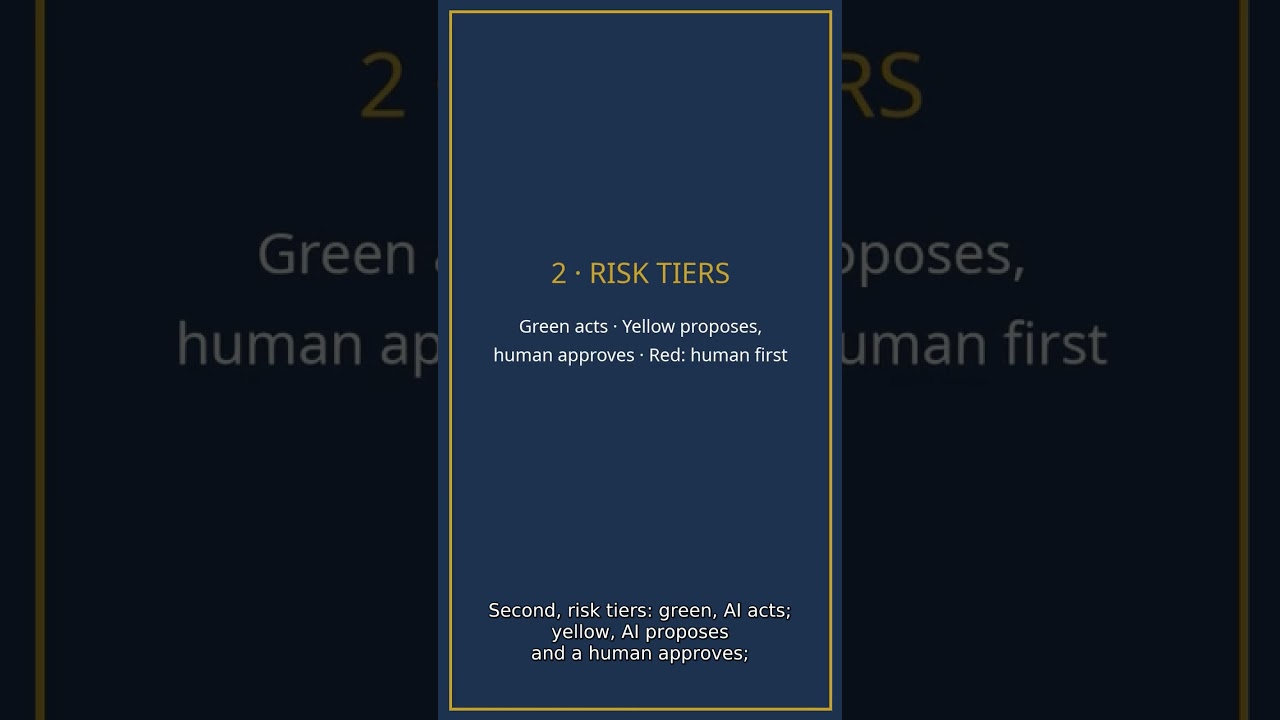
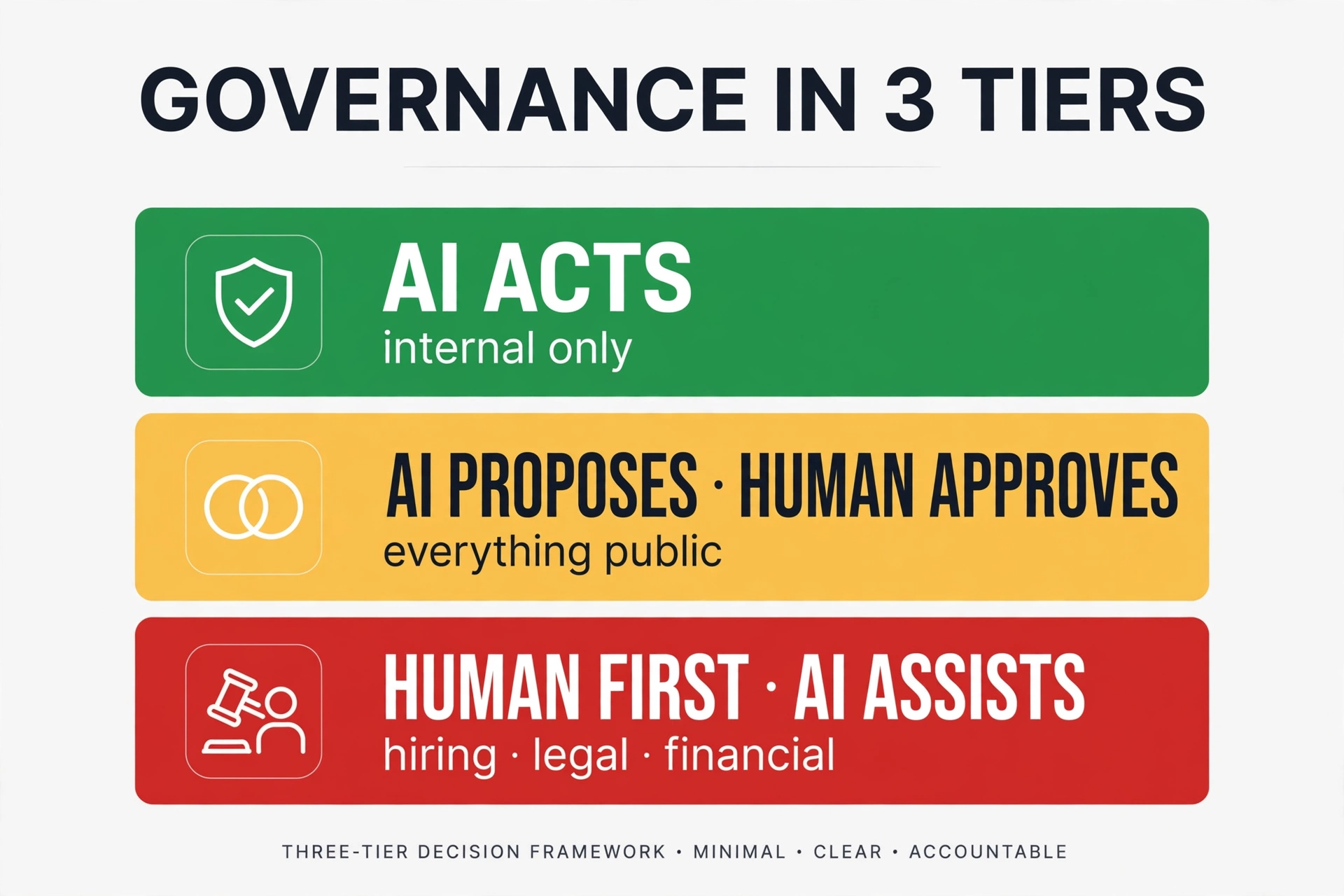
FACT: The proposed risk tiers divide work into three categories: green for internal, low-risk, reversible activity; yellow for work requiring human approval before release; and red for sensitive work where humans lead and AI only assists.
COMMENTARY: That division protects judgment without pretending every task deserves identical attention. Brainstorming is not hiring. A draft headline is not a financial approval. A synthetic illustration is not a photograph documenting an event.
Governance earns its place when those distinctions survive a busy afternoon.
Put Verification, Privacy, and Review Into the Workflow
FACT: The brief’s publication gate requires source-tracing every AI-assisted factual claim. Statistics must be attributed or removed. Names, numbers, quotations, and dates must be verified against primary sources rather than copied from a single AI output.
FACT: Its data rules prohibit entering customer personally identifiable information, passwords, credentials, unreleased financials, source identities, embargoed material, and unreleased code into AI tools. It recommends retention opt-outs where available and consent records for customer data that legitimately enters an approved workflow.
FACT: Vendor checks address training use, storage and processing, breach-notification terms, claimed certifications, published model or system documentation, and changes that could alter outputs. The operating rhythm includes monthly publication sampling, quarterly vendor and regulatory reviews, and an annual charter update.
COMMENTARY: Sampling published work is a check on whether the process operates. It does not replace prepublication approval of public-facing work. Likewise, a quick review cadence is a planning target—not a guarantee that a difficult claim can be verified in minutes.
Frequently Asked Questions
Can AI publish business content without human approval?
FACT: Not under the brief’s proposed charter. Public-facing work belongs in the yellow tier or a more restrictive category, with a named human approving release.
Does every use of AI need a public disclosure?
FACT: The proposed editorial ladder distinguishes fully reviewed assistance from material AI contributions and entirely synthetic segments. Platform rules and promotional-content obligations require separate consideration.
What happens if AI publishes something wrong?
FACT: The brief’s incident procedure calls for prompt correction or removal, a visible correction note, an incident log, repair of the failed control, and direct outreach when a real person was harmed or misrepresented.
Practical One-Page AI Governance Charter
COMMENTARY: The following is the brief’s proposed operating template, not a claim that adopting it establishes legal compliance. Its editorial disclosure ladder does not override applicable advertising or platform requirements.
AI GOVERNANCE CHARTER — [Operation Name] — [Date]
- Roles
AI Owner: [name]. Final approver of all AI-generated public content: [name]. Nobody publishes AI output anonymously. - Approved Tools and Uses
List every approved tool, its permitted use, and its risk tier. Examples: research briefs—yellow; article illustration—yellow with appropriate disclosure; text-to-speech video voiceover—yellow. - Risk Tiers
Green: AI acts on internal, reversible work, with spot-checking.
Yellow: AI proposes; a human approves. Everything public requires named human review.
Red: Human first; AI assists only. Includes hiring, legal/medical/financial advice, financial approvals, and sensitive content involving real people. - Quality Gate
No AI-assisted factual claim publishes without source-tracing. Attribute statistics or remove them. Verify names, numbers, quotations, and dates against primary sources. AI outputs remain drafts until a human confirms them. - Data Rules
Never enter customer personally identifiable information, passwords, credentials, unreleased financials, source identities, embargoed material, or unreleased code into AI tools. Use retention opt-outs where available. - Disclosure Standards
Fully human-reviewed AI assistance: internal flag.
Material AI contribution or AI-generated images/video: disclose within the piece.
Entirely synthetic segments: conspicuous disclosure at the beginning, matching the content’s format.
Apply YouTube altered/synthetic-content disclosures honestly and use applicable Meta and TikTok labels. Assess advertising and endorsement disclosures separately. - Review Cadence
Monthly: sample published AI-assisted work for disclosure completeness and documented verification.
Quarterly: review vendors, terms, and regulatory changes.
Annually: reread and update this charter. - Incident Response
Correct or remove erroneous public output promptly, with a visible correction note. Log the tool, incident, and failed gate. Repair the gate, not merely blame the person. Contact anyone harmed or misrepresented before the next publication cycle. Preserve the log. - Regulatory Watch
Responsible person: [name].
Quarterly scan: Colorado, Texas, California, New York, and EU Article 50. Record changes and adjust workflows or risk tiers where needed.
Want Jackson’s top local stories in one place? Browse the businesses shaping the area in the NeighborClick Local directory — JOIN the FREE Private Insider List for local stories, business spotlights, community updates and even if you don’t have business you’ll be an Insider.


Comments