
An investment club is generally a group of people who pool money to invest together, study investments, and make decisions by vote. The simplest version is even easier: a self-directed club, where members research and discuss investments together but each person invests individually—no pooled account, no partnership tax filings, and no shared brokerage account.
For a small group of friends, coworkers, church members, or neighbors in Jackson, Michigan, that distinction matters. A pooled club can be a powerful education in markets, discipline, and decision-making. But it also brings real paperwork, real legal questions, and real relationship risk. The self-directed model gives you the learning without most of the machinery.
Educational reporting only: This article is not legal advice, tax advice, or investment advice. Offers, qualifications, rules, fees, and legal requirements vary. Consult qualified professionals before forming or funding an investment club.
What an Investment Club Actually Is
FACT: The U.S. Securities and Exchange Commission’s Office of Investor Education and Advocacy describes an investment club as a group that pools money to invest together. Members generally study investments and make decisions together, often through a member vote. Meetings may be educational, and each member may actively help make investment decisions.
FACT: The SEC also identifies a simpler variant, the self-directed investment club. In that model, members research and select investments together, but they invest individually rather than pooling their money.
COMMENTARY: That second model is the one most people should start with. You get the accountability, the monthly meeting, the stock research, and the group discussion—without becoming the treasurer, tax preparer, and unofficial compliance department for someone else’s money.
The Argument
The argument for an investment club is not “get rich quick.” It is education, accountability, and shared judgment.
A club forces you to do the unglamorous work most investors skip: read about a company, write down why you like it, defend your reasoning in front of people who know you, and live with the decision after the vote. That is a better habit than chasing a hot tip, copying a stranger’s trade, or pretending a smartphone app has replaced judgment.
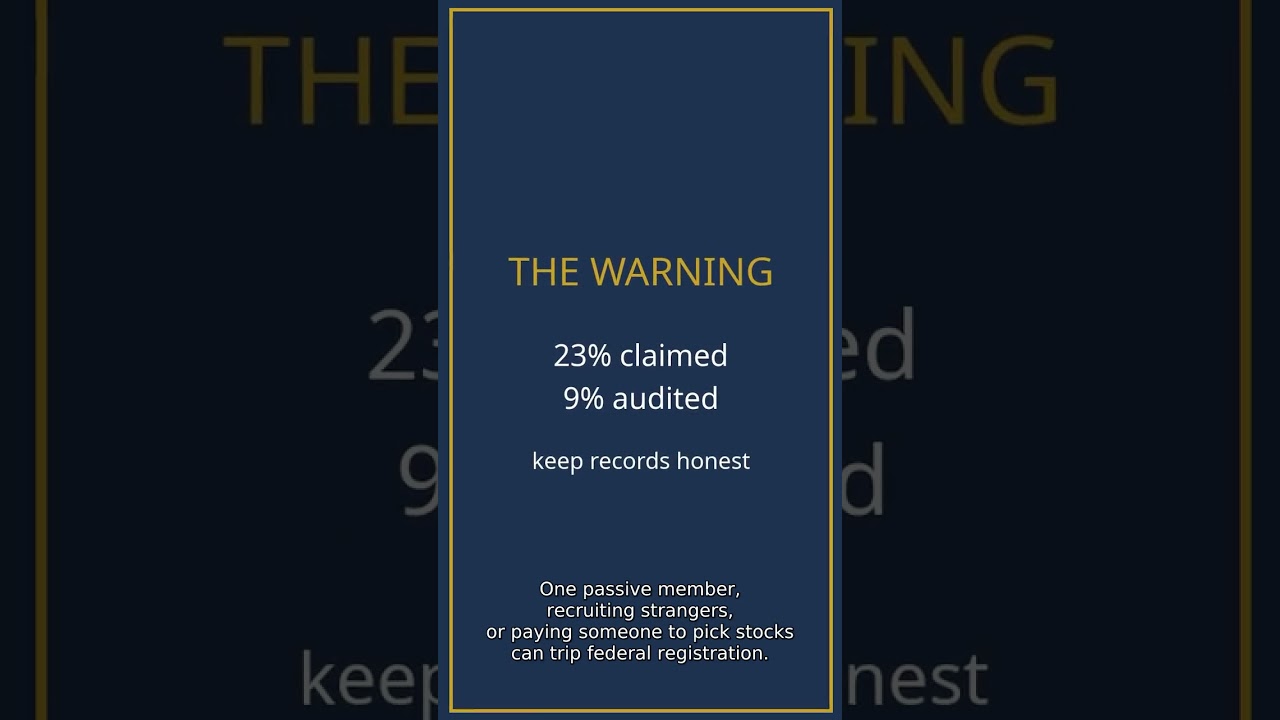
FACT: The SEC’s guidance emphasizes active participation. If every member actively helps decide what investments to make, the club’s membership interests would probably not be considered securities. If the club has even one passive member, it may be issuing securities.
COMMENTARY: In plain English: everyone should show up, study, discuss, and vote. No silent partners. No “just send me the money and I’ll handle it.” The moment one person becomes the stock-picker and everyone else becomes a passenger, the club has drifted away from the simple, education-first model.
FACT: The SEC states that it generally does not regulate investment clubs, but because each club is unique, each club needs to decide whether it has registration requirements.
COMMENTARY: “Generally does not regulate” is not the same as “no rules apply.” A club should stay small, private, active, and free of paid stock-picking. When in doubt, the SEC’s own advice is to consult an attorney experienced in securities law.

The Two Simple Models
Self-Directed Club: Research Together, Invest Separately
This is the lowest-friction version.
- Members meet regularly to study companies, industries, funds, or investing concepts.
- Members may share research, ask questions, and debate ideas.
- Each member makes personal investment decisions in their own account.
- No pooled money, no shared brokerage account, no partnership agreement, and no club-level Form 1065 or K-1s.
- The group’s product is education and accountability, not a shared portfolio.
COMMENTARY: This model is ideal for people who want the social and educational benefits of a club but do not want to manage shared money. It is also the cleanest way to test whether your group can handle disagreement, attendance, and long-term commitment.
Pooled Club: One Partnership, One Account, Shared Decisions
This is the traditional model.
- Members contribute money to a shared club account.
- The club is commonly organized as a general partnership.
- Members research investments and vote before the club buys or sells.
- The club maintains unit-value accounting, similar in concept to a mutual fund’s net asset value.
- The club generally files Form 1065 annually and gives each partner a Schedule K-1.
FACT: BetterInvesting’s model club partnership agreements from multiple states—including Michigan—form the club as a general partnership under that state’s laws.
COMMENTARY: A pooled club is not complicated because investing is complicated. It is complicated because money, friendship, taxes, and decision-making are all in the same room. If your group cannot commit to monthly meetings and clean records, start self-directed.
The Legal Trip Wires
FACT: Under the SEC’s plain-terms framing, a membership interest may be an investment contract—and therefore a security—if members invest and expect to make a profit from the efforts of others. If every member actively helps decide what investments to make, the membership interests would probably not be considered securities. If even one member is passive, the club may be issuing securities.
FACT: The SEC’s guidance contains no automatic “friends and family” exemption. The operative factors are active participation, no public offering, and staying within the relevant limits.
COMMENTARY: Do not assume that because everyone knows each other, the law does not apply. The facts of participation matter more than the relationship.
Investment Company Questions
FACT: Under the SEC’s framing, registration as an investment company may be required only if all three conditions hold: the club invests in securities; the club issues membership interests that are securities; and the club cannot rely on an exclusion from the definition. The SEC names the private investment company exclusion, which requires that the club not make or propose to make a public offering of its securities and not have more than 100 members.
FACT: The SEC warns that a public website or other public communication that could be viewed as suggesting a club is looking for new members might be considered a public offering.
COMMENTARY: Keep recruitment personal. Invite people you know. Do not post “Join our investment club” on a public Facebook page, Craigslist ad, community bulletin board, or open website. A private club should stay private.
Paid Advice
FACT: The SEC states that if someone is paid for providing advice about a club’s investments, that person may be an investment adviser. If one club member, rather than all members, selects investments for the club, that person may also be an investment adviser. Registration with the SEC or states may be required unless an exemption applies, and even an exempt adviser remains subject to the Advisers Act’s antifraud provisions.
COMMENTARY: This is simple: do not pay anyone to pick stocks for the group. Do not let one member quietly become the de facto manager while everyone else sends money. Every member participates, or the club should not pool money.
State Law
FACT: The SEC notes that state securities laws may differ from federal securities laws and points clubs to their state securities regulator through NASAA.
FACT: The SEC advises that an attorney with securities-law experience can help a club evaluate, based on its particular facts, whether its membership interests are securities and whether the club is making a public offering.
COMMENTARY: For a Jackson-area club, that does not mean you need a lawyer before your first coffee-shop meeting. It means you need one before you turn a casual study group into a pooled partnership with other people’s money.
The Tax Reality of a Pooled Club
FACT: A general-partnership investment club is generally a pass-through for income tax purposes. The partnership itself generally does not pay income tax. Each partner reports their share of income, deductions, and credits on their personal return through Schedule K-1 (Form 1065). The partnership files Form 1065 and prepares a K-1 for each person who was a partner at any time during the year.
FACT: The IRS’s Schedule K-1 instructions state that although a partnership generally is not subject to income tax, a partner may be liable for tax on their share of partnership income whether or not it is distributed.
COMMENTARY: This surprises new club members. The club can reinvest every dollar, pay out nothing, and members may still owe tax on their share of partnership income. That is why the treasurer’s job is not a ceremonial title.
FACT: A departing partner’s K-1 is marked FINAL, and no 1099 is issued to the partner for a withdrawal, according to tax-practitioner guidance cited in the research brief.
FACT: Common club tax problems include an EIN or club-name mismatch, year-end withdrawal timing issues, and the general nondeductibility of investment expenses for individual members under current tax law. The IRS may reject an e-filed return if the club name or EIN does not match prior-year returns, the brokerage 1099, or the original EIN application. Clubs should use the full club name consistently.
FACT: The research brief also warns clubs not to date or value withdrawals on December 31 or January 1, recommending completion by December 30 or after January 2.
COMMENTARY: If this paragraph made your eyes glaze over, that is useful information. It means the pooled club needs a competent treasurer, reliable accounting software, and a tax professional at least once a year.
How Unit-Value Accounting Works
FACT: The standard club method, documented by bivio, treats the club’s unit value like a mutual fund’s net asset value. Total club assets—cash plus closing-price stock values—are divided by units outstanding. Members buy units with contributions and redeem units on withdrawal. The unit value changes only as asset values change, not merely because members contribute money.
FACT: bivio uses an arbitrary initial unit value of $10, and the partnership agreement sets an official valuation date each month.
COMMENTARY: This is the antidote to the oldest investment-club mistake: treating a member’s contribution as a gain. If five people each put in $100, the club has more cash, but nobody has made money. Proper unit accounting keeps that straight.
The Beardstown Lesson
FACT: The Beardstown Business and Professional Women’s Investment Club, formed in 1983 in Beardstown, Illinois, became famous in the 1990s for claiming a 23.4% annual return. A 1998 Chicago magazine investigation led to a PricewaterhouseCoopers audit, which found the actual return was 9.1%—below the S&P 500 for the period—because the club had counted members’ own contributions as investment gains due to a spreadsheet formula error.
FACT: Sources conflict on the group’s founding headcount, so no exact founding number should be stated; the material facts are the claimed return, the audit, and the accounting error.
COMMENTARY: This is not a story about women being bad at investing. It is a story about bad accounting becoming a beloved legend. A spreadsheet formula error turned contributions into “returns,” and the error survived because nobody wanted to question a good story.
The lesson is blunt: never trust a self-reported club return without understanding how it was calculated. And never let a homemade spreadsheet become the club’s financial system.

The Simplest Form, Step by Step
If you want the most practical version of an investment club—one that teaches real investing without creating a part-time accounting job—start here.
Step 1: Choose the Self-Directed Model First
- Gather three to ten people who are willing to meet monthly.
- Agree that everyone researches, discusses, and learns.
- Each member invests only in their own personal account.
- Keep no pooled money, no shared brokerage login, and no partnership bank account.
- Use the meetings for stock studies, questions, notes, and accountability.
COMMENTARY: This version can start this month. It requires discipline, not legal paperwork.
Step 2: If You Pool Money, Keep It Small and Active
- Use three to ten committed members.
- Require every member to attend, study, and vote.
- Do not admit passive members.
- Do not pay anyone to select investments.
- Recruit by personal invitation only.
- Stay well below 100 members.
- Do not make public offers or public posts seeking new members.
FACT: These safeguards track the SEC’s guidance on active participation, public offerings, and the 100-member limit relevant to the private investment company exclusion.
Step 3: Put the Agreement in Writing
FACT: BetterInvesting publishes sample partnership agreements and operating procedures. Recurring elements include formation as a general partnership under state law, club name, continuing term, investment purpose, membership rules, regular meetings, officers, voting, amendment procedures, and dissolution procedures.
Your written agreement should cover:
- Club name and purpose.
- Membership rules and attendance expectations.
- Monthly contribution amount and due date.
- Official valuation date.
- Voting rules.
- Officer roles: president, vice president, secretary, and treasurer.
- Withdrawal procedure and timing.
- Dissolution procedure, including payment of debts and pro rata distribution of remaining assets.
COMMENTARY: The agreement is not bureaucracy for its own sake. It is the document that keeps a disagreement from becoming a friendship-ending lawsuit.
Step 4: Use Real Club Accounting From Day One
FACT: bivio provides online investment-club accounting, tax, and management software, including daily unit values from market prices, K-1 generation, withdrawal handling, and basis tracking. Its published pricing in the research brief was from 2022, so clubs should check bivio.com for current pricing rather than relying on old figures.
FACT: myICLUB’s own comparison page listed $98 per year for BetterInvesting members and $160 per year for non-members, with federal tax preparation around $99.99, or about $89.99 early bird. Those figures are competitor-sourced and should be verified before relying on them.
COMMENTARY: The exact software matters less than the principle: do not invent your own accounting system. Use a purpose-built club platform, reconcile statements monthly, and give members visibility into the books.
Step 5: Get the EIN and Handle Taxes Properly
FACT: The IRS charges nothing for an Employer Identification Number. Apply directly through the IRS; paid EIN-filing services are unnecessary middlemen.
FACT: A pooled general-partnership club generally files Form 1065 annually and issues Schedule K-1s to each person who was a partner during the year.
COMMENTARY: Budget for professional help. A one-time attorney review of the partnership agreement and a tax-season consultation are the two most common discretionary costs, though the research brief does not provide a verifiable typical price for either.
Costs Without Made-Up Numbers
FACT: A general partnership generally costs $0 in state filing fees to form, though clubs commonly adopt a written partnership agreement. An LLC may provide liability protection but involves state filing fees and annual statements.
FACT: The research brief reports Michigan LLC figures of $50 to file Articles of Organization and $25 per year for the annual statement, based on 2026-dated secondary guides rather than LARA itself. Those figures should be confirmed directly with Michigan’s Department of Licensing and Regulatory Affairs before relying on them.
FACT: The research brief describes brokerage accounts opened in the partnership’s name as typically free to open, with stock and ETF commissions generally $0 at major discount brokers under standard 2026 market conditions. Clubs should verify the terms of the broker they choose.
FACT: BetterInvesting’s 2026 forms list Club membership at $45 per member per year, Club Core at $105 per year per member, and Club Plus at $130 per year per member. Dues can change, so confirm current pricing before budgeting.
COMMENTARY: Do not treat any of these as a complete cost forecast. The real costs are time, attention, bookkeeping, and the possibility that a member needs money back before the club is ready to pay it.
The Risks Nobody Puts on the Flyer
Illiquidity
FACT: In a pooled club, withdrawals are valued on the club’s official valuation date, not the day a member asks. Payout can take days or weeks, and club units cannot be sold like a stock.
COMMENTARY: If you may need the money for rent, a car repair, or an emergency, do not put it into a pooled club. Use money you can genuinely leave alone.
Member Conflict
FACT: The research brief identifies interpersonal disputes and dissolution as among the most common club killers. Voting, attendance, and dissolution clauses exist precisely for that reason.
COMMENTARY: A club is a small democracy with money involved. That can build lifelong friendships—or expose every fault line in them.
Fraud and Embezzlement
FACT: The research brief describes a structural risk: one treasurer often controls the books and brokerage login. Mitigations include accounting software with per-member visibility, dual authorization on withdrawals, monthly statement reconciliation by a second officer, and annual reviews.
COMMENTARY: Trust is not an internal control. Dual authorization is.
Concentration Risk
FACT: A small club’s portfolio may consist of a handful of stocks and can lag a diversified index for years. The research brief says no return expectations should be set and that the educational purpose is the point.
COMMENTARY: A club is not a replacement for a diversified long-term plan. It is a classroom with real stakes.
A Michigan Connection Worth Knowing
FACT: BetterInvesting, publicly branded as the National Association of Investors Corporation, is a Michigan-based 501(c)(3) nonprofit investor-education organization headquartered in Madison Heights. It was founded in 1951 when five investment clubs formed a national association. Its original name was the National Association of Investment Clubs, and its member magazine, BetterInvesting, became the brand name in 2004.
FACT: BetterInvesting offers investor education, the Stock Selection Guide methodology, sample partnership agreements and operating procedures, local chapters, webinars, classes, BetterInvesting Magazine, and a myICLUB-affiliated accounting ecosystem.
FACT: BetterInvesting claims to have helped more than 5 million people. Secondary sources report roughly 4,000 member clubs and more than 40,000 individual members around 2015–2019, down from a reported peak of well over 400,000 members in 1999; those latter figures are secondary-sourced estimates and should be treated accordingly.
COMMENTARY: For Michigan readers, BetterInvesting is not some distant Wall Street brand. It began as a club-based education movement, and its Michigan roots make it a natural starting point for a local group that wants sample documents and structured learning.
Who Should Start a Club—and Who Should Not
A Club Fits You If
- You want to learn investing by doing it with others.
- You can contribute regularly without needing the money soon.
- You are comfortable researching investments and defending your reasoning.
- You can handle disagreement without turning every meeting into a fight.
- You value education and accountability more than a promised return.
A Club Does Not Fit You If
- You need liquidity.
- You want someone else to pick stocks for you.
- You will not do paperwork.
- You are chasing returns.
- You want to recruit strangers online.
- You expect guaranteed results.
FACT: The research brief specifically identifies illiquidity, passive-member and adviser risks, Form 1065 and K-1 obligations, and unrealistic return expectations as reasons a pooled club may not suit someone.
FAQ
What is the simplest form of an investment club?
The simplest form is a self-directed investment club. Members meet, research investments, and discuss ideas together, but each person invests individually in their own account. There is no pooled account and no partnership-level tax filing.
Do all members have to participate?
For a pooled club, yes. The SEC’s guidance says that if every member actively helps decide investments, the membership interests would probably not be considered securities. If even one member is passive, the club may be issuing securities.
Can we recruit members online?
No—not if you want to stay conservative. The SEC warns that a public website or other public communication suggesting a club is looking for new members might be considered a public offering. Recruit by personal invitation only.
Can one person pick the stocks?
Not in the simplest, safest club model. The SEC says that if one member, rather than all members, selects investments for the club, that person may be an investment adviser. Do not pay anyone to pick stocks for the group.
Does a pooled club owe taxes?
The partnership itself generally does not pay income tax, but each partner may owe tax on their share of partnership income whether or not it is distributed. The club generally files Form 1065 and issues Schedule K-1s.
Is an investment club guaranteed to make money?
No. No club can promise returns, and this article provides no performance expectations. The Beardstown case shows why self-reported returns deserve skepticism: an accounting error caused contributions to be counted as gains.
What should a Jackson, Michigan group do first?
Start with a self-directed club: meet monthly, study investments together, and invest individually. If the group later wants to pool money, use a written partnership agreement, proper unit-value accounting, an EIN, Form 1065 and K-1s, and professional legal and tax review.
The Bottom Line
The simplest form of an investment club is not a pooled account with a homemade spreadsheet and one confident person clicking “buy.” It is a small, private, active group that learns together—and, if it pools money at all, does so with written rules, proper accounting, shared decision-making, and professional guidance.
Start with research. Start with meetings. Start with accountability. Only pool money when every member is willing to participate, nobody is paid to pick stocks, nobody recruits strangers publicly, and the group can handle the paperwork without pretending it does not exist.
Again: this is educational reporting only. It is not legal, tax, or investment advice. Rules, qualifications, offers, and costs vary. Consult a securities attorney, a tax professional, and other qualified advisers before forming or funding an investment club.
Want Jackson’s top local stories in one place? Browse the businesses shaping the area in the NeighborClick Local directory — JOIN the FREE Private Insider List for local stories, business spotlights, community updates and even if you don’t have business you’ll be an Insider.


Comments