

FACT: Roughly 46% of all Google searches carry local intent, according to widely repeated industry compilations of search data. About 76% of people who search for something nearby on a smartphone visit a business within a day, and 28% of “near me” searches end in a purchase, per Think with Google research compiled by Backlinko and others.
FACT: The local map pack appears on roughly 93% of classic local-intent searches, per Whitespark measurement reported in industry roundups, and about 42% of searchers click on map pack results, per Backlinko’s compilations.
COMMENTARY: A national brand can outspend a Jackson business on advertising. It cannot out-partner one. It cannot sponsor the Little League team, co-host the workshop at the hardware store, or get its name spoken with trust at the chamber breakfast. Local collaboration is the one visibility asset that does not scale for the big guys — which is exactly why it works for everyone else.
The Landscape: Local Search Runs on Trust Signals
FACT: BrightLocal’s 2026 Consumer Search Behavior study (1,227 U.S. consumers, reported via soci.ai) found that 72% of people look at three or fewer businesses before deciding — yet only 6% simply click the top result. Proximity (44%), star rating (38%), and review count (37%) all outweighed rank position itself (16%).
FACT: The canonical Think with Google finding is that “near me” and “close by” searches grew more than 900% over a two-year stretch from 2015 to 2017. (Many recent pages repeat that figure as if it described the last two years; it does not — it is the original 2015–2017 window.)
FACT: Discovery still runs through community recommendation. Nextdoor’s own surveys report that 79% of its users were influenced by a Nextdoor recommendation to visit a business and 62% discovered a small business there; organic business recommendations make up nearly 30% of all content on the platform, per Nextdoor figures reported via soci.ai. BrightLocal has found that 49% of consumers trust online reviews as much as recommendations from people they know.
FACT: BrightEdge data reported by EtherealMinds found AI Overviews went from full coverage of local and provider intent searches at the end of 2023 to 0% by December 2025 — Google pulled its AI answers out of “near me” style queries, leaving the local pack and ordinary listings intact. That figure is reported, not independently verified, but the direction matters: local search remains a listings-and-reputation game, not an AI-answer game.
FACT: AI surfaces still matter upstream. SOCi data reported via soci.ai attributes 7.6% of the sources large language models cite for local queries to Facebook, and 59% of U.S. consumers say a social post or video directly made them a customer of a local business.
What Actually Ranks: The Whitespark Picture
FACT: Whitespark’s Local Search Ranking Factors report (titled 2026, published November 2025), scored by 47 local search experts across 187 factors, puts the map-pack signal groups at approximately: Google Business Profile signals ~25%, review signals ~19–20%, behavioral and engagement signals ~17–18%, link signals ~12–14%, citation signals ~11–12%, and on-page signals ~10–15%.
FACT: The top individual map-pack factors are the primary GBP category, distance from the searcher, keywords in the GBP business name, an address in the searched city, and being open at the time of search. Review quantity with text, recency, and a sustained influx over time all score high.
COMMENTARY: Read those numbers the way a small business should: your own website is roughly a sixth of what decides map-pack placement. Reviews, your Google profile, and how people behave toward your listing are more than half. And the strongest factors are mostly free settings inside Google’s own products — not services an agency has to sell you.
The Argument
COMMENTARY: Organic traffic for a local business is not primarily a website problem. It is a presence problem — and presence is built in public, with other people.
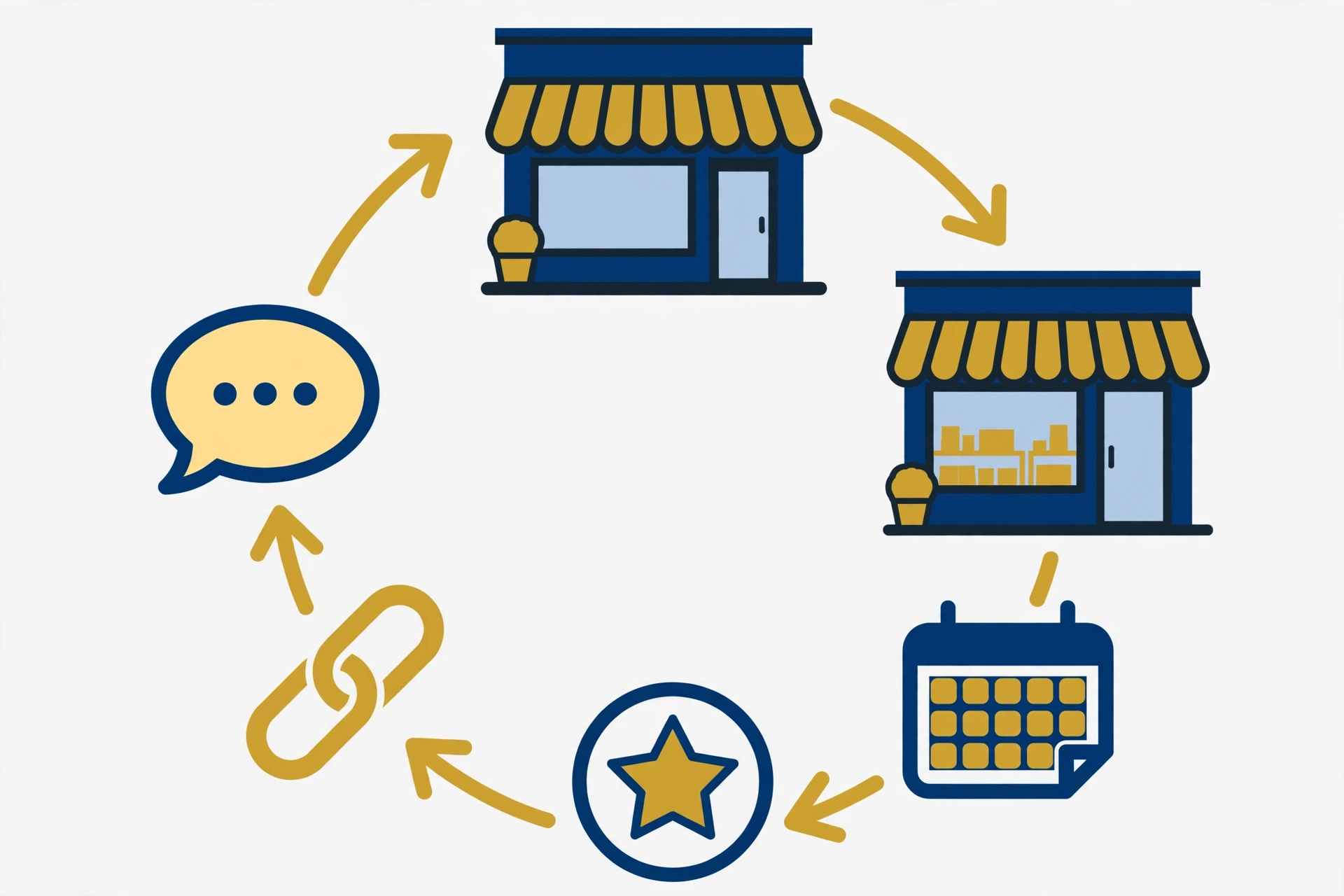
A partnership is a visibility machine because it produces, all at once, the exact signals local search runs on. A co-hosted event creates a listing and a link. A sponsorship puts your name on a page Google already trusts. A joint guide gives other sites something worth citing. A happy crowd at a partner’s event becomes reviews, branded searches, direction requests, and photos — the behavioral signals that weigh nearly a fifth of the map-pack mix. None of that can be bought as an ad package, and none of it can be faked for long.
The national competitor’s advantage is money. The local business’s advantage is that it actually lives here. Collaboration is how that advantage gets converted into rankings: every real-world relationship leaves a digital trace, and the traces compound. One partner, one event, one week is enough to start the flywheel — the businesses that win local search in five years are the ones whose names keep showing up, in real contexts, all over town.
The Mechanisms: How Partnerships Turn Into Traffic
FACT: Practitioner sources including CATTIX, Flento, DesignLoud, and seoforsmallbusiness.com.au hold that local backlinks from real-world involvement — chamber of commerce member listings, sponsorship pages, local news coverage of community events, industry-association chapter listings — carry geographic relevance that national backlinks cannot replicate for local rankings. Many businesses pay for listings they never claim or activate.
FACT: Whitespark’s 2026 report added an AI-search visibility axis that explicitly scores presence on expert-curated lists, prominence on industry-relevant domains, and unstructured brand mentions — the AI-era analogue of link equity.
FACT: Local media and community coverage drives branded searches, direction requests, and calls, which are the behavioral signals weighted at roughly 17–18% of the map-pack mix.
FACT: Co-hosted events and cross-promotions create natural review moments. Practitioners warn against review spikes — a burst of dozens of reviews in a day can trigger filtering — and advise asking after the visit, not at the counter, so reviews arrive at a steady cadence.
FACT: Every partnership listing is a citation, and citation consistency matters: BrightLocal reports that 62% of consumers avoid a local business with incorrect online information. Name, address, and phone must be identical everywhere a partner lists you.
FACT: Practitioner consensus holds that in niche communities — forums, subreddits, Slack and Discord groups, trade publications — the rule is participate first, promote second. Comment links carry little direct weight; the value is referral traffic, brand mentions, and demonstrated expertise.
The Playbooks
COMMENTARY: None of these require a marketing department. They require a phone call to a business that serves the same customers you do, differently.
- Complementary cross-promotions. Joint offers and bundles, receipt shows (a discount with a partner’s receipt), in-store poster swaps, shared email features. Restaurant + gym, salon + boutique, coffee shop + bakery, contractor + hardware store.
- Co-hosted events and giveaways. One-hour workshops, open houses, joint giveaways, social story takeovers. Chamber guidance (Grandview Chamber) is to start small — a one-hour workshop or a one-week cross-promotion — measure registrations, attendance, and redemptions, then scale what works.
- Neighborhood guides and expert roundups. Co-published “best of” guides and visitor guides are precisely the kind of asset local sites actually link to.
- Community sponsorships. Youth teams, school fundraisers, festivals, charity runs. Sponsor pages typically link back to sponsors. The practitioner rule: genuine sponsorship with real presence — not a link purchase wearing a sponsorship costume.
- Chamber membership. A directory listing and member link, plus something underrated: chambers introduce complementary members to each other — partner matchmaking a business would not find on its own.
- Local media guest spots. Pitch genuine stories — a milestone, a hire, a new service, a community contribution. Local reporters and podcasters need local voices.
- Directory hygiene. Claim and complete the high-authority local directories. Ten quality citations beat five hundred low-quality ones; paid directory links and bulk backlink packages are red flags, not bargains.
- Niche plays. For businesses whose market is a vertical rather than a town: real participation in the industry’s forums and communities, guest posts on niche blogs with actual readership, newsletter mentions, and co-created content with recognized experts.

Jackson, Michigan: What This Looks Like on the Ground
COMMENTARY: The through-line is simple: a local business’s community involvement is a ranking asset no national competitor can copy. Start with one partner, one experiment, one week.
- Restaurant + local farm — “Farm-to-Table Friday.” The farm supplies the special; the restaurant promotes the farm; the farm’s newsletter and site link the event page; the restaurant’s menu feature reaches the farm’s email list. Both sides earn event-page links and branded searches.
- Salon + boutique — “Style Saturday.” The boutique outfits a styled model, the salon does the hair, both post the same photo shoot, each shop’s window carries the other’s cards, and a co-branded hashtag collects customer photos.
- Contractor + hardware store — a seasonal DIY workshop. Free at the store, taught by the contractor. The store’s event calendar links the contractor; the contractor’s site links the store’s materials list; both collect emails.
- Coffee shop + bookstore — joint book-club and author nights. Shared audiences, shared promotion, two listings promoting one event.
- Any business + the local chamber. Membership becomes a directory link, and the directory becomes introductions to complementary members.
- A UGC starter. A branded hashtag and a monthly giveaway for the best customer photo, with winners featured on the Google profile and the website.
FACT: The zero-budget checklist from the playbooks: claim the chamber link, claim the high-authority local directories, complete the Google Business Profile in full, ask every customer for a review (all of them, not only the happy ones), and publish one local event guide per quarter with a partner.
Reported Case Studies, Not Proof
FACT: Vendor-adjacent case-study roundups report that a local brewery saw roughly a 30% foot-traffic lift over three months from user-generated content (FasterCapital roundup), and a coffee shop reported about 30% more foot traffic over six months from an Instagram UGC campaign (SavvyRest case study). These are reported case studies, not independent findings, and they are included as illustrations of the mechanic — not as promised outcomes.
FACT: There is no independently verified small-business local-partnership ROI study. The strongest available numbers are industry surveys and vendor benchmarks, and any article — including this one — should be read with that limit in mind.
Measure What the Partnership Actually Did
FACT: Map-pack visibility is measured with grid-style ranking tools (Local Falcon is the commonly cited one), which show the radius within which a business appears. Service-area settings in the Google profile do not affect rankings — they only tell customers where you travel — and a business generally cannot rank 50-plus miles away without a physical location there, per Whitespark’s summaries.
FACT: The GBP Performance tab reports branded versus discovery searches, direction requests, calls, website clicks, and bookings. Google retired the old Insights tab in favor of Performance in 2023, removed call-history detail on July 31, 2024, and added Posts view counts in September 2026. Practitioners (Joy Hawkins, via MapObserver) caution that Performance numbers measure intent and engagement, not confirmed transactions — directional guides, not a ledger.
FACT: Partner traffic is isolated with UTM-tagged partner links read in GA4’s referral channel, and per-campaign promo codes for cross-promotions and giveaways. Review velocity, branded-search volume before and after collaboration waves, direction requests, and redemption counts are the practical scoreboard. A quarterly NAP-consistency audit across partner listings, directories, and the Google profile keeps the citation base clean.
The Compliance Lines (Practical Notes, Not Legal Advice)
FACT: Google’s spam policies explicitly list “excessive link exchanges” as link spam. Google’s John Mueller has stated that a link exchange where both sides link because of the deal — even between topically relevant sites — is essentially against the webmaster guidelines; algorithms ignore such links, and manual actions apply when they form the majority of a profile.
COMMENTARY: The safety rule follows from that: partner links must come from real collaborations — event pages, sponsor listings, co-created content — never from “you link to me, I link to you” arrangements. One natural reciprocal link inside a genuine partnership is normal life. A systematic program of them is a scheme.
FACT: The FTC’s consumer review rule (16 CFR Part 465), effective October 21, 2024, prohibits fake or false reviews and testimonials (including AI-generated ones and celebrity testimonials without real experience), buying positive or negative reviews, compensation conditioned on sentiment, undisclosed insider reviews, company-controlled review entities misrepresented as independent, and review suppression. Knowing violations carry civil penalties — the 2025 figure stood at about $53,088 per violation. In December 2025, FTC staff sent warning letters to ten companies — warnings, not adjudications. Practically: never condition a discount on a five-star review, and ask all customers for reviews, not only the happy ones.
FACT: Partner choice is also reputation exposure. A partner’s failures become your association; one partner scandal contaminates by proximity. Choose businesses whose service quality you would defend as your own.
A One-Week Starter Plan
COMMENTARY: Day one: pick one complementary business whose customers should also be yours. Day two: propose the smallest real thing — a one-hour workshop, a joint giveaway, a shared guide. Day three: build one shared event page, with both businesses named identically to their Google profiles. Day four: tell both email lists and both storefronts. Day five: hold the event and ask every attendee — every one — for an honest review afterward. The weekend: post the photos, tag the partner, and write down what happened — attendance, sign-ups, redemptions, direction requests. Then decide, with numbers, whether to do it again bigger.
FACT: That loop — real collaboration, clean citations, steady reviews, measured results — is the whole strategy. It fits inside a week because it was never a campaign. It is just what being a good neighbor looks like when the neighbor’s name is also a search result.
Want Jackson’s top local stories in one place? Browse the businesses shaping the area in the NeighborClick Local directory — JOIN the FREE Private Insider List for local stories, business spotlights, community updates and even if you don’t have business you’ll be an Insider.


Comments