
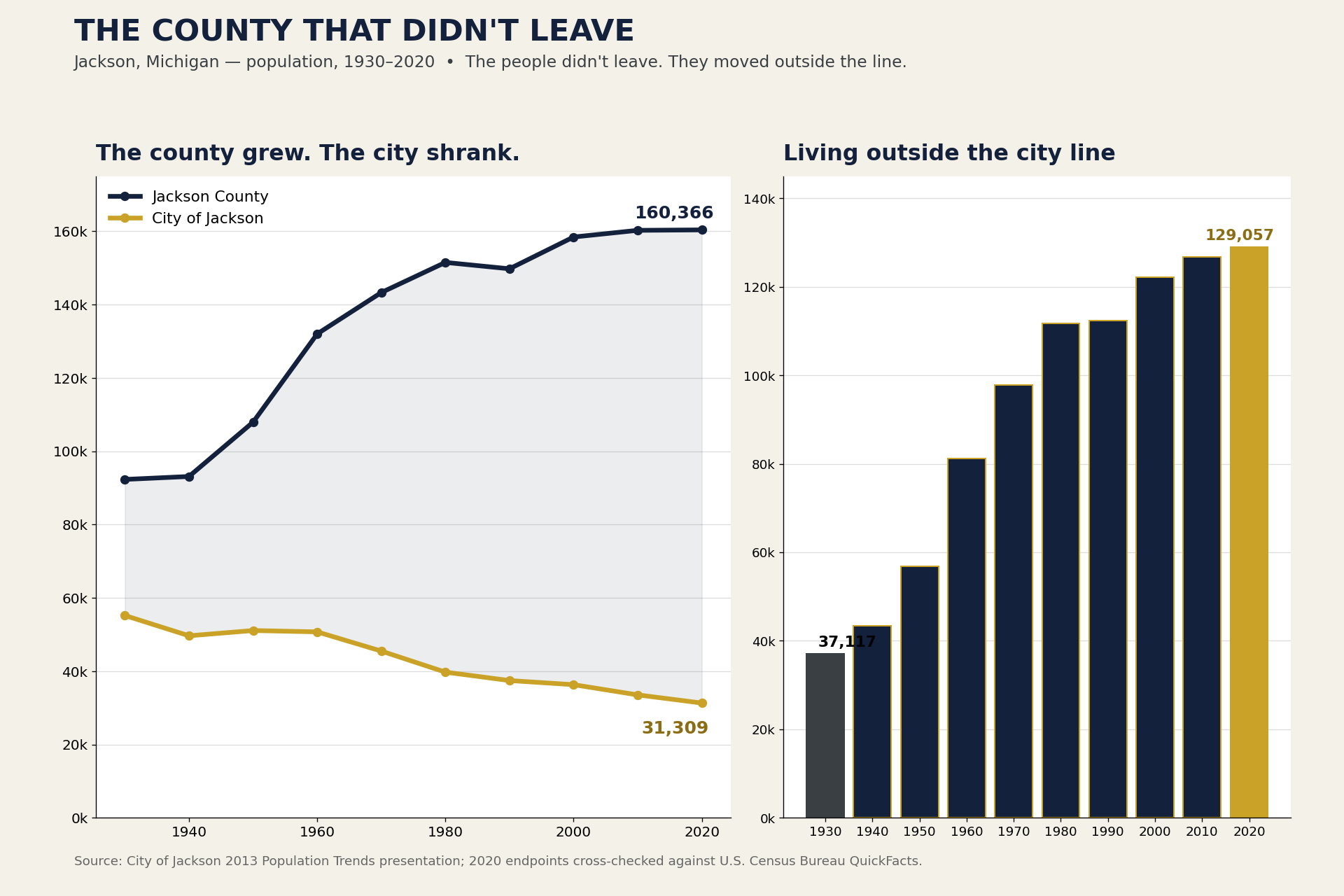
FACT: In 1930, the city of Jackson held 55,187 people — and that was the peak. By the 2020 census, the city counted 31,309. If you read only those two numbers, the story writes itself: Jackson is a city that lost its people.
FACT: Read the other column. In 1930, Jackson County held 92,304 people. By 2020 it held 160,366. The county didn’t decline. It grew — by nearly three-quarters across ninety years — while the city inside it shrank by 43 percent. The people who supposedly vanished are in the table the whole time. They just aren’t where the headline says to look.
FACT: Here’s the full series, from the City of Jackson’s own 2013 population-trends presentation, with 2020 endpoints confirmed against U.S. Census Bureau QuickFacts:
- 1930: City 55,187 | County 92,304 | City share: 59.8% — six in ten county residents lived inside the city.
- 1940: City 49,656 | County 93,108 | 53.3%
- 1950: City 51,088 | County 107,925 | 47.3% — the city slips below half.
- 1960: City 50,720 | County 131,994 | 38.4% — the county adds more than 24,000 people in one decade while the city starts its long slide.
- 1970: City 45,484 | County 143,274 | 31.7%
- 1980: City 39,739 | County 151,495 | 26.2%
- 1990: City 37,446 | County 149,756 | 25.0% — one in four. Not 2010; 1990. The city’s own slide put this milestone two decades earlier than most tellings would have you believe.
- 2000: City 36,316 | County 158,422 | 22.9%
- 2010: City 33,534 | County 160,248 | 20.9% — one in five.
- 2020: City 31,309 | County 160,366 | 19.5% — fewer than one in five.
FACT: Now run the number the declinists never run. The county’s population living outside the city limits was 37,117 in 1930. In 2020 it was 129,057. That’s a gain of 91,940 people — roughly three and a half times the starting figure — while the city lost 23,878. For every person the city lost on paper, the county outside the line gained nearly four. The county didn’t empty. It rearranged itself.
FACT: It rearranged into the townships. The four urban townships ringing the city — Blackman, Leoni, Summit, and Spring Arbor — held 68,633 people in 2010, more than double the city’s 33,534, according to the county’s own planning documents. Blackman Charter Township reached 25,638 in 2020 — within about 5,700 residents of the city itself. Summit Township is near 22,900. Leoni Township, home of Michigan Center, holds nearly 14,000. The Census Bureau’s Jackson urban area — the actual built-up Jackson — counted 84,307 people in 2020, about two and two-thirds times the city-limits figure.
COMMENTARY: Say “I’m from Jackson” and mean a lake lot in Leoni, a subdivision in Summit, a house on the north side of Blackman. The mailing address says Jackson. The census says township. The decline story says you left. None of the three agrees with the other two, and the one that’s wrong is the one quoted most.
FACT: Part of the reason the numbers never corrected themselves is that the line never moved. In Michigan, a city can’t simply absorb its suburbs: annexing township land runs through the State Boundary Commission under Act 191 of 1968, with petitions, hearings, and possible referendums. And the Charter Township Act shields qualifying charter townships — Blackman and Grass Lake both hold charter status — from annexation to a neighboring city outside narrow exceptions. The legal result: the postwar decades sent subdivisions, strip retail, and lake communities into the townships by default, and the city map stayed nearly still while the lived city kept spreading.
FACT: Two honesty notes, because this story deserves its own scrutiny. First, not all of the township growth is families in subdivisions: four state prison facilities — Parnall, Cotton, the Egeler reception center, and Cooper Street — sit in Blackman Charter Township, with roughly 6,800 beds of listed capacity between them, and the census counts inmates where they are incarcerated. Second, the census is a snapshot, not a tracker: it proves the county’s population didn’t leave, not that the same families stayed. And households got smaller — 2.29 people per household in the city versus 2.41 countywide — so some of the city’s slide is fewer people per house, not only departures. None of this reverses the picture. It sharpens it: even netting out the caveats, the rearrangement is the story.
FACT: Now cross the county line, because the same question is being decided in real time next door. In February 2023, Ford announced BlueOval Battery Park Michigan for Marshall in Calhoun County: a $3.5 billion, 2,500-job, 35-gigawatt-hour battery plant making lithium-iron-phosphate cells. After a construction pause and a scale-back, the plant is going ahead at about 1,700 jobs and 20 gigawatt-hours — and as of mid-2026 it is producing and testing its first cells, with more than 500 people hired and the plant on track to ship batteries this year.
FACT: The fight around it is the boundary story in reverse. About 700 acres were transferred from Marshall Township to the City of Marshall under a Public Act 425 agreement and rezoned industrial — the line didn’t freeze; governments moved it, and the question was whether residents got a say. A committee of residents pushed a referendum petition (they said they gathered more than 800 signatures; the city clerk’s review found 136 valid), then sued. Courts dismissed the case in 2024, upheld the dismissal, and in 2025 the Michigan Supreme Court sent it back for another look. Whatever the courts finally say, the plant is real, and it’s operating.
FACT: Then there’s the solar. Calhoun County is stacking utility-scale solar project by project: the 200-megawatt Calhoun Solar Energy Center (~1,200 acres, selling to Consumers Energy, the Michigan Public Power Agency, and Lansing’s utility), the 360-megawatt Sunfish Solar 2 from Consumers Energy and Hecate Energy targeted for completion in 2026, the 149-megawatt River Fork project straddling Sheridan Township in Calhoun and Parma Township back in Jackson County, and an AES project in Sheridan Township. That’s more than 700 megawatts of solar built or underway in and around one county — thousands of acres of former farmland under panels.
FACT: This is where Allen’s addition to the pitch meets the record. At a January 2023 Marshall Township meeting, homeowner Julie Bryant told officials she and her husband had bought their home about three years earlier because they wanted the country life — “we wanted to be in the country, we wanted to see the stars,” she said — and the megasite would sit about a half-mile from their house. She feared for the air, the land, and the river. That household is the emblem of the story: people spend a working life in apartments, rentals, or a house in town, saving the dream of a quiet place in the country — and the country gets loud and busy around them. The record supports the “busier” part for the Marshall corridor: multi-year construction, a state traffic study of the M-96 corridor, road upgrades. It does not support claims about noise from the solar fields specifically — the documented solar neighbors’ concerns are farmland, views, property values, and who gets to decide, with the state’s 2023 siting law shifting large-project authority toward the Michigan Public Service Commission when local rules don’t line up.
COMMENTARY: Jackson’s rearrangement and Marshall’s fight are the same question asked at opposite ends of a timeline. In Jackson County, the line froze and the people moved quietly across it for ninety years — no petitions, no lawsuits, just a slow drift to the townships that nobody narrated. In Calhoun County, the line moved and the people fought it in open court, because this time the change arrives as bulldozers and rezoning votes instead of subdivision signs. The question in both places: where, inside your own county, do you get to live the life you planned — and who decides what arrives next door?

The Argument
FACT: The obituary was written for a line, not a people. Jackson’s city-limits population fell from 55,187 to 31,309 — and that is a real fact about a real place that has absorbed real hardship. But the county holding it never left. It grew by 68,000 souls and put most of them exactly where you’d put them if you were building a life: outside the old line, where the lots are bigger, the lakes are closer, and the house can be the retirement you’ve been picturing since you were thirty.
COMMENTARY: Here’s the argument, and it cuts two ways. First: stop using the city-limits number as a synonym for the community. When outsiders cite 31,309 as proof that Jackson is emptying out, answer with 129,057 — the county outside the line, bigger than it has ever been — and with 84,307, the built-up Jackson that still works, worships, and sends its kids to school every morning. A community that moved is not a community that died.
COMMENTARY: Second, and this is the harder one: the move was free. Nobody in 1930s–1990s Jackson County got a vote on whether the suburbs would grow; the growth just happened, and the ones who benefited most never had to fight a city council to do it. So when the next county over fights tooth and nail over a battery plant and a thousand acres of solar panels — when people show up at township meetings because the country they retired to is about to get industrial — don’t call them anti-progress. They’re asking for the one thing Jackson’s rearrangement gave its movers for free: a say in what their neighborhood becomes. The county that didn’t leave is now the county being arrived at. The question has always been the same. It’s just louder now.
Want Jackson’s top local stories in one place? Browse the businesses shaping the area in the NeighborClick Local directory — JOIN the FREE Private Insider List for local stories, business spotlights, community updates and even if you don’t have business you’ll be an Insider.


Comments