
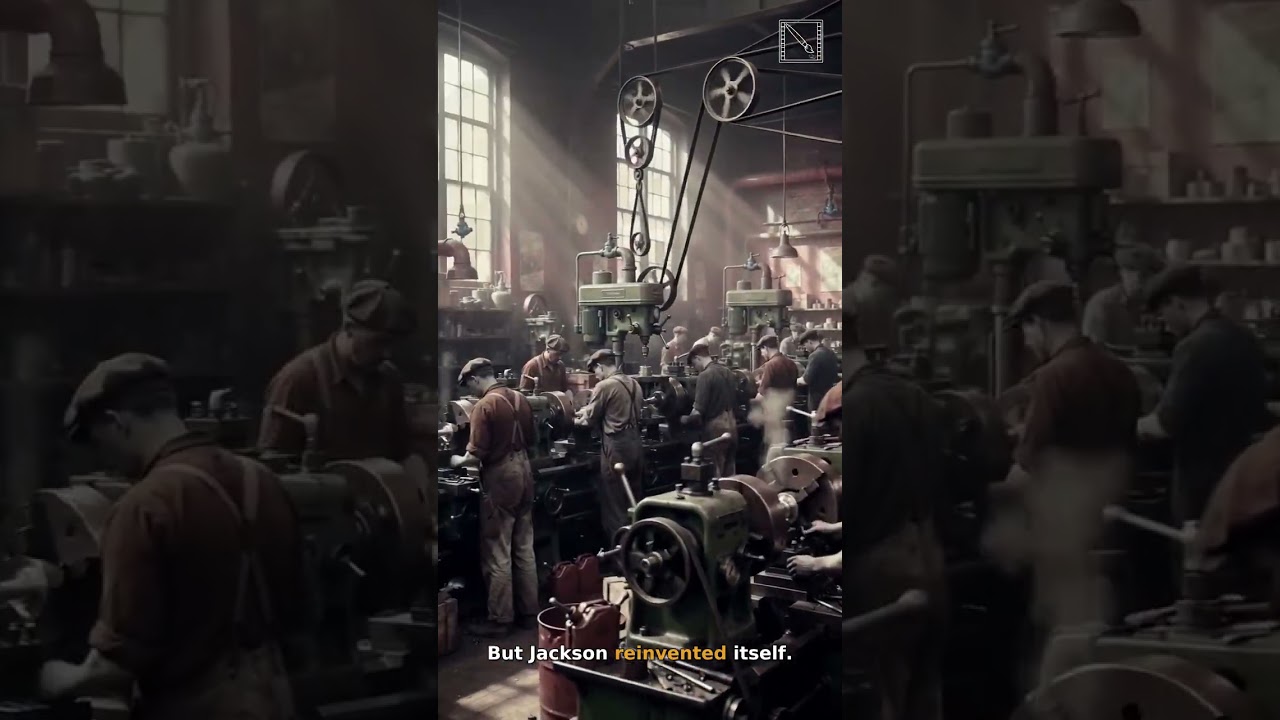
Jackson, Michigan’s rise, contraction, and reinvention—from corsets and locomotives to the business of power
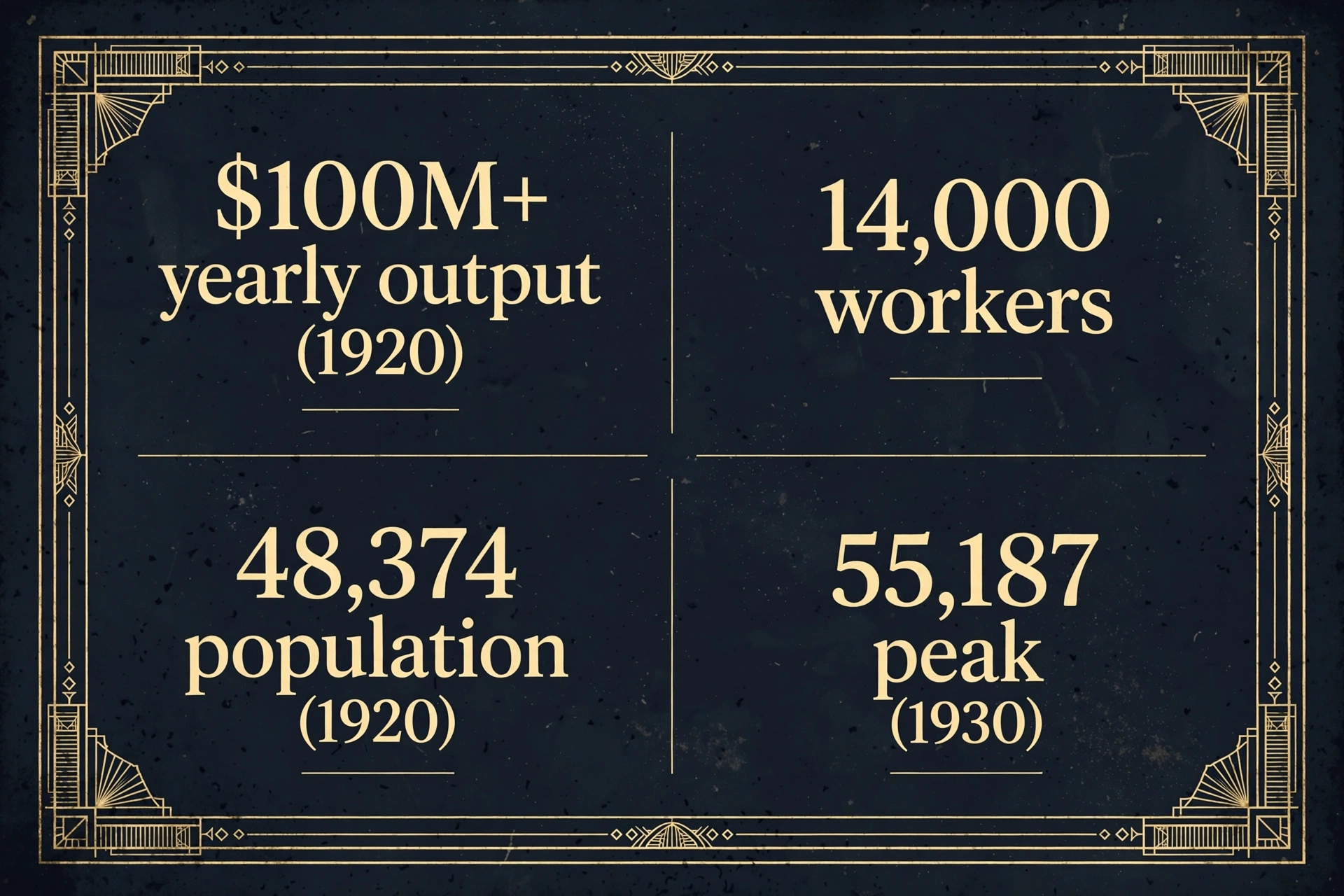
FACT: In the 1920 Encyclopedia Americana, Jackson, Michigan, was a manufacturing city employing “about 14,000 hands,” with yearly output exceeding $100 million in the dollars of that era. Its products ranged from corsets and cigars to automobiles and locomotives. Separate census figures counted 48,374 residents in 1920; the population peaked at 55,187 in 1930 and fell to 31,309 by 2020. Today, downtown Jackson houses Fortune 500 energy company CMS Energy and its principal subsidiary, Consumers Energy.
COMMENTARY: The story is reinvention — but not the easy kind. Jackson’s signature product is now, metaphorically, electrons. The question is whether that statewide business can help build a stronger hometown.
Then: A city that made almost everything
FACT: The encyclopedia’s inventory reads like a shopping list for an industrializing country:
• Sewer pipe and agricultural implements.
• Automobiles and automobile accessories.
• Oil stoves, engines, and motors.
• Corsets, underwear, waists, and skirts.
• Locomotives and wire fence.
• Oils, greases, chemicals, and medicines.
• Foundry products, iron and steel, cigars, and Portland cement.
COMMENTARY: Jackson did not just make things people wanted. It made things a growing country needed to function. Sewer pipe belonged beneath expanding communities. Wire fence belonged around farms. Engines moved machinery; locomotives moved commerce. Clothing manufacturers supplied households, while automobile makers competed to put those households on wheels. This was not one factory carrying a town on its shoulders. It was an industrial ecosystem.
FACT: The encyclopedia also described five banks, six building-and-loan associations, 34 church buildings, schools, business colleges, newspapers, hospitals, and extensive railroad connections. It identified nearby coal and clay deposits and an agricultural region trading in fruits, grains, and vegetables.
COMMENTARY: That broader inventory matters. Manufacturing was the headline, but the city behind it needed financing, transportation, education, housing, and customers. A factory does not become an economic engine merely because somebody buys a machine. It needs a whole community of supporting capabilities. Jackson’s encyclopedia entry captures that community—not simply its smokestacks.
What the $100 million actually meant
FACT: The encyclopedia stated: “All the above employ about 14,000 hands, with a yearly output of more than $100,000,000.” That is a historical reference work’s claim, not an independently audited finding established by this article. Its wording groups the listed manufacturing and industrial activities together.
COMMENTARY: Despite this story’s title, the $100 million was not a municipal budget or a shopping fund. It was the reported annual value of industrial output. It was not necessarily profit. It was not money deposited into workers’ pockets. And it was not a modern measurement of Jackson’s entire economy. Those distinctions prevent a big number from doing more work than the evidence permits.
FACT: The entry does not provide a precise reporting year for its output estimate. It includes bank clearings specifically dated 1918, demonstrating that its information was not uniformly a calendar-year 1920 snapshot. This article leaves the output figure in its original nominal dollars rather than converting it to present-day purchasing power.
COMMENTARY: The meaningful point is the scale and breadth of activity described. Jackson was producing goods worth more than $100 million annually, according to an encyclopedia published in 1920. That is impressive enough without attaching a flashy, unsourced modern-dollar equivalent.
One important correction: The encyclopedia and census disagree
FACT: The research brief places Jackson’s 1920 census population alongside the encyclopedia’s industrial figures. They belong to different sources. The encyclopedia itself says “Pop. about 55,000,” whereas the historical census series records 48,374 in 1920.
COMMENTARY: That is not a rounding difference to sweep under the rug. It is a source conflict. The proper approach is to attribute the industrial figures to the encyclopedia and the population figures to the census series. A historical document can illuminate a city while still containing an estimate that differs from an official count.
FACT: The historical population series shows Jackson growing from 31,433 residents in 1910 to 48,374 in 1920—an increase of 53.9%—and then to 55,187 in 1930.
COMMENTARY: Imagine the pressure and promise of that growth. More customers. More workers. More demand for homes, streets, classrooms, and services. Yet growth can disguise a dangerous assumption: that the industries filling today’s order books will keep filling tomorrow’s.
Boom did not mean permanence
FACT: Jackson’s automobile history demonstrates how quickly an industrial advantage could change. A 2013 MLive historical account reported that the city hosted 25 automobile manufacturers between 1901 and 1954. The Jackson Automobile Company, formed in the early 1900s, had closed by the early 1920s. The same account described Jackson’s difficulty competing with larger assembly-line producers. It also reported that by 1927, the Jackson Chamber of Commerce said more than half of the city’s 18,000 registered workmen earned their living making automobile parts.
COMMENTARY: Reinvention was already happening before Jackson reached its population peak. The local automobile story was not simply “cars disappeared.” Vehicle production gave way to supplying the larger automotive system. That transition preserved an industrial role, but changed who controlled the final product and where the biggest decisions were made.
FACT: The corset industry underwent its own transformation. Historical accounts describe a cluster of manufacturers that declined as fashions and materials changed, with some surviving companies shifting toward therapeutic and prosthetic support products.
COMMENTARY: A locomotive, a corset, and an automobile look like unrelated businesses. Economically, they share a vulnerability: somebody can change the technology, the production method, or the customer’s preference. A town can be exceptionally good at making yesterday’s product. That is not a criticism of the people who built it. It is the challenge every generation inherits.
Peak: 1930—and then a long contraction
FACT: Jackson’s highest decennial census population was 55,187 in 1930. The following counts trace a decline with a brief recovery rather than a perfectly straight downward line: 1940: 49,656. 1950: 51,088. 1960: 50,720. 1970: 45,484. 1980: 39,739. 2000: 36,316. 2020: 31,309.
COMMENTARY: This was not one bad year. It was a multigenerational adjustment. The 1950 recovery matters because it complicates the familiar rise-and-fall narrative. Jackson did not hit 1930 and immediately stop functioning. It continued working, producing, and adapting while its population trajectory changed.
FACT: The 2020 count was 23,878 people below the 1930 peak—approximately 43.3% lower, calculated from those two census counts. Historical summaries identify restructuring in heavy industry as a contributor to Jackson’s loss of jobs and population.
COMMENTARY: But population counts alone cannot tell us how much decline came from factory losses, household changes, relocation outside the city, or other forces. City boundaries are not the boundaries of an entire labor market. Jackson County manufacturers and downtown employers participate in a regional economy that extends beyond the municipal population count. The loss is real. So is the need to describe it precisely.
Now: The hometown business that powers a much larger market
FACT: CMS Energy and Consumers Energy list their headquarters at One Energy Plaza in Jackson. Fortune’s 2026 list ranks CMS Energy No. 464 on the Fortune 500. Consumers Energy is its principal business, providing electricity and natural gas across much of Michigan’s Lower Peninsula.
COMMENTARY: This is where the “electrons” angle earns its place. The old encyclopedia celebrated goods leaving Jackson: pipe, garments, machinery, vehicles. Today, one of Jackson’s most prominent corporate identities concerns the systems that make everybody else’s activity possible. Electricity runs factories, refrigeration, offices, and equipment. Natural gas is part of the company’s business too. “Electrons” is a useful shorthand—not a complete description.
FACT: According to CMS Energy’s corporate description, Consumers Energy provides natural gas and electricity to 6.8 million of Michigan’s 10 million residents through its combined operations in all 68 Lower Peninsula counties. Its electric and gas service territories differ; it does not provide both services everywhere in that region.
COMMENTARY: A city of roughly 31,000 residents can therefore host a company whose operating reach is far larger than its hometown. That is an important form of economic relevance. It is not, by itself, proof that every neighborhood shares equally in the benefits.
The energy story started before the manufacturing peak
FACT: Consumers Energy traces its beginnings to Jackson in 1886. A utility-sponsored anniversary history and MLive’s historical reporting distinguish that starting point from the formation of Jackson Electric Light Works in 1888. They describe William A. Foote’s early downtown electric-lighting efforts and the later company organized with Samuel Jarvis and James B. Foote.
FACT: Those accounts place the Consumers Power consolidation in 1910. CMS Energy, the holding company, was created in 1987—not 1886. CMS’s 2004 annual report states the company relocated its headquarters from Dearborn to Jackson in July 2003, when One Energy Plaza opened.
COMMENTARY: These distinctions correct two tempting shortcuts. First, “founded in Jackson in 1886” accurately describes the utility’s historical roots, but compresses the later formation of Jackson Electric Light Works. Second, today’s CMS headquarters represents a return to Jackson, not an uninterrupted history of that holding company occupying downtown since the nineteenth century. The deeper story is stronger than the shortcut: Jackson’s modern energy identity grew out of an enterprise that was already taking shape before the encyclopedia’s manufacturing snapshot. It is not a replacement industry that arrived from nowhere. It is an old local capability that expanded into a statewide institution.
Manufacturing did not leave the story
FACT: TAC Manufacturing supplies automotive shifters, steering wheels, and related components. In its April 24, 2024 announcement, Consumers Energy described TAC as “one of Jackson County’s largest manufacturers and employers.” In an April 24, 2024, announcement, Consumers Energy reported that TAC had grown over 30 years in Jackson and employed more than 800 people. That is a company-provided employment figure dated 2024, not a newly verified October 2026 headcount.
COMMENTARY: Calling Jackson’s signature product “electrons” should not erase the people still making physical goods. The better description is an economy in which manufacturing and energy increasingly intersect.
FACT: The 2024 announcement described TAC’s solar array and participation in Consumers Energy’s Renewable Energy Program. It said TAC would generate electricity onsite and match its remaining energy use with renewable energy through the program. It also described energy-saving technology and an agreement to reduce consumption during peak periods when needed.
COMMENTARY: That wording matters. Renewable-energy matching is not the same as saying every machine receives electricity exclusively from the nearby solar panels, every hour. Still, the connection is substantial: an automotive supplier is treating energy as part of its production strategy. Jackson’s industrial past and energy-centered present are not opposing teams. Here, they are working on the same plant floor.
Then versus now: What changed—and what did not
Then: Visible goods and a rapidly expanding city
FACT: The 1920 encyclopedia described a diverse industrial base, extensive rail connections, approximately 14,000 industrial workers, and annual output exceeding $100 million. The separate census series shows rapid population growth into the 1930 peak.
COMMENTARY: The outward signs of success were tangible: finished products, industrial employment, and more people.
Now: A smaller city with a wider corporate reach
FACT: Jackson’s 2020 population was 31,309. Its downtown hosts CMS Energy and Consumers Energy, while the surrounding manufacturing economy includes employers such as TAC.
COMMENTARY: Success now requires more than counting residents or pointing to a major headquarters. Useful questions include: Are local residents gaining access to durable, well-paid work? Can small businesses qualify to supply major employers? Are commercial districts benefiting from regional activity? Can employers obtain dependable power at workable costs? Does investment improve the neighborhoods where workers live? These are proposed tests of reinvention—not outcomes this article claims Jackson has already achieved.
What comes next?
COMMENTARY: Jackson should resist two equally unhelpful stories. The first says the city is finished because it is smaller than it used to be. The second says the city is fixed because it has a Fortune 500 headquarters. Neither asks enough of the evidence—or of the future. The next chapter should connect existing strengths rather than chase an imaginary return to 1930. Energy expertise can intersect with manufacturing, maintenance, construction, technical training, and business services. Healthcare remains another major part of the local employment landscape.
COMMENTARY: For small businesses, the useful question is practical: What can we provide that these institutions actually need? That might mean investigating procurement opportunities, building a specialized maintenance capability, or developing skills relevant to industrial operations. These are possibilities to evaluate, not promises of contracts. For civic leaders, the harder question is whether opportunity travels outward from the major employers into households and neighborhoods. A company’s statewide importance and a community’s everyday prosperity are related. They are not interchangeable. Jackson does not need to manufacture the same products forever. It needs to keep manufacturing opportunity.
FAQ: Jackson’s industrial past and energy future
What did Jackson, Michigan, manufacture in 1920?
FACT: The 1920 Encyclopedia Americana listed sewer pipe, automobiles, automobile accessories, oil stoves, corsets and underwear, locomotives, wire fence, chemicals, medicines, and foundry products, among other goods. It also identified cigar making and iron and steel as important industries.
Did Jackson really produce $100 million worth of goods annually?
FACT: That is what the encyclopedia reported: yearly output exceeding $100 million across the listed industries. The figure is attributed to that historical source; this article has not independently audited it or converted it into modern dollars.
When was Jackson’s population highest?
FACT: Jackson’s highest decennial census count was 55,187 in 1930. Its 2020 census population was 31,309.
Was CMS Energy founded in Jackson in 1886?
FACT: Its utility lineage dates to Jackson in 1886. Historical accounts place Jackson Electric Light Works’ formation in 1888; CMS Energy itself was created as a holding company in 1987.
Is Jackson still a manufacturing community?
FACT: Yes. TAC Manufacturing produces automotive components, and Consumers Energy’s April 2024 announcement reported more than 800 TAC employees. That dated, company-provided figure should not be presented as a verified current headcount.
Has energy reversed Jackson’s population decline?
FACT: The census figures cited here do not establish such a reversal. They show 33,534 residents in 2010 and 31,309 in 2020. The presence of a large energy company establishes an economic anchor, not proof of population recovery or broadly shared prosperity.
COMMENTARY: That is the unfinished part of the story. A century ago, Jackson’s factories demonstrated what the city could produce. The next chapter will be judged by what its economy enables its people to build.
The Argument
In 1920, Jackson made almost everything — corsets, cigars, automobiles, and locomotives — employing about 14,000 hands with yearly output exceeding $100 million. The city then shrank by nearly half, from a 1930 peak of 55,187 residents to 31,309 in 2020. Today, Jackson has reinvented itself around energy: downtown hosts Fortune 500 CMS Energy and its principal subsidiary Consumers Energy, whose operations reach 6.8 million of Michigan’s 10 million residents.
Want Jackson’s top local stories in one place? Browse the businesses shaping the area in the NeighborClick Local directory — JOIN the FREE Private Insider List for local stories, business spotlights, community updates and even if you don’t have business you’ll be an Insider.


Comments